This article is published in Aviation Week & Space Technology and is free to read until Mar 27, 2026. If you want to read more articles from this publication, please click the link to subscribe.
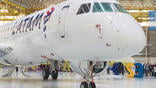
Marion Smeyers is in charge of fixing production at ATR.
ATR has become somewhat creative in characterizing the state of its business. When the turboprop manufacturer had looked ahead to 2025, CEO Nathalie Tarnaud Laude had predicted a year of stabilization. A year on, she described 2025 as “a transition year.”
“Stabilization,” “transition”—putting it less politely, one could say that things are moving very slowly at ATR and not always in the right direction. Deliveries, for example, were down to just 32 aircraft in 2025 from 35 in 2024, which was already a disappointing year since ATR had been hit by major supply chain issues. For perspective, ATR delivered 88 aircraft in 2015 and 80 annually in 2016 and 2017. Output slowly declined in 2018-19, and then production and demand temporarily collapsed due to the COVID-19 pandemic.
- The turboprop manufacturer reopens second final assembly line
- The company plans to reach 60 annual deliveries by 2030
Last year was also lackluster in terms of orders, particularly given that ATR enjoys a monopoly in the regional turboprop market. Customers ordered 56 aircraft in 2024 and 60 in 2025, but an unidentified customer canceled an order for 10 aircraft. Again, for perspective, ATR’s best year for orders was 2011, when airlines and lessors signed up for 157 aircraft. At that time, Bombardier was still producing Q400s.
The market for turboprops has clearly shrunk, yet ATR has been implementing plans to make production of its aircraft a lot more efficient and to increase output substantially. After disappointing years, Tarnaud Laude is targeting at least 20% growth in volume for 2026 and anticipates annual deliveries will reach at least 60 by 2030.
ATR is the only Western manufacturer of turboprops, since Bombardier exited the market and Embraer decided not to reenter the segment with a conventional design. According to Aviation Week’s Fleet Discovery database, ATR has firm orders for 205 aircraft, plus options for another 160 in its backlog. Half of the firm orders are for airlines in the Asia-Pacific region, although there are five outstanding deliveries to India and one to China.
For the ramp-up, Alexis Vidal, senior vice president of commercial, is betting on a large replacement market. More than 600 aircraft in the in-service fleet are at least 12 years old. Vidal says the growth opportunities “are even more exciting.” Among other things, he hopes that JSX’s decision to introduce ATRs to its fleet will open the door for more demand in the U.S. In Europe, Vidal sees more room for contract flying by regional specialists on behalf of major airlines. And, of course, there is Asia.
But first, ATR needs to tackle its internal production and supply chain challenges. “[Last year] was a challenging year with a lot of disruption in the supply chain,” Marion Smeyers, senior vice president of operations and procurement, said on Feb. 18 at the ATR headquarters in Toulouse. “Some of the suppliers are still in financial difficulties. We have lost competencies that we are rebuilding. But this takes time.”
Before COVID-19, ATR operated two final assembly lines (FAL) in Toulouse—FAL North and FAL South. In 2020, the airframer shut down FAL North to align capacity with what was left of demand for its aircraft. Now ATR is reopening the second line to help reach production growth targets and to install some capacity buffer in case new supply chain issues emerge.
“[FAL North] creates surge capacity and gives us more resilience,” Smeyers said. If steps in the assembly process of a particular aircraft take more time than foreseen, the flow would be less affected because of the additional buffers.
Some indicators of production efficiency are pointing in the right direction. Assembly time is slated to be reduced by 40% from mid-2025 levels as part of ATR’s Boost transformation program. So far, the company has reached a 20% reduction. The level of missing parts is down to one-third of what it was last year; the level of outstanding work at certain gateways is at 10%. Like everyone else in the industry, ATR aims to identify supply chain issues as early as possible in order to address them promptly. Sometimes, the company provides financial assistance to Tier 2 or 3 partners.
However, the planned broader revision of ATR’s production and final assembly system is not in the cards for the time being. Smeyers said the “pragmatic way is to reopen what already existed,” referring to the final assembly facilities.
That also appears to be the approach of ATR’s major component suppliers and two shareholders—Airbus and Leonardo. Airbus builds wings for ATR aircraft in Bordeaux, and Leonardo builds fuselages at its site in Naples. While neither Airbus nor Leonardo are disclosing details about the viability of their ATR work, profitability must have suffered amid the downturn and low production rates.
Given that ATR has long identified Asia as its biggest market for replacement and growth, one might wonder if ATR aims to move some production to that market, as Embraer is planning to do after signing a memorandum of understanding with Indian conglomerate Adani Defense and Aerospace. Embraer and Adani specified the target of their initiative and confirmed the intention to set up a FAL for the E175, the last in-production version of the first E-Jet generation.
ATR, too, is betting big on India and has put out detailed studies to prove that its aircraft are ideal for the country’s secondary markets. Yet Tarnaud Laude appears to be taking a cautious approach. “We have a lot of ambition in India,” she said. “We are talking with partners, airlines and authorities. We will look at everything.” A potential decision on deeper industrial cooperation appears to be a while off.
As for Embraer, moving work to India would cut production costs over the longer term and provide better market access. However, more orders from Indian airlines have yet to materialize.