This article is published in Air Transport World part of Aviation Week Intelligence Network (AWIN), and is complimentary through Apr 09, 2026. For information on becoming an AWIN Member to access more content like this, click here.
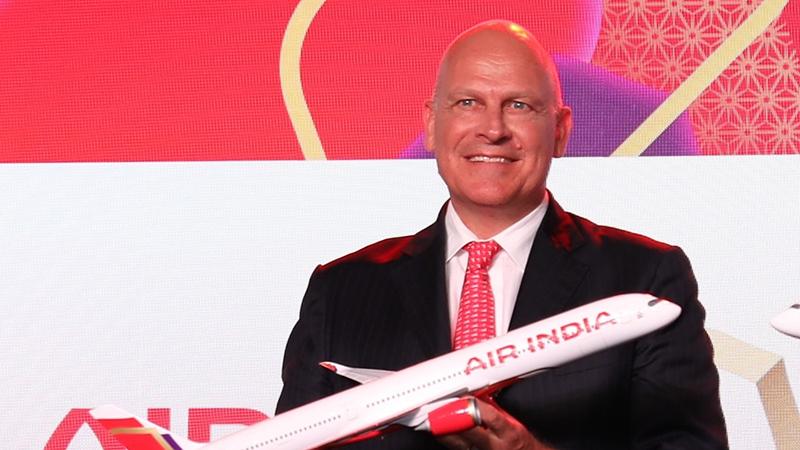
The crash of Air India Flight 171—a Boeing 787—in Ahmedabad in June, resulting in the deaths of 241 passengers and crew on board and a further 19 on the ground cast a pall over the airline’s ongoing transformation plan—which was already facing long-haul operational challenges because of the closure of Pakistan’s airspace. In this interview with ATW in December, Air India CEO Campbell Wilson talks about Indian traffic rights, aircraft deliveries, and the carrier’s image and position in the aviation world in the wake of the crash. Wilson became Air India CEO and managing director on July 25, 2022, on the heels of the airline’s privatization.
Which ultra-long-haul routes does Air India operate and what type of aircraft are you using for them?
Campbell Wilson: We classify ULR routes in our Indian geography as [destinations in] North America and Australasia. This includes Airbus A350s, Boeing 787s, and we also have an option for 10 [Boeing] 777X aircraft, which will allow us to increase services to North America and Australia. We see this as a significant market opportunity because there is a huge Indian diaspora. Obviously, trade and connectivity between the regions are very strong. Those aircraft are the backbone of our long-haul network. In terms of ASKs, these ultra-long-haul routes account for around 30%.
How much impact has the closure of Pakistan’s airspace had on those ultra-long-haul flights? It is very significant. Every flight to North America is affected by between one and three-and-a-half hours. Most flights to Europe are affected by 40 to 60 minutes. That’s additional flying time, additional fuel burn, loss of connectivity, loss of payload and loss of competitiveness. We are making do with technical stops or by taking payload restrictions. We have had to trim back some frequencies and drop several destinations while this continues.
Can the Boeing 777X provide new opportunities? In terms of range, not necessarily, but in terms of capacity, of course, it is one of the aircraft types we will use for long-haul growth. When Air India was privatized, India had only 43 widebody aircraft in commercial service, compared with Singapore Airlines’ 150 or Emirates’ 550 aircraft. Given the broad geographic dispersion of the Indian diaspora, the size of the Indian market, the potential for travel and 7% to 8% GDP growth, we actually think that every continent offers an opportunity for significantly more capacity. And that’s before we start considering the Sixth Freedom opportunity that geography allows.
Does Air India plan to further develop its hub system in New Delhi, and what is the infrastructure situation at your main airports in India? Domestic-
to-international traffic is a good proportion. International-to-international traffic was not the focus of pre-privatization, but it is going to be a focus moving forward. It will always be a relatively small share of total traffic because India is the third- or fourth-largest market. Obviously, infrastructure needs to be built to accommodate connecting traffic. Because it wasn’t the airline’s strategy in the past, airports were not necessarily built for that proposition, but now they are starting to do so. It will be low double digits.
Delhi is our main hub, where we exclusively operate from Terminal 3, which is under an expansion program. That means there is a temporary capacity reduction while construction is under way. Presently, our operations are split across three terminals. This will continue until 2029, when the larger terminal becomes available for our use.
In Mumbai, a new airport was opened Dec. 25, but it will take some time before it is fully mature and customers are familiar with it. It also requires the development of a second terminal to fully support the type of operation we have. That terminal is being planned at the moment. It should open toward the end of the decade, and then we will leave behind the constraints we currently face there.
How does the fleet delivery look for 2026? We are looking at about 20 or 21 aircraft. It is a relatively small number and significantly less than what we had expected. By this point, we should have received 28 aircraft. As of Dec. 1, 2025, deliveries were already 28 aircraft behind, and that propagates down the years.
I think 2026 is the year when we will start seeing real material change in the international proposition. We have completed the refit of our full-service domestic fleet. The widebody fleet retrofit program is well under way. There was a delay of 18 months to two years because of first and business class seats. The first two retrofitted 787s are coming back in February, and every month thereafter we will do two or three more aircraft. The 777 retrofit starts in 2026. Within 18 months or so, the entire widebody fleet will be fully world-class to complement the narrowbody fleet.
How important is Air India’s membership in Star Alliance? Very important. We took a long time to evaluate the appropriate alliance membership after privatization, and we concluded Star Alliance was the best fit. We have built strong relationships with several key alliance members, including Singapore Airlines, the Lufthansa Group, Air Canada and United Airlines. We are now reaching a point of maturity where we are happy with those relationships.
Some of your colleagues, such as Emirates Airline president Tim Clark, have complained about not getting more traffic rights to India. What is your view? First, nearly every customer we lift from India to most Gulf states disembarks in the Gulf. More than half, and sometimes nearly all, of the customers that Gulf carriers uplift from India continue through their airports to somewhere else. It is not a true like-for-like comparison. They already have more than enough seats to serve their home markets if they reduce the amount of Sixth Freedom traffic they carry.
Second, in terms of exchange, Dubai wouldn’t even rank among the top 20 Indian cities by population. Opening up India is not the same as opening up Dubai. Third, because of government ownership of Air India in the past and the absence of capital to fund expansion, we ended up with only 43 widebody aircraft serving India. That has changed with government policy, private ownership of airports, and private ownership of airlines. We have nearly 3,000 aircraft in the country’s order book, including many widebodies. That brings the focus of Indian travel back to Indian soil and allows ecosystems—business, tourism, and all the catalytic factors aviation brings—to grow in India rather than offshore locations.
I think it is absolutely right that there is rationality with respect to liberalization. Liberalization is a good thing, but it needs to be at a pace that is appropriate for all parties, not just one. We believe the right place for the hub of India and Indian aviation is in India.
Do you have any new information about the crash of Air India Flight 171? It was absolutely devastating for all the families involved, and we have done all we can to support them. We received the preliminary report, which indicated there were no recommendations for the aircraft or engine manufacturers or the operator. When the final report comes out, we will obviously review it and determine whether there is anything we need to learn or change. At this point, there doesn’t seem to be anything, but we will wait and see. We have set up a trust of up to €15 million ($17.5 million) to continue supporting victims, whether through medical care, education or financial assistance, for as long as it takes.
What does this tragedy mean for the image of Air India? It is a huge setback, to be honest. Any event like that, involving any airline in any country, damages people’s confidence. It takes time and sustained action to restore confidence. History has shown that confidence does come back if airlines and countries continue to implement what is necessary to reassure the public and, most importantly, operate safely. We are absolutely committed to doing that. We were committed, we remain committed, and we will continue to be. We must move forward and ensure that whatever we need to improve—as an industry, as a company, and as a country—we do so.

Related Content