This article is published in Aviation Week & Space Technology and is free to read until Oct 21, 2026. If you want to read more articles from this publication, please click the link to subscribe.
Opinion: Why Carbon Fiber Is China’s Next Big Breakout
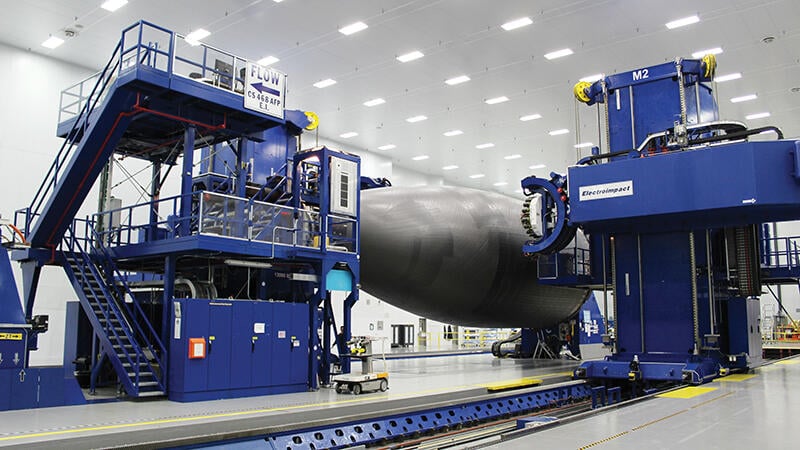
When Boeing announced in 2003 that its new 787 would be the first commercial jet with a primary structure composed mostly of advanced composite materials, the modern era of carbon-fiber-reinforced composites manufacturing was born. The structural volumes of the 787, which entered service in 2011, and the Airbus A350, which followed in 2015, are both more than 75% composite.
Today, carbon-fiber (CF) composites are critical to a host of markets and applications ranging from wind turbine blades to high-performance cars, fighter jets, drones, aircraft brakes, rocket nozzles, space launch vehicles and more. If you are fighting gravity, friction or time, you will likely use CF, which has morphed into a strategic material. And China, which has upended a long list of markets—including electric vehicles, batteries, solar power and wind turbines—has taken notice.
CF has been produced in China for 25 years, but until recently nearly all of it was consumed domestically for golf club shafts, bicycles, sporting goods and, more recently, to reinforce wind turbine blades, which have become the largest consumer of CF. Chinese-made CF was often characterized as inferior to fiber from leading producers such as Japan’s Toray, which supplies composites for the 787 and is one of the world’s largest and arguably best CF manufacturers, and Connecticut-based Hexcel, which produces the A350’s composites.
For many years, China’s access to higher-quality fibers from producers in Japan and the U.S. was limited by export controls, which hobbled the ability of Comac and suppliers to the Chinese defense industry to develop aerostructures or weapons with aerospace-grade fibers. It is no surprise, then, that about six years ago CF began to show up in Chinese industrial policy as a critical strategic material. In China’s 15th Five-Year Plan (2026-30), which was only recently adopted and is still being fine-tuned, CF is identified as critical to the country’s industrial strategy.
It is unclear how much China has invested in this effort, but Chinese CF producers have expanded enormously in the last three years to take two of the top five spots in the global CF manufacturing capacity rankings (see table). In fact, China was producing so much fiber by 2023 that supply exceeded domestic demand, which led to the exportation of Chinese CF for the first time.
With a quantity strategy established, Chinese producers began climbing the quality ladder about a year ago. At the JEC World 2026 composites trade show in Paris in March, Chinese state-controlled CF producer Zhongfu Shenying reported that it has begun making small quantities (100 metric tons) of a fiber equivalent to Toray’s T1200, which is among the highest-performing CF in the world.
Then, in July, Zhongfu Shenying announced the opening of manufacturing lines to produce 30,000 metric tons of three grades of CF, including one said to be equivalent to Toray’s T1100. The company says it invested $893 million on the project, which represents the single largest CF capacity launch in the history of the composites industry.
What does all this mean? The core issue is that CF has become an enabling material. It allows the fabrication of structures as no other material does—at least not affordably or efficiently. Higher-quality fiber translates to higher-performing applications.
None of this is lost on Chinese companies that aspire to take their place among the most technologically advanced composite structure manufacturers. Take Comac and the next generation of commercial aircraft it is developing, the C929 and C939. Does Comac have the composites know-how to produce an aircraft on par with the 787 and A350? No. Does the state-owned OEM know what is required to reach technological parity and break the Boeing/Airbus duopoly? Absolutely.
The speed and scale of China’s CF expansion—particularly into high-strength fibers—sends a strong signal that the country is determined to be self-sustaining in production of fibers not just for commercial aircraft, but also for missile systems, drones, rocket bodies, satellites and more. The lesson here is simple: Underestimate China’s willingness and ability to scale up rapidly at your own risk.
Jeff Sloan is global content advisor and editor at JEC Composites, a media and events company that serves the global composites manufacturing community.
Related Content