This article is published in Aviation Week & Space Technology and is free to read until Dec 11, 2026. If you want to read more articles from this publication, please click the link to subscribe.
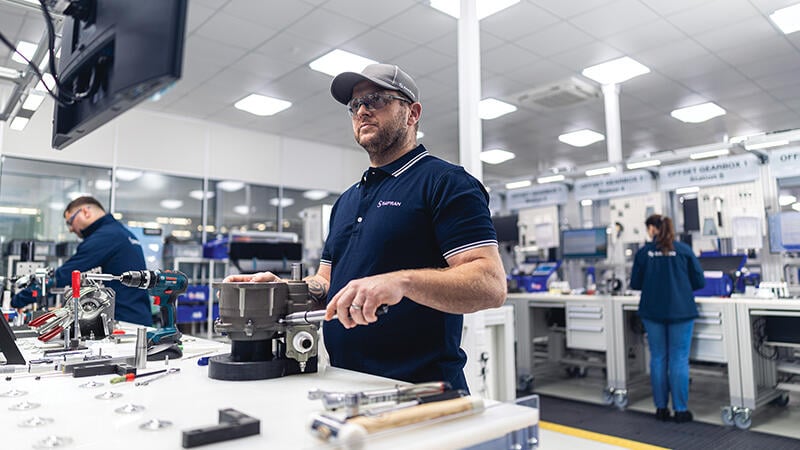
Safran supplies gearboxes for the Airbus A320neo family actuation system. The company is aiming to expand its role for successor aircraft, whose folding wingtips would require even more actuators.
Airbus and Boeing have yet to decide on the system architecture of their next-generation single-aisle aircraft—succeeding the A320neo and the 737 MAX, respectively—but suppliers are already offering innovative technologies. In control surface actuation, Safran is betting on a high-aspect-ratio smarter wing and accompanying folding wingtip—a novel design that would call for new, more numerous actuators.
High-aspect-ratio wings can reduce aerodynamic drag, improving fuel efficiency. Such wings’ greater span requires folding wingtips to fit in the 36-m-wide (118-ft.) spaces normally allotted to narrowbodies at airport gates.
- Folding wingtip would enable greater wingspan, a higher-aspect-ratio wing and improved aerodynamics
- Safran mulls actuators for distributed flap system
Airbus is conducting two parallel research and technology programs on wings, and both need new actuators. The airframer’s UpNext innovation arm is modifying a Cessna Citation VII business jet with a high-aspect-ratio, adaptive-profile wing and hinged wingtips, which help the wing withstand extreme turbulence in flight. Airbus is planning the first flight of the eXtra Performance Wing, or X-Wing, for this year.
The second program, Wing of Tomorrow, is studying manufacturing methods. As part of the initiative, Airbus plans to test wing extensions, representing folding wings in the fully extended position during flight, on a modified A321neo. On a larger aircraft, the in-development 777X, Boeing has designed folding wingtips.
Safran Electronics and Defense has integrated the flight control and actuation activities it acquired from Collins Aerospace in 2025. The combination of Collins’ hydraulic and mechanical actuation capabilities—as well as fly-by-wire experience—with Safran’s know-how in electro-mechanical actuation and electronics will help contribute to the high-aspect-ratio wing breakthrough, Safran Electronics and Defense executives said during a visit to Wolverhampton, England, Oct. 26.
The company is conducting research and technology demonstrations to convince Airbus that it is the right partner for actuation in an advanced wing. Safran is aiming for a scenario where Airbus would adopt a high-aspect-ratio wing to become central to the design of the eAction—Airbus’ internal name for a future narrowbody.
If Boeing goes for a similar layout, the Paris-based equipment manufacturer plans to offer customized products using the same technologies, Safran Electronics and Defense CEO Franck Saudo said. The company’s competitors include Eaton, Liebherr-Aerospace, Moog and Parker Aerospace.
Safran has its own technology demonstration programs and also collaborates with Airbus on Wing of Tomorrow. The equipment manufacturer expects to be prepared for a product launch at Technology Readiness Level 6 around 2030.
That scenario relies on a 4.5-m extension at each wingtip, for a 20% wingspan increase. The company’s engineers are working on more compact actuators, as the wing would be thinner toward the tip.
Latches and locks on the folding wingtip will be critical, Saudo said. Certification authorities will look closely at how the wingtip is held in the extended position in flight and unlocked while taxiing on a bumpy surface. Safran’s design relies on two latching-locking units and accompanying latching position sensors on each wingtip.
The system is planned to use both electric and hydraulic power, with a single motor designed to deliver a very high torque. When taxiing in crosswinds, the raised wingtip could generate a sail effect, increasing the torque requirement for extension and folding. Safran’s system has contributed to ground evaluations for two years at Airbus facilities in Bremen, Germany, and Filton, England.
On the new slender wing, a distributed flap system would enable distributed trailing-edge control to improve aerodynamic efficiency and counter the relative instability. Moving to electromechanical actuators would streamline installation and maintenance, making the system less complex and lighter than its hydraulic equivalent.
Safran’s engineers are targeting fully electric synchronous actuation. The system would manage load by segments and enable active trim. Other design drivers include repairability in the thinner part of the wing and resistance to vibration, as the structure would be more flexible. Control surfaces on a high-aspect-ratio wing might move more frequently, Saudo added.
He anticipates that the actuators on the new wing of the Airbus eAction would need to roughly double from the current double-digit count used on the A320. He expects hydraulic actuators to account for a decreasing share of the total, as electric systems would meet half of the need.
To convince Airbus, Safran also has worked on its manufacturing process. The airframer is planning on high production rates for the eAction—around 100 aircraft per month. For one year, Safran has automated a process on an A320neo component, demonstrating that a dexterous activity could be entrusted to robots, increasing output. The A320neo uses gearboxes involving 10 pinions each for its slats and flaps, and Safran has automated assembly of those gearboxes. To start with, the higher production rate supports Airbus’ goals for the A320neo.
In addition, Safran took over Chambery, France-based specialist Alt Bearings in June for greater vertical integration.

Related Content