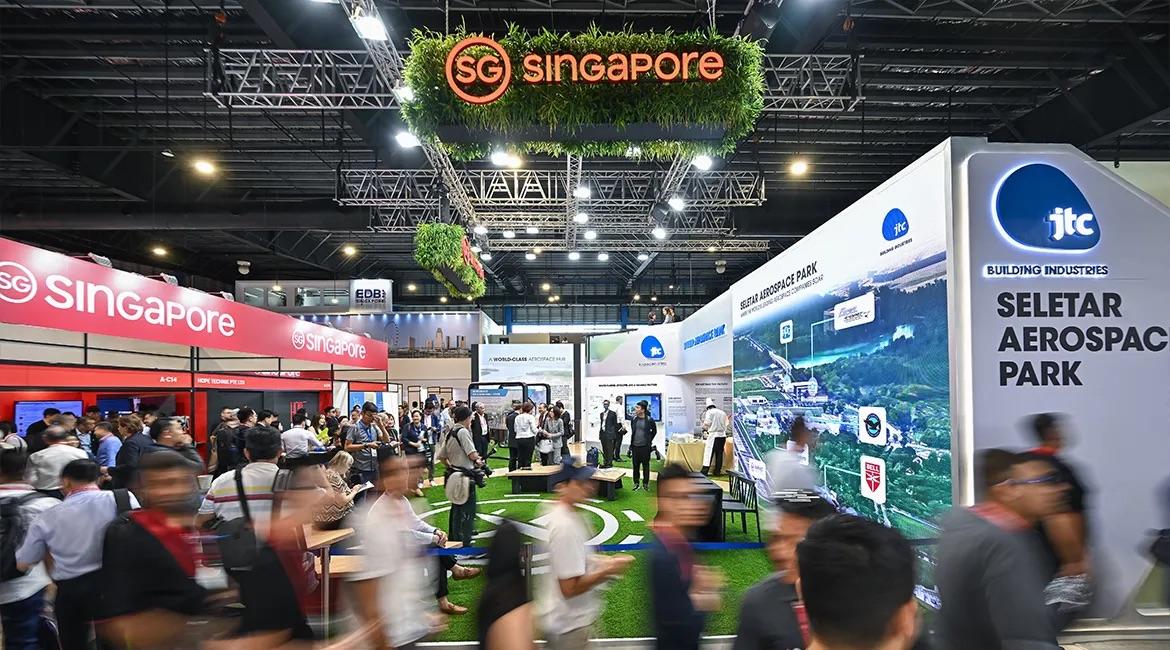
SINGAPORE—Singapore’s Economic Development Board (EDB) is stepping up efforts to attract international aerospace companies to the city-state.
The EDB is particularly interested in those firms developing emerging technologies such as additive manufacturing, robotics and artificial intelligence, as it looks to strengthen the country's long-term competitiveness in the global aviation sector.
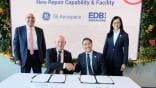
Singapore’s aerospace output grew 19% in 2024, significantly outpacing the country’s overall GDP growth of 4.4%. The sector also contributed to 1% of Singapore's GDP between the 2024 and 2026 Singapore Airshows. EDB has helped Singapore secure S$750 million ($591 million) in aerospace-related investments, largely concentrated in maintenance, repair and overhaul (MRO) capabilities involving companies such as Collins Aerospace, Rolls-Royce and Safran.
While official 2025 figures have yet to be released, Cindy Koh, EDB executive vice president, told Aviation Week on the eve of the Singapore Airshow that she expects “strong growth” to continue in the sector. She inferred that Singapore’s political stability and regulatory predictability remain key selling points as companies reassess their global footprints.
“There is continued uncertainties, and companies and businesses are looking for a stable, reliable, trusted location, and we will continue to build on that,” she said, adding that work will be done to entire the country has critical infrastructure and talent to support the growth.
EDB, an agency under the Ministry of Trade and Industry, is responsible for investment promotion and industrial development across Singapore’s key sectors.
Koh said the Johor–Singapore Special Economic Zone could also play a complementary role in aerospace development. Higher-value research and development activities could remain in Singapore, while more land-intensive operations—such as metalworking and component fabrication—could be located in Johor, Malaysia.
On future-of-flight technologies such as urban air mobility (UAM), Koh said cross-border operations are likely to be central to commercialization. She added that the Civil Aviation Authority of Singapore (CAAS) is actively studying potential use cases and regulatory frameworks to enable such operations.
Organizers of the Singapore Airshow have this year put the focus on new technology, AI and dual-use technologies, with companies like Anduril, Helsing, Radia and Vertical Aerospace participating.

Related Content