This article is published in Aviation Daily part of Aviation Week Intelligence Network (AWIN), and is complimentary through Jul 02, 2026. For information on becoming an AWIN Member to access more content like this, click here.
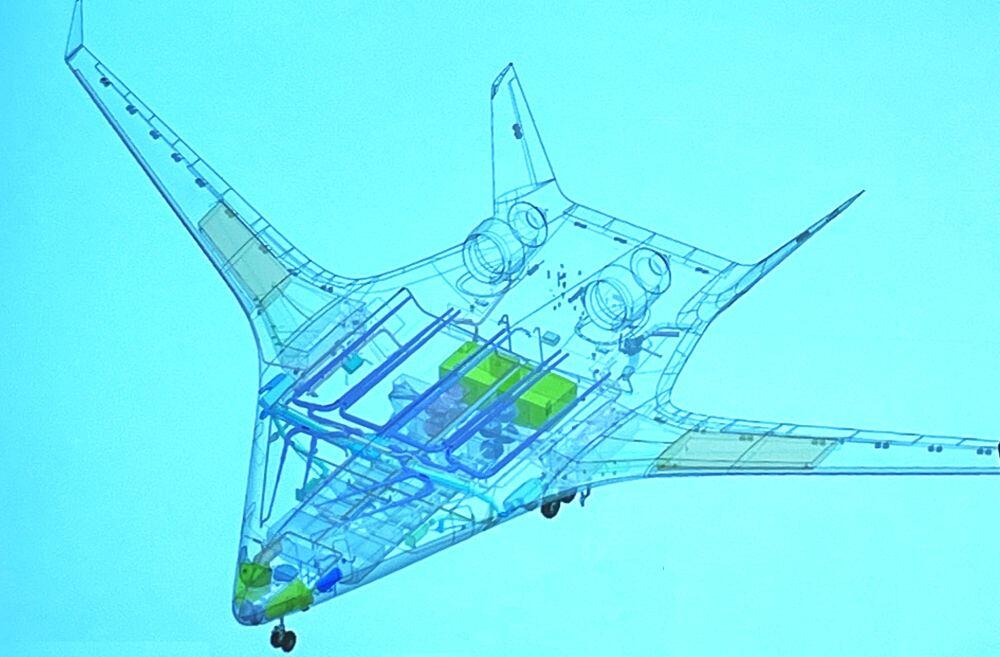
JetZero's BWB demonstrator will feature V tails and winglets rather than the original wingtip rudders.
JetZero has revealed key design changes to its blended wing body (BWB) demonstrator as it moves toward the first flight readiness assessment at the end of the year.
Supported by funding from the U.S. Air Force, the full-scale demonstrator is planned to fly in late 2027.
The wingtip rudders shown in previous artists’ impressions of the BWB demonstrator and planned Z4 airliner have been replaced with conventional V tails and winglets. Mounting of the engines above the aft fuselage has also been revised.
JetZero revealed the design details in a special session at the American Institute of Aeronautics and Astronautics’ Aviation Forum in San Diego on June 11.
V tails provide noise shielding for the engines and locate the rudders farther aft, where they are more effective at trimming the relatively short aircraft, which has a 5% static stability margin, for maximum cruise efficiency, Chief Design Officer John Vassberg said.
The demonstrator is being built principally to validate the BWB’s aerodynamic efficiency and its projected lift-to-drag ratio of 22. JetZero is aiming for a mission fuel burn reduction of of 20% relative to an equivalent technology tube-and-wing configuration for aircraft entering service in the early 2030s.
JetZero showed video of its 6.25%-scale SV-4 model flying in the revised configuration under its Pathfinder program. The subscale vehicle is being used to test the demonstrator’s model-following flight control laws, said Norm Princen, acting chief engineer for the Z4.
The other key change revealed involves how the pair of Pratt & Whitney PW2040 engines are mounted on the demonstrator. The former Boeing 757 engines, provided by Delta Air Lines, are designed to be hung under the wing and need modifications for top mounting.
JetZero previously planned a dual-pylon arrangement with curved frames that connected to the existing wing pylon attachment on top of the engine. This has changed to a design similar to the “banjo” frames supporting the center engine on the McDonnell Douglas MD-11.
Loads will be carried from the engine support box on top of the PW2040, down through the inner fixed structures of the bypass duct to a single lower pylon attached to the BWB’s upper fuselage. A diverter channel under the nacelle will prevent boundary layer ingestion.
Even in worst-case conditions—90-deg. crosswinds up to 24 kt.—computational fluid-dynamic simulations show no ingestion of the boundary layer airflow by the engine. “There is essentially no distortion—zero relative to the engine limits,” Vassberg said.
JetZero is still evaluating engines for the production Z4. Mounting the nacelle on a single pylon could distort the engine structure under load, so it is looking at attachment options including angled pylons and side mounts, said Romar Frazier, head of propulsion systems.
Assembly of the 178 ft. wingspan, 260,000 lb. gross weight demonstrator is progressing at partner Northrop Grumman’s Scaled Composites subsidiary. “We are on time and under budget. We have hit all milestones,” said Florentina Viscotchi, JetZero chief of engineering.
The system integration review was completed in late May, said NASA’s Fay Collier, chief engineer for the government team, adding that the demonstrator program is currently under the $800 million estimate for the budget up to the first flight readiness review.
Large pieces of the demonstrator are coming together in Mojave, California, where the entire team is located, and Scaled has 150 people working in shifts on the program, Viscotchi said. The fuel tanks are complete, cockpit assembled, wing skins and main body in build and the landing gear in house.
While the BWB demonstrator takes shape, JetZero is progressing design of the Z4, a 250-seat, midmarket airliner with a 200-ft. wingspan, Mach 0.8 cruise and 5,000-nm range with a 30-50% better fuel performance than a Boeing 767 on a gallon-per-available-seat-mile basis. JetZero is also maturing the design of a commercial-derivative aerial refueling tanker version of the Z4 that is being proposed to the U.S. Air Force.

Related Content