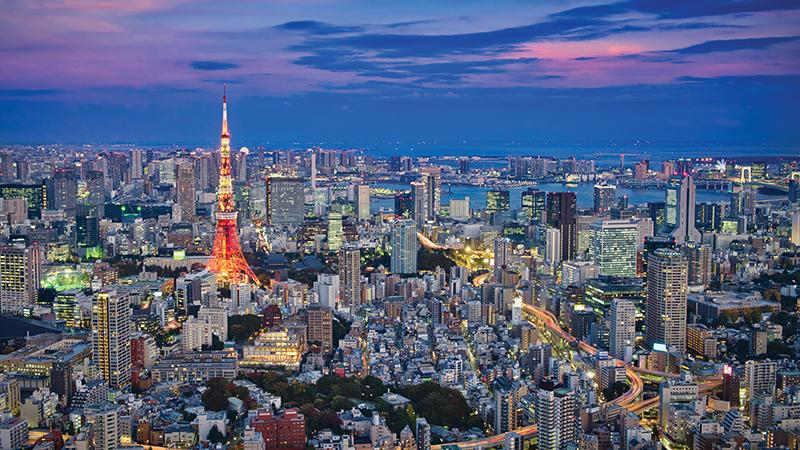
Much of Japan’s space industry is based in Tokyo.
After decades of economic stagnation, Japan is betting big on growth in the aerospace industry, particularly the new space sector.
At the center of that gambit is the Japanese government’s ¥1 trillion ($6.8 billion) Space Strategy Fund, a decadelong effort that kicked off in 2024 that the country hopes will transform its industry.
- JAXA works to become more entrepreneurial, innovative and strategic
- The country proceeds on hydrogen as others retreat
Tokyo wants to double the size of the Japanese domestic space market, to ¥8 trillion (about $54 billion) from ¥4 trillion in 2020 by the early 2030s. By then, Japan wants to launch some 30 rockets into space each year and have more than 30 new satellite services on offer—everything from communications constellations to robotic spacecraft.
Japan’s Space Strategy Fund is the country’s largest dedicated technology development program for aerospace. Although spending from the fund will fluctuate annually, the average amounts to ¥100 billion per year—about 65% of the Japan Aerospace Exploration Agency’s (JAXA) budget in 2025.
Yet the Space Strategy Fund is by no means the country’s only initiative. The Japanese government and industry are retooling across aerospace in anticipation that next-generation technologies could allow the country to seize a greater share of the market.
As Airbus and Boeing put off investments into a next-generation airliner, the Japanese government has launched a hydrogen-powered effort to grab a larger share of that market. The country’s New Energy and Industrial Technology Development Organization (NEDO) is making considerable investments in advanced composite structures that could be used for a blended wing body, as well as fuel cells and hydrogen-burning turbines. Japan also is working to develop cheaper sustainable aviation fuel and create a hydrogen supply chain.
In the automotive field, several of Japan’s large automakers are expanding their involvement in aerospace, aiming to evolve into mobility companies. For example, Toyota is lending its manufacturing expertise and making grants to U.S.-based Joby Aviation, an electric vertical-takeoff-and-landing (eVTOL) aircraft developer. Honda is developing its own hybrid eVTOL, too.
Part of the thinking is that Japanese excellence in automotive manufacturing—the sort that perfected lean manufacturing and produces millions of cars annually—can boost the country’s prospects in the nascent space and eVTOL sectors.
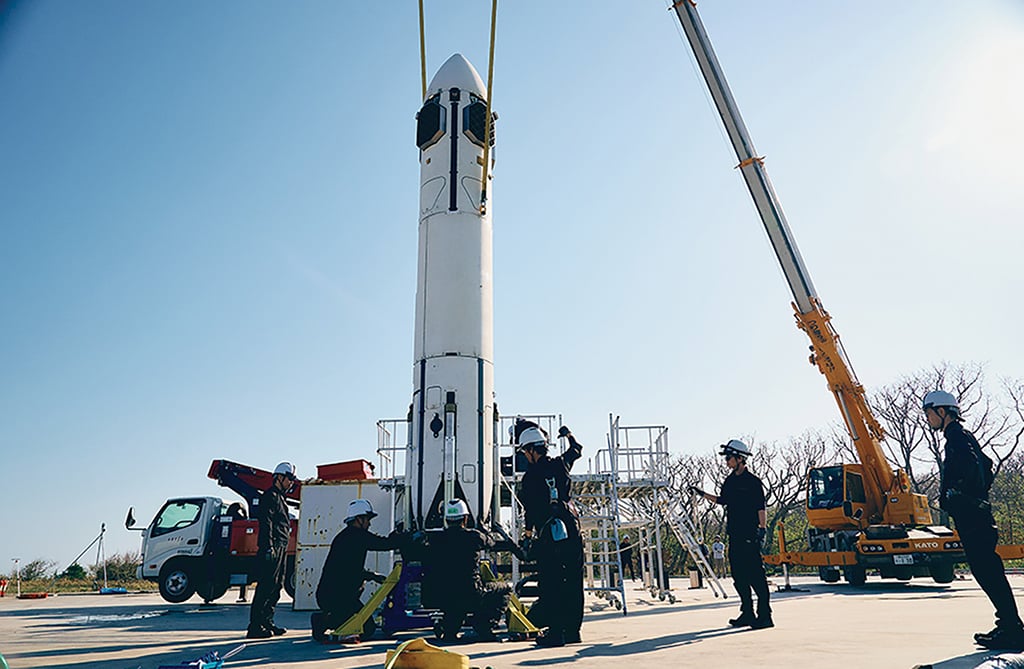
Honda surprised the space industry in June when it launched a small reusable rocket to an altitude of nearly 900 m (2,950 ft.) and landed it successfully back on the ground. The rocket was developed in secret, after a brief press announcement about the effort in 2021. Guidance and control systems for the rocket came from Honda’s autonomous driving development project.
Whereas other countries’ automakers see battery-electric powertrains as the future of cars, Japan has not given up on hydrogen fuel cells. In partnership with JAXA, Toyota is developing a large, inhabitable, regenerative, fuel-cell-powered lunar rover, the Lunar Cruiser. And in April, American Honda Motor Co. announced plans to test an electrolysis system onboard the International Space Station, part of its own potential lunar regenerative fuel cell system.
Japan’s longstanding interest in developing hydrogen-powered vehicles is often linked by industry observers to the country’s lack of hydrocarbon fuels. There is also concern that manufacturing cars with electric batteries, which have fewer components, would mean less work for automotive workers and suppliers—a serious concern in Japan, where social cohesion is paramount.
Doubling Down
The Space Strategy Fund is a sort of doubling down by the Japanese government on the new space sector. The Japanese government launched a ¥100 billion, five-year support package in 2018 for new space startups. Seven years later, the country boasts more than 100 space startups.
JAXA has a separate budget, but the agency runs the Space Strategy Fund on behalf of three core Japanese ministries, including the Ministry of Economy, Trade and Industry (known as METI). Despite its name, the fund is not an investment vehicle for taking equity stakes; it makes grants to companies.
The multiple government ministries behind the fund are also indicative of broad consensus within the Japanese government that the space industry cannot be ignored.
“The importance of space assets is expanding,” says Maruoka Shingo, advisor to the director of the Space Strategy Fund. “People’s [day-to-day] living is supported by space assets.”
Tokyo also sees launch capacity, satellite communications and navigation as national assets, he adds.
“The underlying objective is about building a Japanese domestic space market, creating the opportunity that certain payloads can be bought domestically and not have to be imported,” says Rainer Horn, partner and managing director of consultancy Novaspace.
JAXA selected Phase 1 projects for grants from the Space Strategy Fund in November, some 52 projects spread across 22 technology themes.
“These themes are decided by the government cabinet office,” says Ina Koji, manager of the strategic planning division within the Space Strategy Fund Department of JAXA. “They are the command and control.”
JAXA advises and selects companies based on those policy goals, Koji tells Aviation Week.
In Phase 1, three themes stand out for receiving considerable investment: commercial satellite constellations, high-resolution and high-frequency optical observation satellite systems and regenerative fuel-cell systems.
Submissions for Phase 2 were due in September, and rocket components, orbital transfer vehicles and satellite-based optical data relays were earmarked for the biggest grants.
The Space Strategy Fund is also part of a larger push by the Japanese government to evolve JAXA beyond its traditional research role. In recent years, JAXA has launched a series of parallel funds, incubators, tech transfer, co-development and small business research and development initiatives designed to help startups at each stage of their development.
Horn sees an effort to change the culture of JAXA.
“They want JAXA engineers to think beyond JAXA, to see where they can be useful in either joint projects or to learn from the interaction [with startups]—to get a bit more of a commercial spirit,” he says.
Ambitious Agenda
Despite heavy investment, the Japanese aerospace industry faces sizable obstacles. Japan is a relatively small market compared with China, the European Union or the U.S. And in some areas, domestic Japanese companies are playing catch-up to rivals that have a big lead, such as SpaceX, which dominates the launch vehicle service and broadband internet satellite constellation markets.
This latest push is by no means guaranteed to succeed. The glaring cautionary tale is Japan’s last ¥1 trillion aerospace development project: the SpaceJet program.
SpaceJet, Mitsubishi Heavy Industries’ ambitious effort to develop a regional airliner, was shut down in 2023 after a 15-year effort. The program was fighting an uphill battle from the beginning, looking to enter a lucrative U.S. market where it would have had to elbow out incumbents, such as Embraer. Expensive mistakes helped sink the effort, as the airliner’s original design was too big to meet U.S. scope-clause requirements and added to redevelopment costs.
At least initially this time, Japanese government ministries and companies are mostly avoiding head-to-head competition with international rivals in foreign markets. They are opting to carve out local niches, take a complementary role in another country’s program or grab a share of not-yet-cemented markets, such as space or advanced air mobility.
For example, Interstellar Technologies aims to serve the small satellite launch market for the Japanese government, as well as commercial satellite operators in Japan and the Asia-Pacific region. NEDO’s Next-Generation Aircraft program does not necessarily aim to take the lead on developing a future airliner, but the effort intends to position Japanese industry to take a bigger slice of critical composite structures work and engine manufacturing.
For small-satellite developer ArkEdge Space, a Japan-focused strategy means serving the country’s needs as a maritime nation by developing satellites with payloads such as next-generation maritime communication systems and hyperspectral sensors for maritime observation.
“Japan is just one single country. It is difficult to develop the space utilization industry, so we have to work with Pacific Ocean countries and also some [Association of Southeast Asian Nations] countries,” ArkEdge CEO Takayoshi Fukuyo tells Aviation Week. “We have to think strategically about which areas we can develop.”
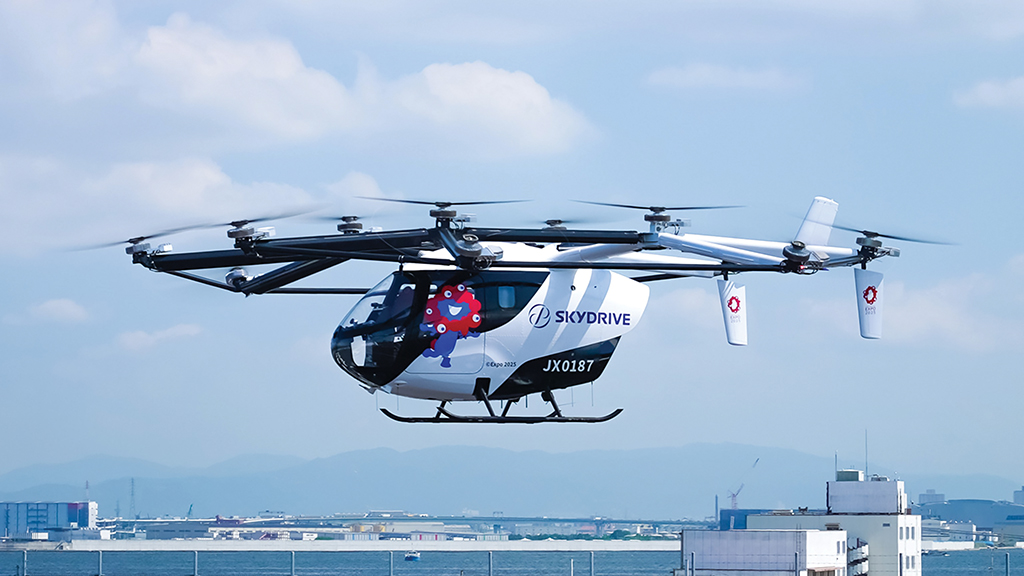
For its part, SkyDrive has partnered with Suzuki Motor Corp. to develop an eVTOL that is considerably smaller than the aircraft of U.S. rivals Archer Aviation and Joby Aviation. Both American companies are developing aircraft to carry four passengers on fixed shuttle runs from city centers to airports, but SkyDrive’s SD-05 eVTOL carries two passengers and one pilot. That smaller, lightweight configuration is intended to enable a conventional taxi business carrying passengers on hops between unreinforced landing pads on high-rise buildings and railway stations. Japan’s urban rail networks are tightly integrated, with door-to-door travel times that often rival or beat car journeys. SkyDrive, of Toyota City, Japan, has formed strategic partnerships with prominent Japanese rail operators.
Many new aerospace technologies have dual uses and are also boosted by government spending, especially Japan’s Defense Ministry, whose budget has grown 67% over the past four years to ¥8.7 trillion in fiscal 2025. The space-related items in this year’s fiscal budget amounted to ¥79 billion
Space Compass, a joint venture between terrestrial telecommunications company NTT and satellite communications company SKY Perfect JSAT, is developing a geostationary-Earth-orbit laser communications relay satellite network. It received a defense ministry contract in April to demonstrate relaying space domain awareness data from geostationary Earth orbit.
As other countries are developing rival offerings and chasing SpaceX’s Starlink low-Earth-orbit broadband constellation, Japan is working on alternative technologies. Space Compass is partnered with Airbus subsidiary AALTO, operator of the solar-powered Zephyr High-Altitude Platform Station (HAPS), to supply broadband from the stratosphere. The partners are targeting a launch of commercial service for a HAPS-based cellular network in 2026. Phase 2 of the project includes integrating a satellite backhaul system for areas where terrestrial gateways cannot be installed.
Telecommunications company SoftBank also plans to launch a HAPS smartphone network in Japan in 2026 with a “pre-commercial” service that is slated to be supported by a stratospheric airship built by Sceye of New Mexico, SoftBank said in June. The company also has a partnership to use AeroVironment’s fixed-wing, solar-powered HAPS Sunglider aircraft.
This 21st-century aerospace push by the Japanese government in some ways follows the industrial policy of “Japan Inc.,” a 20th-century coordinated development effort among the country’s ministries, banks and corporations that led to a post-World War II economic boom known as “The Japanese Economic Miracle.” That model produced world leaders in the automotive, electronic, machine tool, shipbuilding and heavy industries, among other sectors.
While Tokyo was attempting to catch up and leapfrog foreign rivals in its original “Japan Inc.” industrial policy—a much lower-risk strategy because the technological trail had been blazed by others—its latest push is into the great unknown of emerging technologies, some of which are destined to fail.
Yet wide-ranging investments into new aerospace technologies sets recent Japanese government policy apart, not just from the past, but from other governments. For example, European governments are not betting so boldly, says Horn, Novaspace’s managing director. “The Japanese are very courageous,” he adds.

Related Content