This article is published in Aviation Week & Space Technology and is free to read until Aug 24, 2026. If you want to read more articles from this publication, please click the link to subscribe.

Boeing 737-7 And -10 Certification Looms As 777-9 Tests Continue

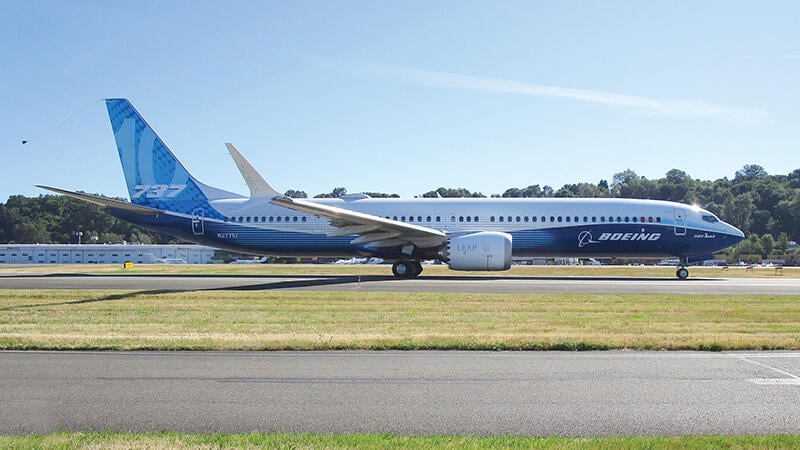
Boeing 737-10 on tarmac

Certification flight tests of the 737-10 were 98% complete by mid-July.

Credit: Joe Walker

Looking at the absence of Boeing commercial aircraft on display at this year’s Farnborough Airshow, attendees could be forgiven for having a sense of deja vu.

As in 2024, Boeing is not displaying flight test hardware at the show to prioritize the finalization of 737 MAX and 777-9 certification. At the last Farnborough Airshow, Boeing faced extra scrutiny after the infamous January 2024 Alaska Airlines 737 door-plug blowout incident and was challenged by the reality of an ever-extending certification timeline for the 777-9. This show, however, seems different.

Yes, the company’s display aircraft are absent again, but Boeing is poised this year to cross the line on both its large widebody and final MAX certification efforts. First up is the 737-7, whose regulatory approval appears to be imminent, and certification testing on the stretched 737-10 is all but complete.

  • The airframer unveils details of the 737 engine anti-ice redesign
  • The 777-9 passes 50% certification flight-test mark

Regulatory clearance for both models, when confirmed, will mark a key milestone in Boeing’s long-drawn-out campaign to complete development of the 737 MAX series and begin deliveries across the full range of its single-aisle family.

The 737-7 first flew in March 2018, but new FAA requirements and an engine anti-ice (EAI) redesign issue have prolonged its certification. The same hurdles have also delayed the 737-10, which made its first flight in June 2021.

“For the -7 certification, we are 95% complete with all of our certification deliverables,” says Chris Payne, vice president and program manager for 737 development programs. “We have a few more deliverables that we are working to submit to the regulator, and the regulator has the balance to get through the approvals, but we’re tracking really well there.”

Certification flight testing for the 737-7 was completed after accumulating 686 hr. on 441 test flights, in addition to 349 total ground test hours. Certification flight tests on the 737-10 were 98% complete as of July 8; 2,060 flight test hours were amassed on 972 test flights.

“We’re literally two tests and about eight days away from being done with that,” says Mike Sinnett, Boeing Commercial Airplanes’ senior vice president of product strategy, product development and development programs.

For the moment, Boeing is pursuing FAA certification only for the 737-7. “We don’t have any early [European Union Aviation Safety Agency (EASA)] customers,” Sinnett says. “To simplify the work that’s being done by our team, by the regulators, we’ve separated those two. We will follow up as we have more time with an EASA validation for the MAX 7 and for the MAX 10—and for the 777-9,” he says, referencing Boeing’s ongoing certification campaign for the large twinjet.

“We’re doing all of that work concurrently, and ultimately the FAA will issue the amended type certificate first, and then EASA will follow with validation of that type certificate,” Sinnett adds. How long that process will take is unknown. “We probably won’t know until that last week,” he notes. “It could be a day, it could be a week, it could be a month, but it’s intended to be roughly the same time period.”

Progress toward certification is also measured by completion of the final phases of the Design Assurance Review (DAR), a multidisciplinary process required by the regulators to verify safety and compliance.

“DAR 4 is the final process check, and that one is more of a checklist.” Payne says. “It goes back through all the prior DARs and makes sure that you did everything you said you were going to do. We are 100% complete with DAR 3, and we are 60% complete with DAR 4. Then we have our system safety analyses, which are the last big documents to get submitted, and we are 30% complete with the overall submittals of those to the regulators.”

A major pacing item for the final set of 737 certification programs has been the completion of the EAI redesign; a finalized version was defined in late 2025. The EAI system redirects engine bleed air to the inlet cowl to prevent ice buildup. A redesign of the original system was deemed necessary, however, when development tests revealed that the inlet’s composite structure was vulnerable to thermal damage under certain conditions of prolonged use.

“We’re right in the final stages of getting our engine anti-ice solution certified,” Payne says. Because current 737-8 and 737-9s are subject to in-service EAI operating limitations until the new inlet is available for retrofit, Boeing plans to introduce the certificated redesigned system first on production 737-8, 737-8200 and 737-9 versions. “Then we’ll roll it off onto the 737-7 for the amended type certificate, and then we’ll put it on the 737-10 for that [amended type certificate],” Payne says.

Revealed in detail for the first time, major features of the redesigned EAI include a set of inlet turbulators arranged circumferentially inside the inlet lip to promote boundary layer mixing (see diagram below). “They’re literally a washer and a fastener that goes through the inlet,” Payne says. The small devices trigger the transition from laminar to turbulent flow earlier than in the current inlet, entraining colder airflow and causing a 200F temperature drop around the critical heat-affected structural areas.

“It does a fantastic job of really taking care of the temperature conditions, and then we marry that with a CFM hard wall forward fan case,” he adds.

The hard wall design replaces the standard CFM inlet, which normally uses noise‑reducing perforations. The standard inlet lining was originally added to make sure the turbulators would not reduce the fan flutter margin. During testing at GE Aerospace’s facility in Peebles, Ohio, engineers discovered something unexpected: The combination of the hard wall forward fan case and the turbulators actually produced less noise than the standard perforated inlet. “It was a win-win,” Sinnett says.

Much of the EAI hardware can be retrofitted in a maintenance shift, Payne says, although some elements—such as the wiring associated with the system’s fault-detection and pressure-sensing functions—will require removal of the galley to connect them to the P6 electrical distribution and circuit breaker panel in the flight deck.

“We’re working really closely with the FAA as they put out airworthiness directives to see if we can get a time frame interval [that works] for the operators that we get them to a heavy check, so that they can pull the galley out and do the wiring then,” Payne says.

Another test priority has been the enhanced angle-of-attack (eAOA) system introduced as part of the suite of improvements that would allow the MAX to return to service following the 2018 and 2019 accidents. The eAOA collects AOA data from five aircraft parameters and provides a new safety feature by constantly checking the derived AOA against inputs from the standard AOA sensors mounted on either side of the aircraft’s nose. If the eAOA receives an erroneous signal from either of the standard sensor vanes, it suppresses that input.

Boeing 777-9 in flight
Boeing 777-9 flight tests have passed the 50% mark. WH003, the third 777-9 development aircraft, was used for propulsion certification tests in mid-July. Credit: Joe Walker

A simple “AOA fail” (left or right) indication on the primary flight display (PFD) “replaces about five different indications that a crew would normally have seen on their PFD, along with a possible persistent stick shaker going on in the background,” says Bill Quashnock, deputy chief pilot for 737 programs. “The new monitor will capture those faults, give a single simplified indication to the crew that that is what the problem is, and allows you to quickly run through the checklist.”

The eAOA will be retrofitted on existing MAX fleets within the next two years and introduced on the production line with certification of the 737-10.

Boeing says the finish line is also finally in sight for certification of the long-delayed 777-9 following the completion of more than 50% of the flight tests required for regulatory approval.

The milestone comes as Boeing accelerates predelivery preparations for its long-range flagship as initial pilot and operator maintenance training begins and certification of the first model starts for the initial customer airlines.

“We’ve executed over 1,700 flights for over 4,800 flight hours,” says Terry Beezhold, 777-9 vice president and general manager. “This airplane has been around and put through its paces, and it is performing very well. It is very mature.”

Work to modify the four primary 777-9 development aircraft into a finalized configuration for certification is ongoing. “We are in the final phases of completing those layups,” Beezhold says. Configuration revision tasks have been completed on WH001 and WH003; WH002 and WH004 are due to rejoin the test fleet by the end of July.

For the certification phase, WH001, the first 777-9, is focused on handling qualities and stability and control work, while WH002 recently completed natural icing tests. WH003 is the focus for auxiliary power unit and avionics testing, and WH004 is the prime airframe for lighting and environmental control system certification work.

“Our focus is completing our remaining 50% of certification testing,” Beezhold says. The certification campaign has been divided into FAA-designated Type Inspection Authorization (TIA) phases. “We’ve been successful in TIAs 1 through 4, and the major TIAs left are TIA 5, which is largely around our final aerodynamic performance software and our display software,” he adds.

“Then we have a unique TIA around [extended-range twin operations (ETOPS)], and that allows us to begin our demonstration of the airplane’s capability to fly ETOPS,” Beezhold continues. “Our certification is 180 min. at entry into service and then working with our customers; they can go ahead and extend those as demonstrated.”

ETOPS flight tests are expected to begin within the next few months using a production aircraft, he adds. “We will conduct a bunch of ETOPS operation tests, where we do diversions with various lengths and various system failures to show that it meets all of the requirements,” Beezhold notes. “Then we do function and reliability testing, basically putting the airplane through its paces, demonstrating that all the systems work under all the different conditions.”

The aircraft destined for the role is “going through its final checks, and it will conduct its first flight here in the coming weeks,” Beezhold says.

As certification nears, Boeing is stepping up pilot qualification testing with regulators to ensure that training differs for the 777-9 compared with the 777-300ER and other 777 versions. “That’s progressing well,” Beezhold says. “Also, we have simulators coming online, and they’re getting through all of their qualification testing.”

Boeing has also been hosting preparatory “maintain like an airline” events. “We have done three of these where many of our customers send some of their mechanics here to Everett, [Washington], and we conduct simulated maintenance activities on the actual airplane,” Beezhold explains. “They can get familiar with things like the folding wingtip or an engine removal—some of the things that are different than what they’re used to.”

The 777-9 fatigue test airframe has so far completed more than 63,000 cycles in a special rig at Everett, well beyond the full airframe design lifetime of 33,000 cycles, since testing began in 2020. Boeing will continue loading and pressurizing the article, says Tresha Lacaux, 777-9 vice president and chief project engineer.

“We don’t set a time limit on it, because we’ve already experienced one full flight-cycle lifetime on the aircraft. We’re just letting it continue to cycle through,” Lacaux says. “We have regular inspection intervals, and so we are going to let it take the time that it takes. We test a minimum of three lifetimes because we want to understand how much extra capability is truly in the aircraft.”

Guy Norris

Guy is a Senior Editor for Aviation Week, covering technology and propulsion. He is based in Colorado Springs.