This article is published in Aviation Week & Space Technology and is free to read until Dec 21, 2025. If you want to read more articles from this publication, please click the link to subscribe.
Test Markets Beckon Advanced Air Mobility Sector
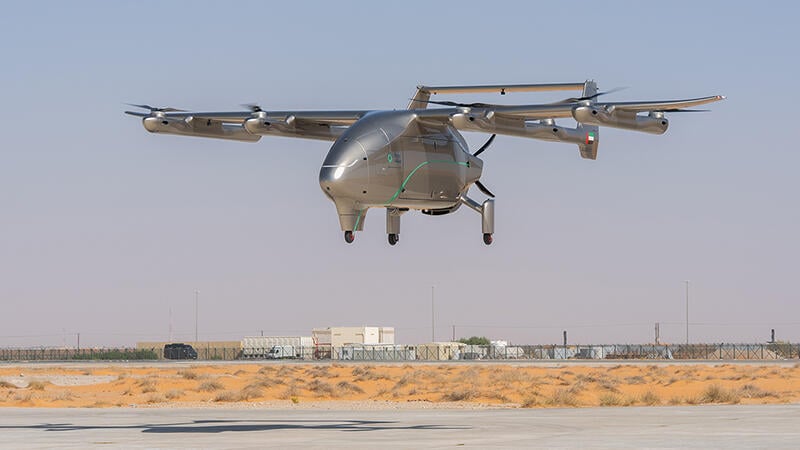
Lodd Autonomous has commenced flight trials of its Hili autonomous cargo aircraft.
The advanced air mobility sector is approaching a transition point. The coming year is emerging as the moment the industry’s focus likely shifts from how the myriad vertical-takeoff-and-landing systems work to how they can make money. Saudi Arabia’s Public Investment Fund, Emirates Airline and others used the Dubai Airshow to announce agreements with aircraft suppliers to put the technology to the test.
Key to that happening is the United Arab Emirates (UAE) regulator, which is among those most aggressively trying to court the sector. The director general of the country’s General Civil Aviation Authority, Saif Mohammed Al Suwaidi, tells Aviation Week that he is optimistic the regulator will approve the first systems for commercial service next year but acknowledges that manufacturers still have work to do.
- Joby and Archer are poised for Saudi trials
- Lodd Autonomous begins flight trials of its Hili cargo hybrid-electric air vehicle
Joby, Archer Aviation and now also home-grown Lodd Autonomous are flight-testing their vehicles in the UAE to win regulatory approval for commercial service.
The Helicopter Co. (THC), owned by the Public Investment Fund, signed separate memoranda of understanding with Archer and Joby that each also involve real estate development company Red Sea Global. Under the deals, the aircraft-makers are being invited to bring their aircraft to Saudi Arabia for a “sandbox” demonstration to assess whether they could serve the resort area on the country’s west coast, THC CEO Arnaud Martinez said.
“We want to get a sense of what the product is like in Saudi conditions,” THC Chief Commercial Officer A.J. Baker says. “We face some unique challenges, even quite different to what you see here in the UAE.” Flight operations in Saudi Arabia, even along the country’s western coast with the Red Sea, face a dry heat, different from the humidity and heat in Dubai.
The demonstrations are likely to take place at Red Sea International Airport in northwestern Saudi Arabia starting in April. Officials are trying to assess if the electric vertical-takeoff-and-landing (eVTOL) aircraft could replace seaplanes used in the area.
THC officials are betting that the initial use case for advanced air mobility (AAM) will be less urban air mobility in the big cities, where developing AAM infrastructure will be a challenge, than moving people around the various new developments along the Red Sea and around Neom, the Saudi megaproject to create new communities in the northwest of the country near the Jordanian border.
Archer and Joby have been selected because “they have a product ready for trials,” Baker says. “We have been watching them for a while, and we know how their developments are going. There is no doubt we will be looking at others in the future as they come online.”
Honda used its Dubai Airshow debut to reveal details of its previously secretive eVTOL. It displayed a mockup of the cabin, a model of the aircraft’s 250-300-kW turbogenerator and the one-third-scale demonstrator it has used to verify flight control software.
Building on these tests, Honda aims to begin flight trials of a full-scale proof-of-concept aircraft next spring; it is targeting certification of an initial production eVTOL in the early 2030s. The company has also conducted ground tests of the compact turbogenerator during which it achieved continuous and transient power runs.
Joby used the Dubai Airshow to showcase its progress and garnered the milestone of being the first in the eVTOL sector to fly at the gathering. The demos follow Joby’s first point-to-point flight in Dubai on Nov. 9, a 17-min., 21-nm trip from its test facility in Margham to Al Maktoum International Airport.
Archer’s UAE lead, Talib Alhinai, says the company is working toward its first piloted transition flight using the Midnight vehicle. The startup recently announced the conclusion of its flight-test campaign in Abu Dhabi with its remotely piloted aircraft, which included transition from vertical to forward flight. In the U.S., Archer says it will proceed with testing its piloted prototype in California from wingborne conventional-takeoff-and-landing mode to thrustborne VTOL ahead of a first transition flight next year.
“This is obviously the most challenging part of flight, because there’s a lot of intricacies about modeling it and ensuring that we’re able to do it safely and smoothly,” Alhinai says. “And we also have to think about the passenger experience” during transition.
The market is not just about ferrying passengers, however. Archer also disclosed an expansion of its business model: It struck a deal to provide the powertrain for the Anduril-Edge Omen military hybrid-electric tailsitter uncrewed aircraft. “It’s the start of a new business line for us,” Archer Chief Commercial Officer Nikhil Goel says. “We are now open to hosting our propulsion system on specific civil and defense customers.”
And Emirates Airline signed an agreement with Abu Dhabi-based Lodd to assess its autonomous, hybrid-electric VTOL Hili cargo aircraft, which aims to replace the trucks and aircraft that are linking logistics hubs and distribution centers. The airline is assessing how a system such as the Hili could support its SkyCargo operation. Etihad Cargo had signed up to assess the technology, too.
Lodd has opted to focus on the middle-mile sector, which it sees as the main bottleneck in the logistics chain. In the middle mile, items are moved from a regional hub to a local warehouse by air or truck, loaded and unloaded along the way and then shipped on to a distribution center. “It has many interfaces, and it takes a lot of time,” CEO Rashid Al Manai says. “So our idea is [to] make this simple.” Al Manai sees pursuing a more direct path as the way forward, and notes that another goal is to serve customers with time-sensitive cargo.
The 1.4-metric-ton (1.5-ton) air vehicle is designed to fly about 300 km (186 mi.) with fuel reserves and land in a 20 X 20-m (66 X 66-ft.) area to be close to a warehouse while carrying 250 kg (550 lb.) of payload at a speed of up to 100 kt. The service ceiling would be around 14,000 ft., although the Hili typically would operate at 2,000-3,000 ft. It has a wingspan of 11.9 m, is 8.9 m long, stands 3 m in height and boasts a 2.7-m3 cargo bay.
Lodd is aiming for certification in 2028. To pave the way, the company intends to finalize the certification plan early next year and have a couple of aircraft participating in experimental operations in 2026. Those should generate lessons that would inform finalization of the Hili production version around mid-2027.
The Hili has cargo doors on each side to facilitate the loading and unloading flow. The vehicle also has been designed to be insensitive to how items are loaded in terms of center of gravity. That should save time and cost by eliminating the need for a load master specialist to oversee cargo storage. “This makes the aircraft very user-friendly,” Al Manai says. The company strives to cut transport times in half and shave 30-40% off operating costs.
Lodd hopes to build 600 aircraft by the end of the decade using an assembly process that should take hours rather than days. Al Manai says one of the early use cases could be emergency services where cargo operations are needed.
Elsewhere in the region, China’s EHang announced the completion of a series of point-to-point passenger-carrying flights in Qatar, its first in the Middle East. Conducted in partnership with Qatar’s Ministry of Transport, the flights ferried passengers between the Doha Port and the Katara Cultural Village in the heart of the city.
—With Graham Warwick in Washington