This article is published in Aviation Week & Space Technology and is free to read until Mar 06, 2026. If you want to read more articles from this publication, please click the link to subscribe.

Flying In Electra’s Ultra-Short-Takeoff-And-Landing Tech Demonstrator
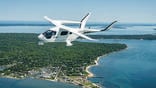
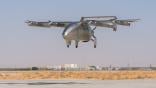
Electra EL2 in flight

Electric propellers blow over the EL2’s wing and flaps to increase lift coefficient and reduce takeoff and landing distances.

Credit: Electra.aero

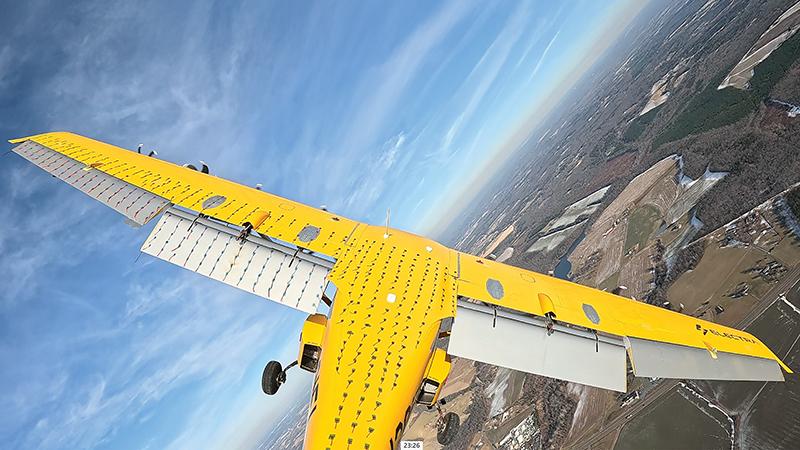
Flying in Electra’s bright yellow EL2 technology demonstrator proved to be both dramatic and not.

It was undramatic because taking off with a ground roll of less than 150 ft. on the power of eight electric propellers entails less noise and vibration than expected. It was dramatic because in a mere moment, the ground is 100 ft. below us. Within seconds we are airborne and in an elevator-like climb out of Virginia’s Manassas Regional Airport.

  • Electra wants to redefine regional aviation
  • Early customers see potential in ultra-STOL

Landing in less than 150 ft. is a bit more striking, largely because you have time to stare at the strip of mown grass in a farmer’s field on which you are about to touch down. But even with a relatively steep glideslope of 6 deg., at an approach speed of 35 kt. the drama is muted.

After my flight in the EL2, I sat in the spacious nine-passenger cabin of the full-scale “glass airplane” mockup of Electra’s planned production EL9 and reflected on the potential of combining that relative lack of drama with a sophisticated passenger experience to unlock “direct aviation.”

This is Electra’s term for reimagined regional aviation, where small aircraft connect airports small and large and provide a new level of accessibility to air transportation by operating not only from underused runways, but also taxiways, ramps and even heliports and parking lots.

Direct aviation is empowered by Electra’s core technology—ultra-short-takeoff-and-landing using blown lift enabled by hybrid-electric distributed propulsion. Christened the Goldfinch, the pint-size EL2 was built to validate that technology and answer key questions posed by both Electra and its customers.

Electra has rebranded the capability, originally termed electric short-takeoff-and-landing (eSTOL). “We don’t talk eSTOL because this is not STOL—this is Ultra Short,” CEO Marc Allen says. “The difference in performance capabilities is so vast, it’s the equivalent of calling a STOL airplane a conventional airplane. We’re talking 150-ft. takeoff and landing rolls for a nine-passenger airplane. STOL in that category normally means 800-1,000 ft.—eSTOL mischaracterizes what we’re doing.”

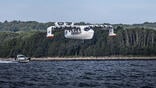
electra e2 on ground at snowshoe mountain ski resort
The EL2 landed at the Snowshoe Mountain ski resort in November to demonstrate improved accessibility using ultra-short capability. Credit: Electra.aero

Ultra-short performance tackles what Electra views as the greatest constraints on the air transportation system—airspace, gate space and ramp space. “If you can deliver ultra-short capability, you can now enter into the airspace on helicopter routes,” Allen says. “You can land not on runways, but rather ramps and taxiways, and you can address gates by using courtesy vehicles.

“What earns us the right to fly into a large commercial airport with a fixed-wing propeller aircraft and land not on a runway?” he asks. “The only thing that can earn us that right is demonstrated ultra-short performance with robust safety margins. We must demonstrate that we have roll and yaw control at super-low speeds, and we’ve flown [the EL2] slower than 20 kt.”

First flown in November 2023, the demonstrator has a modified Cessna 172 wing, with eight electric-powered propellers mounted under a reprofiled leading edge so their slipstream flows back over the wing and blows large, double-slotted flaps and drooped ailerons to increase lift coefficient.

The two-seat demonstrator’s purpose-designed composite fuselage has a turbogenerator in the nose, liquid-cooled battery packs under the floor with radiators on the sides, and a large T-tail to counteract the pitching moment generated by blowing the wing.

Blowing increases the airspeed experienced by the wing, but the biggest lift augmentation comes from the large flaps turning the flow. Blowing adds energy to the wake coming off the trailing edge and creates a jet flap that continues downward, like a flap extension. Essentially, the airflow sees a bigger wing. This effect strengthens as speed decreases and diminishes as speed increases and flaps are raised. This allows for a normal-size wing in cruise to reduce drag and helps dampen the effects of turbulence.

The EL2’s donor 172 wingbox has a break at about two-thirds span and is tapered outboard, so the outer pairs of propellers are smaller to avoid overblowing the outboard sections. All eight propellers are powered by the same MAGicALL motors. On the production EL9, all eight propellers will be identical.

The EL2’s four inboard propellers blow the double-slot Fowler flaps that generate the majority of the lift augmentation. The four outboard propellers blow the drooped ailerons, which open a slot as they extend. Aileron and rudder deflection are coupled to propeller speed to augment roll and yaw control.

Inboard flaps have low-bandwidth actuators for drag control on takeoff versus landing. Ailerons are controlled by the pilot’s yoke for high-bandwidth authority. Blowing the wing and producing a jet flap moves the center of pressure aft and causes a nose-down pitching moment. To maintain stability, the horizontal tail includes a high-lift slot.

The EL2’s series hybrid-electric propulsion system is built around a 100-kW turbine engine based on a helicopter auxiliary power unit and driving a custom gearbox and generator. The turbine is sized for cruise. The two 10-kWh battery packs handle peak power and provide redundancy. The production EL9 will have a 600-kW hybrid powertrain with a 50-kWh battery system.

Aviation Week was invited to Electra’s headquarters in Manassas in mid-December for a flight in the EL2, with Electra Chief Test Pilot Cody Allee at the controls. Allee is an experienced STOL flyer, as a former U.S. Marine Corps Boeing F/A-18 pilot and lead U.S. pilot on the Rockwell-MBB X-31 Vector project.

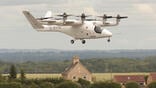
electra e2 taking off from manassas airport
The hybrid-electric blown-lift EL2 lifts off from Electra’s Manassas base after a takeoff ground roll of 150 ft. or less. Credit: Mark Usciak/Electra.aero

Most EL2 test flights have been from Manassas. But in cooperation with customers, the aircraft has operated off-runway from grass fields, a paved surface used for drone flights, a taxiway at Watertown International Airport and a ramp at Griffiss International Airport, both in New York. The aircraft also landed on a 400-ft. strip of graded land next to the Snowshoe Mountain ski resort in West Virginia in November—a 1-hr. flight from Manassas versus a 4.5-hr. drive on winding roads.

Sitting in the aircraft on Electra’s ramp as Allee goes through the pre-takeoff checklist and starts up the EL2 provides a revealing glimpse into the complexities of hybrid-electric propulsion. High voltage is turned on, and red strobe lights warn the ground crew. Batteries are brought online, voltages matching and contactors closing. The turbogenerator is started, coolant flows, and temperatures rise and stabilize.

The details are fascinating. Impedance between the 700-volt high-voltage buses and the airframe is monitored continuously to detect a short circuit. To avoid arcing, a precharging circuit brings the bus voltages up before the contactors are automatically closed. A DC-to-DC converter takes the 700-volt battery output and converts it to 28 volts to power the avionics.

Throughout our flight—the 151st for the EL2—Allee is constantly switching the turbogenerator in and out of boost, the battery charging between high and low C-rate to manage the state of charge (SOC) and the large side-mounted radiators between inline and bypass to manage coolant temperatures. This is in part because the demonstrator’s off-the-shelf turbine engine is not powerful enough both to cruise and charge the batteries at high rate at the same time, Allee says.

The fly-by-wire EL9 will have a more efficient purpose-designed turbogenerator provided by Safran that will power advanced axial-flux electric motors developed by Evolito. “All this will be automated,” he says. “You’ll bring up the high voltage, then you’ll have a switch to turn the turbine on.”

The EL2 is a flying testbed and provides the pilot with a lot of information on each system. “We can see each subcomponent temperature: generator, rectifiers, windings, bearings, coolant temperatures,” Allee says. “And then you get the different cells in the batteries. The motor page gives me the exact rpm, what power it’s pulling, the temperature—it’s basically flight-test instrumentation.

“This will be vastly simplified in the production aircraft,” he continues. “You’ll have a high-level display that will give you overall system status, and you will be able to deep-dive on a synoptic display—essentially what we have outboard here.” He indicates the information on the display: rpm of the motors, left and right battery SOC, turbogenerator power, flap and aileron positions.

Taxiing out to Runway 16 Right, we are instructed to hold for what seems like a continuous stream of private jets and training aircraft taking off and landing. Manassas is a busy airport. But this shows the flexibility of hybrid-electric propulsion, Allee says: “The beauty is we haven’t bled any battery charge at all because we have the turbine on and we’re making power.”

Finally we are lined up on the runway, positioned on the letter R at the EL2’s 3,300-lb. maximum takeoff weight after burning off a few pounds of fuel taxiing and holding. This is to be a maximum-performance takeoff, turbogenerator and batteries on, with an aggressive rotation at 27 kt. to 10-deg. nose-up and a climb at 35 kt. to 100 ft., where power is reduced.

Allee advances the throttles to full power, the EL2 responds with a noise like a manic lawn trimmer, and he releases the brakes. With the batteries boosting takeoff power close to 500 kW—almost four times that of a Cessna 172—we reach 27 kt. in seconds and leap skyward from the middle of the number 16 on the runway. My only response is: “That was ridiculous!”

Allee later calculates our ground roll was just 129 ft., considerably shorter than Electra’s design goal of 150 ft. The takeoff demonstrates the rationale behind hybrid-electric distributed propulsion. Because the batteries provide a power boost, the turbine can be sized for cruise. “Our approach is that we have got this reserve of power for takeoff and landing, but we’re not carrying all that displacement,” Allee says.

The turbogenerator runs at a constant power point. “Turbine efficiency drops off precipitously when you reduce rpm, but we’re running at peak efficiency all the time,” he says. “And it’s not being thermally cycled. When we need to meet a transient power demand, that comes from the battery.”

Turbine maintenance cost is driven by cycle count, not running time. In operation, the EL9 could leave the turbine running while on the ground between flights, charging the battery, so that it is not thermally cycled. “You kill the cycle counts, and you kill the thermal stress of throttling the turbine,” Allee says.

Heading south, we settle into a 70-kt. slow climb at 1,200 ft. on 95 kW of power, preserving the batteries for planned demonstration maneuvers. The EL2’s maximum speed is around 100 kt., but integration of the motor pylons into the original Cessna 172 wing is draggy, Allee says. In hindsight, the company should have opted to design a clean-sheet wing for the demonstrator, says JP Stewart, senior vice president for product development.

When the EL2 first flew, its flaps did not fully retract, but after an upgrade they now do. The EL9 will have a more highly loaded, lower-drag wing and larger-diameter, variable-pitch propellers. The EL2 has fixed-pitch propellers that “are pitched so flat for takeoff that we run out of prop,” Allee says. With fixed-pitch propellers governed on rpm, the throttles are decoupled from power and instead control motor rpm, he adds.

The outer motor pairs are coupled to the ailerons and rudder so that differential thrust augments the aerodynamic surfaces and improves control coordination. Handing me control of the aircraft for some gentle maneuvers, Allee points out how motor power settings change with aileron and rudder inputs.

aviation week executive editor for technology graham warwick at the electra e2 controls
Aviation Week Executive Editor for Technology Graham Warwick at the EL2's controls. Credit: Electra.aero

A crucial task for the EL2 was to validate the buffet boundary where airflow begins to separate to ensure the blown-lift aircraft could be flown safely to the high angles of attack required for ultra-short takeoffs and landings with a safe margin to the stall.

Allee first demonstrates the buffet boundary with power off and no blowing over the wing. Setting flaps and droop to 30 deg. and 20 deg., he brings the power back to idle; a dip in motor rpm indicates there is no thrust. He pulls the nose up. Rumble starts at 19-deg. angle of attack (AOA); at 20 deg., the wing starts to drop. Recovering the aircraft, he gives me the chance to take the EL2 through the same maneuver.

Then Allee sets up to demonstrate the buffet boundary with power on, as it would be during takeoff and landing. Setting the rpm to 80%, he takes the aircraft up to 15-, 20-, 25- and finally 30-deg. alpha (AOA), making brisk left-right control inputs at each point to demonstrate the aircraft’s controllability. “We can fly the airplane at 30 alpha with normal control inputs—and that’s the big point,” he says.

To demonstrate the redundancy provided by eight motors, Allee sets up to perform a simulated takeoff at altitude and directs me to switch off one of the outermost motors—the worst case—without warning. I cover both switches with my hands. At 25-deg. AOA and 25 kt., with the motors drawing 100 amps from the batteries for 100% power, I turn off the left outboard motor.

A wing dips slightly, but otherwise nothing untoward happens. “When you lose a motor, you lose a little lift,” Allee says. “There was a yaw and a roll right, both simultaneous, but otherwise that was it.”

Our next stop was Maples Field, a private airstrip on a farm where Allee planned a maximum-performance landing on grass. He entered the pattern with flaps 30/20 and 85% power, leaving the turbogenerator in boost before lowering flaps to 60/25, derating turbogenerator and C-rate and coming in over the trees at 35 kt. on a 6-deg. glideslope. The 2,000-ft. airstrip looked short; we used only a fraction of it.

Almost immediately, Allee prepares for a maximum-performance takeoff. He sets the flaps to 40/25, turbogenerator to boost and C-rate to high and, when battery SOC reaches 85%, advances the throttles, releases the brakes and rotates at 27 kt. Later, he calculated our landing ground roll was 186 ft.—poor braking action on the grass extended it slightly—but our takeoff roll was just 110 ft.

Coming back around, Allee flies a second maximum-performance landing, then sets up to demonstrate a quiet takeoff. “This will be flaps 30/20 and a slightly lower boost and C-rate, 73% SOC for the simulated quiet departure,” he says. “We’ll take a bit longer on the takeoff roll, but it’ll still be fairly fast.” Acceleration is slower, and we rotate at 35 kt. but are still off the ground long before the end of the grass strip.

With the propellers always blowing over the wing, ailerons and flaps, the EL2 is highly maneuverable at low airspeed, which Allee demonstrates. With flaps 30/20 at 45 kt. and 60-deg. bank, he flies a figure eight at 2g and 50-60 deg./sec. Looking out, our wingtip appears anchored to a building on the ground below us. “That’s the maneuverability this thing has, which is just nuts,” he says.

Our activities at Maples have taken their toll on the batteries, and SOC has dropped to 60%. We need at least 75% to attempt the planned turbogenerator-off maximum-performance quiet landing back at Manassas. Allee puts the turbogenerator in boost and slows down to buy us more time to recharge, but the extra 15% SOC proves out of reach.

The demonstrator’s turbine is a little too small and its batteries are not intended to enable the aircraft to fly for extended periods on electric power alone. But that is the point of a hybrid: the ability to size the turbine for cruise while minimizing the weight penalty from heavy batteries. The EL2’s two battery packs can provide about 15 min. of all-electric flight when fully charged, Allee says.

The ability to fly turbogenerator-off reduces noise. Electra has not measured the EL2’s noise during takeoff, when the turbogenerator is on and the electric engines are at full power, but in electric flight mode with the turbine off, the company has validated an overflight noise level of approximately 55 dBA at 500 ft., compared with 75 dBA for a conventional turbine aircraft flying the same altitude and flightpath.

Abandoning plans for a turbogenerator-off landing, Allee sets up for a steep approach back to Manassas’ Runway 16, flaps 60/25 and an 8-deg. glideslope. The approach display comes on. Described as a “poor man’s head-up display,” this shows imagery from a camera on the EL2’s nose overlaid with AOA, indicated airspeed, ground speed, radar altimeter, vertical speed, crosswind limit and velocity vector.

Electra is still deciding whether the EL9 will need a similar display for ultra-short landings. The production aircraft has been designed to provide a pilot with the same downward visibility as from a helicopter cockpit, with a lowered instrument panel glareshield and deep windshield.

full-scale mockup of the electra el9 on the ground
A full-scale mockup of the EL9 has been built to showcase the cockpit and cabin design as well as passenger experience. Credit: Dave Koch/Electra.aero

Touching down, Allee says he landed a little long. I take his word for it, but video later verifies the ground roll was 155 ft. With the turbogenerator at idle and 67% SOC on the batteries, we begin taxiing back to Electra’s hangar.

Allee gives me the opportunity to taxi, steering in one of two ways. He can turn off the coupling between the rudder and the ailerons, and I can use the throttles for differential thrust—or he can leave the coupling on, and I can drive the aircraft like a car by using the yoke. The EL9 will have a single throttle, he notes.

I choose the throttles first, using my thumb and pinkie to move the levers controlling the outer pairs of propellers. I then try using the yoke. I find it easier to steer the aircraft using the throttles but still manage to overcontrol and cause pilot-induced oscillation. Allee comes to my rescue.

Shutting down the EL2 is as fascinating an insight into electric propulsion as was the start-up. After 3 min. at idle to cool down, the turbogenerator is turned off. We have 12 of our 33 gal. of fuel remaining, as planned, and battery SOC is 61%. The high-voltage system is turned off, followed by the batteries. High voltage is then turned back on and the motors are briefly spun to remove residual charge. “We kill the capacitance with the motors,” Allee says. The remainder of the systems are turned off, and the EL2 is safely shut down.

“Two-plus years of flying the EL2 was all about getting real flight data to replace assumptions, allowing us to retire the hardest technical risks in the scaling around aerodynamics and blown lift,” CEO Allen says. “We validated the ultra-short-takeoff-and-landing performance under real-world flight conditions, and we gave ourselves the confidence then to launch the product.”

Electra submitted its application for Part 23 type certification of the EL9 to the FAA in November. Aiming for certification by late 2029 or early 2030, the company plans to build one Gen 0 prototype with known nonconformances followed by three Gen 1 conforming aircraft for certification testing.

“As we were flying the EL2, we were able to take down marks of consistency between this airplane and conventional airplanes, and we were able to build the certification strategy [for the EL9] around the fact that this is indeed just an airplane,” Allen says. “We don’t need powered-lift certification; we don’t need rotorcraft certification. We filed under Part 23 because we are just an airplane.”

Electra will need to raise additional funding to get to certification, but the startup has financial runway through the end of the year.

“We’re still flying the EL2 because there are two things we still need,” Allen continues. “One, we need to continue to do real-world demonstrations with customers, going to places airplanes haven’t been before. Two, it’s still a flying laboratory, providing pilot feedback on flight procedures, on precision landing.”

But do Electra’s prospective customers really need the EL9’s unique capabilities, as demonstrated by the EL2, or will they just want a modern, more efficient replacement for the nine-passenger Cessna Caravan?

Bristow Group is the first to place a firm order with Electra, backed by multimillion-dollar deposits in January to secure five delivery slots, including the first EL9 off the line. The company is a major operator of medium and heavy helicopters for offshore support and search-and-rescue but wants to expand its offerings to existing customers as well as enter new markets with cargo and passenger networks.

Bristow was the first to sign a joint development agreement with newly founded Electra in 2021. “We then went through a very detailed analysis and modeling—Caravans, reengined Caravans with hybrid-electric powertrains, other reengined aircraft with hydrogen engines,” Bristow Chief Transformation Officer Dave Stepanek says. “We analyzed the whole structure of it, both costs and reliability of future technologies, and it led us right back to the EL9.

“Specifically, we were looking at Scandinavia, where there are a lot of geographical barriers and older airports with shorter runways being serviced by turboprop aircraft,” he continues. “And as they want to expand services, and the turboprop aircraft start to age out, they’re going to have to make major investments in extending runways and improving facilities. The EL9 could eliminate that requirement for future investment. You can utilize the infrastructure that exists. That was very appealing to us.”

Bristow projects the hybrid-electric EL9 will save on fuel and maintenance costs. “We think it’s a 50% reduction in direct operating costs relative to turboprop aircraft, and it’s greater versus a helicopter,” Stepanek says. Bristow also plans to operate all-electric aircraft as part of a network and is testing Beta Technologies’ Alia CX300. “But [the EL9 is] about half the price of 100% battery-electric because it has more payload and range,” he notes.

Bristow plans to build out cargo networks as a step toward passenger transportation. “We’re also going to be looking at direct aviation,” Stepanek says. “In the ’80s and ’90s, when I was a helicopter salesman for Sikorsky, I used to fly a lot of Beech 1900s around the Midwest and Pacific Northwest, and I would be able to fly to town to town to town. That just evaporated. We think direct aviation is a great opportunity for low-cost transportation with airline-type reliability and safety.”

JSX is a Dallas-based public charter operator that offers scheduled flights between smaller airports. The carrier now flies 30-seat Embraer ERJ 135/145s regional jets and ATR 42-600 turboprops, but it signed a letter of intent with Electra in 2023 for up to 82 EL9s.

“We don’t fly any nine-seaters,” JSX CEO Alex Wilcox says. “If we’re going to enter that market, then why aren’t we flying Caravans today? Every time we’ve looked at them, we’ve always decided ‘no.’ We came close on the Pilatus PC-12, then we decided to go with the ATR. They can both go in and out of the airports we want to go to, but we can take more than three times as many people in the ATR.”

The EL9 begs the same question, he says. “Are nine seats enough to be meaningful? I think that the answer we’re coming to is ‘yes,’ because it’s got to be right for the market, and it’s got to be a super-short market. So think not just Dallas to Austin, but Dallas to Fort Worth, McKinney to Fort Worth. There’s a train that goes from Dallas to Fort Worth, and it takes twice as long to take a train as it does to drive.”

Wilcox points out the investment that Dallas and other cities are putting into infrastructure for electric vertical-takeoff-and-landing (eVTOL) air taxis. “There is a ton of money right now chasing eVTOL infrastructure,” he says. “I have my doubts about the certification timelines and the practical utility of those vehicles. Along comes Electra, probably years ahead of eVTOL in terms of certification timeline, more or less a standard Part 23 airplane, no new rules required. I think they have a multiyear head start.”

Although JSX has another 20 Embraers in desert storage that it could bring into service, the carrier went with the ATR “because it goes places a jet cannot go,” Wilcox says. “To me, it’s the opportunity provided by the infrastructure that only this platform can accommodate. I can take that, map it onto the Electra, and I think there is going to be significant infrastructure that only this airplane is going to be able to access for a good period of time.”

He gives the example of a passenger wanting to travel from downtown Dallas to Miami. “You can take the Electra from the [Kay Bailey Hutchinson] Convention Center straight to Love Field and just walk across the ramp and get on the JSX flight to Miami,” he explains. “The way the airplane is going to be handled at Love Field is like a helicopter, not like an airplane.

“We’re not going to have to get in the queue and wait for clearance,” Wilcox continues. “It’s usually [visual flight rules] here, so helicopters can come in right over the terminal between the two runways. It’s more direct, more convenient, and it does not interfere with the airline operation.”

While traveling on commercial airlines in the weeks following my EL2 flight, I paid particular attention to the takeoffs and landings. Going out of and back to Ronald Reagan Washington National Airport in an Airbus A319 and Boeing 737-800, the acceleration and deceleration, noise and vibration were substantial.

The EL2 does make some noise, but with a takeoff speed of only 35 kt., acceleration is car-like and climb elevator-like. Both are brief and far from uncomfortable, as is the landing.

The EL9, meanwhile, is a thoroughly modern design with a roomy cabin, big windows, wide aisle, ample legroom and no intruding wing spars to negotiate. Luggage or cargo is safely stored behind a solid divider. From the perspective of a passenger, I see nothing objectionable to the direct aviation experience.

Editor's note: This article was updated to clarify information about EL9 flap retraction. 

Graham Warwick

Graham leads Aviation Week's coverage of technology, focusing on engineering and technology across the aerospace industry, with a special focus on identifying technologies of strategic importance to aviation, aerospace and defense.