This article is published in Aerospace Daily & Defense Report part of Aviation Week Intelligence Network (AWIN), and is complimentary through Jan 22, 2026. For information on becoming an AWIN Member to access more content like this, click here.
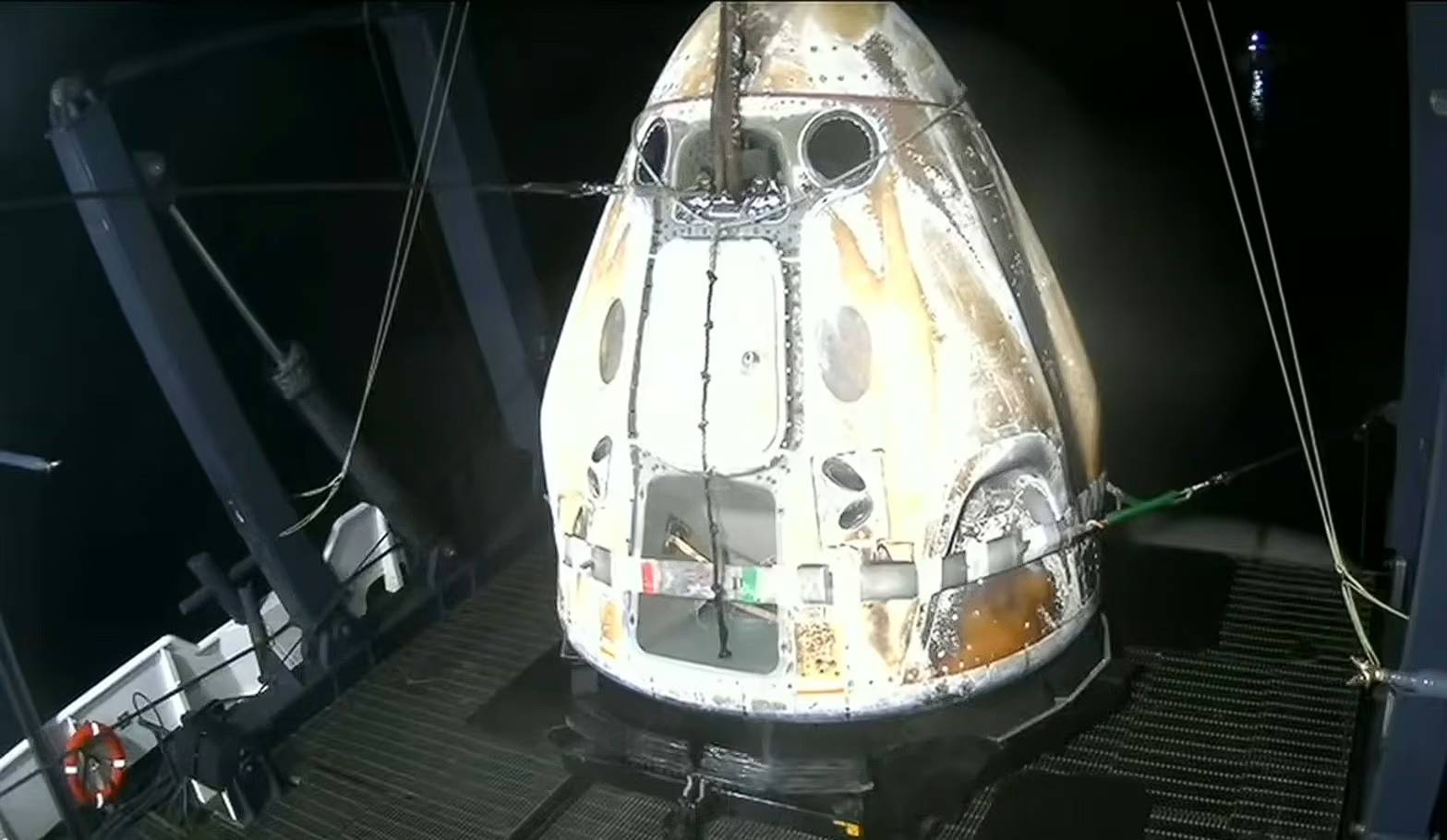
HOUSTON—NASA completed the unprecedented early return of International Space Station (ISS) astronauts when the SpaceX Crew-11 Dragon Endeavour capsule splashed down Jan. 15 in the Pacific Ocean off the San Diego coast.
The parachute-assisted splashdown occurred at 3:41 a.m. EST after the Endeavour capsule departed the ISS U.S. segment Harmony module at 5:20 p.m. EST Jan. 14. The capsule returned NASA astronauts Zena Cardman and Mike Fincke, the commander and pilot, as well as mission specialists Kimiya Yui, of the Japan Aerospace Exploration Agency, and Russian cosmonaut Oleg Platonov.
Splashdown capped a week-long series of events sparked by an undisclosed health concern involving one of the Crew-11 astronauts, who has not been identified. It prompted NASA on Jan. 8 to announce the early end to their mission.
Endeavour was greeted quickly by the SpaceX Shannon recovery vessel. Fastboat recovery personnel tethered the capsule allowing it to be hoisted onto the ship within 30 min.
After the hatch was opened, Finke, Cardman, Yui and Platonov exited the capsule under their own power, waved and were, as is standard procedure, placed on medical gurneys and escorted to onboard health checks. They completed the exit within 60 min. after splashdown.
The four, unusually, will then be transported to a local hospital ashore for further checks using medical equipment not on the ISS given the health issue affecting one of the crew. The four are then due to board a NASA aircraft for flight to Johnson Space Center in Houston, home to the agency’s astronaut corps and Mission Control.
The Crew-11 Dragon astronauts and cosmonaut launched and docked to the ISS over Aug. 1-2, 2025, for an anticipated six-month mission.
Crew-11’s departure leaves the ISS, which is normally staffed by seven astronauts and cosmonauts, in the hands of cosmonaut Sergey Kud-Sverchkov, who replaced Fincke as the Expedition 74 commander. NASA astronaut Chris Williams and cosmonaut Sergey Mikaev also remain onboard the orbital lab.
“What an adventure we had together,” Fincke remarked prior to the undocking. “We achieved our science goals. What I remember the most is the camaraderie we had across the planet.”
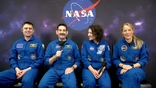
Originally, those onboard the Crew-11 Dragon were not to depart for Earth until Feb. 20, following a Feb. 15 launch of their four SpaceX Crew-12 Dragon replacements, arrival at the ISS and handover activities. NASA is trying to move up the launch of the Crew-12 Dragon with NASA astronauts Jessica Meir and Jack Hathaway, European Space Agency astronaut Sophie Adenot and cosmonaut Andrey Fedyaev.
A Feb. 8 launch is possible for Meir and Fedyaev, who will serve onboard the ISS for a second time, and first-time space explorers Hathaway and Adenot. All four have trained for a nine-month stay onboard the ISS.
The SpaceX Dragon and the three-person Russian Soyuz crew capsule, once docked to the ISS, serve as lifeboats before making their scheduled returns to Earth with their astronauts and cosmonauts. Should the ISS encounter an emergency or if any one of the crewmembers arriving onboard a Dragon or Soyuz encounter a concern, all who launched must return together.