This article is published in Aerospace Daily & Defense Report part of Aviation Week Intelligence Network (AWIN), and is complimentary through Feb 28, 2026. For information on becoming an AWIN Member to access more content like this, click here.

Debrief: The Legacy Of Challenger

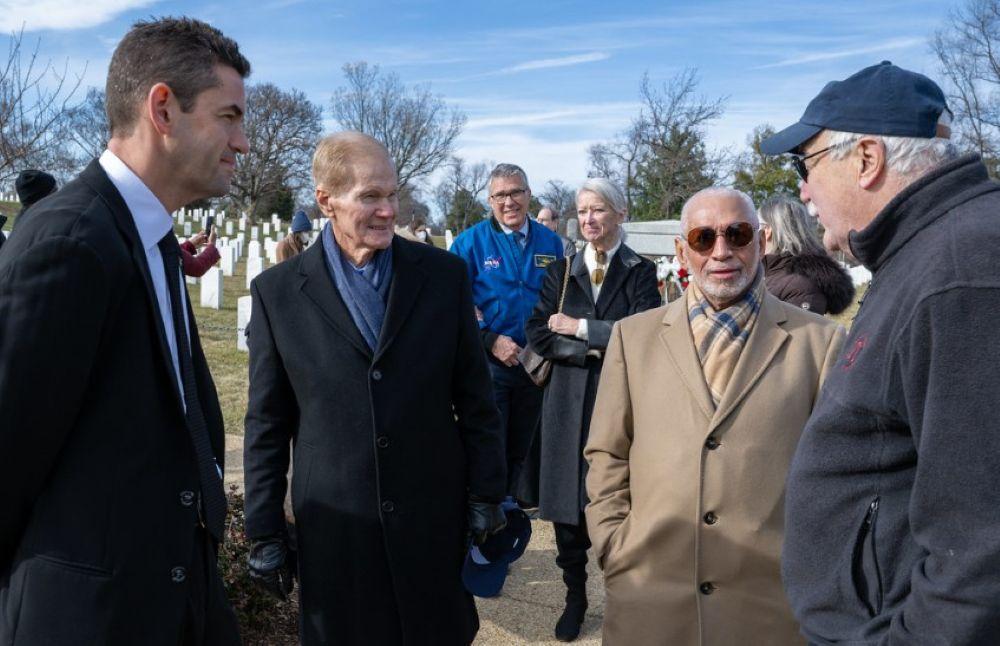
NASA Administrator Jared Isaacman, left, speaks with, second from left to right, former NASA Administrators Bill Nelson, Charles Bolden, and Sean O'Keefe following a wreath laying ceremony as part of NASA's Day of Remembrance, Thursday, Jan. 22, 2026,

NASA Administrator Jared Isaacman, left, speaks with, second from left to right, former NASA Administrators Bill Nelson, Charles Bolden, and Sean O'Keefe following a wreath laying ceremony as part of NASA's Day of Remembrance on Jan. 22.

Credit: NASA

The human spaceflight community becomes particularly sensitive this time of year, with three memorial dates on the calendar for NASA missions that ended in disasters.

Jan. 28 marked 40 years since the space shuttle Challenger broke apart over the Atlantic Ocean 73 sec. after liftoff from NASA’s Kennedy Space Center. NASA lost its innocence—and some hubris—as the results of the presidential-appointed Rogers Commission investigation reframed the operational environment and technical parameters in which the agency had been conducting the program.

Lost that fateful day were Commander Francis Richard Scobee, pilot Michael Smith, mission specialists Judith Resnik, Ronald McNair and Ellison Onizuka, payload specialist Gregory Bruce Jarvis, and teacher-in-space Christa McAuliffe, who was flying as part of a Science, Technology, Engineering and Mathematics outreach program.

“I was in the agency, working on the shuttle program when Challenger happened,” says Wayne Hale, a retired aerospace engineer whose 32-year career at NASA included roles as a flight director, shuttle program manager and deputy associate administrator.

“I watched all the Rogers Commission public meetings, and I read the report thoroughly and studied it. The lesson that I came away with—which I think was the prevalent view of most people in the agency at the time—is that we had one rogue manager who let ‘launch fever’ make a decision for him that he shouldn’t have.

“So the lesson we all learned was that we need to be on the lookout for someone who has launch fever and not let them make a really bad decision. Then we kind of went on our way,” he says.

NASA’s wake-up call came 17 years later when the shuttle Columbia broke apart during reentry on Feb. 1, 2003. Another investigation, this time led by retired U.S. Navy Adm. Harold Gehman, and another report followed. “I was at a more thoughtful place in my life and I learned that there were a lot of lessons that we should have learned from Challenger that we did not. We made very similar kinds of mistakes,” Hale notes.

“If you’re not really delving into understanding what happened, you might learn the wrong lessors, or at least an incomplete set of lessons,” he adds.

In her insightful book “The Challenger Launch Decision,” author and sociologist Diane Vaughn pinned the accident on what she termed “the normalization of deviance.” In the case of Challenger, NASA had allowed production compromises on the shuttle booster rocket’s O-rings, which led to a flawed decision-making process. A flawed O-ring allowed hot gases to escape from the shuttle’s right solid rocket booster, triggering an explosion.

Seven years after the book’s publication, the Columbia Accident Investigation Board (CAIB) determined a similarly flawed process led NASA managers to regard foam falling off the shuttle’s external fuel tank as primarily a refurbishment issue, not a flight risk.

Columbia’s left wing was damaged by a suitcase-sized piece of foam insulation that fell off the tank during the shuttle’s launch on Jan. 16, 2003. The orbiter was destroyed during reentry 16 days later, killing commander Rick Husband, co-pilot William McCool, mission specialists Michael Anderson, Kalpana Chawla, David Brown and Laurel Clark, and Israel’s Ilan Ramon.

“We need to pay attention to the weak signals, as the CAIB put it, and not browbeat the introverts who might have something to say into remaining silent,” Hale says.

Whether the painful lessons of the shuttle era will continue to resonate with the current generation remains to be seen.

Irene Klotz

Irene Klotz is Senior Space Editor for Aviation Week, based in Cape Canaveral. Before joining Aviation Week in 2017, Irene spent 25 years as a wire service reporter covering human and robotic spaceflight, commercial space, astronomy, science and technology for Reuters and United Press International.