This article is published in Aerospace Daily & Defense Report part of Aviation Week Intelligence Network (AWIN), and is complimentary through Sep 08, 2026. For information on becoming an AWIN Member to access more content like this, click here.
CAPE CANAVERAL—NASA opened a new chapter in the exploration of the structure and evolution of the universe with the launch of a new flagship observatory that also will test technology to directly image planets beyond the Solar System.
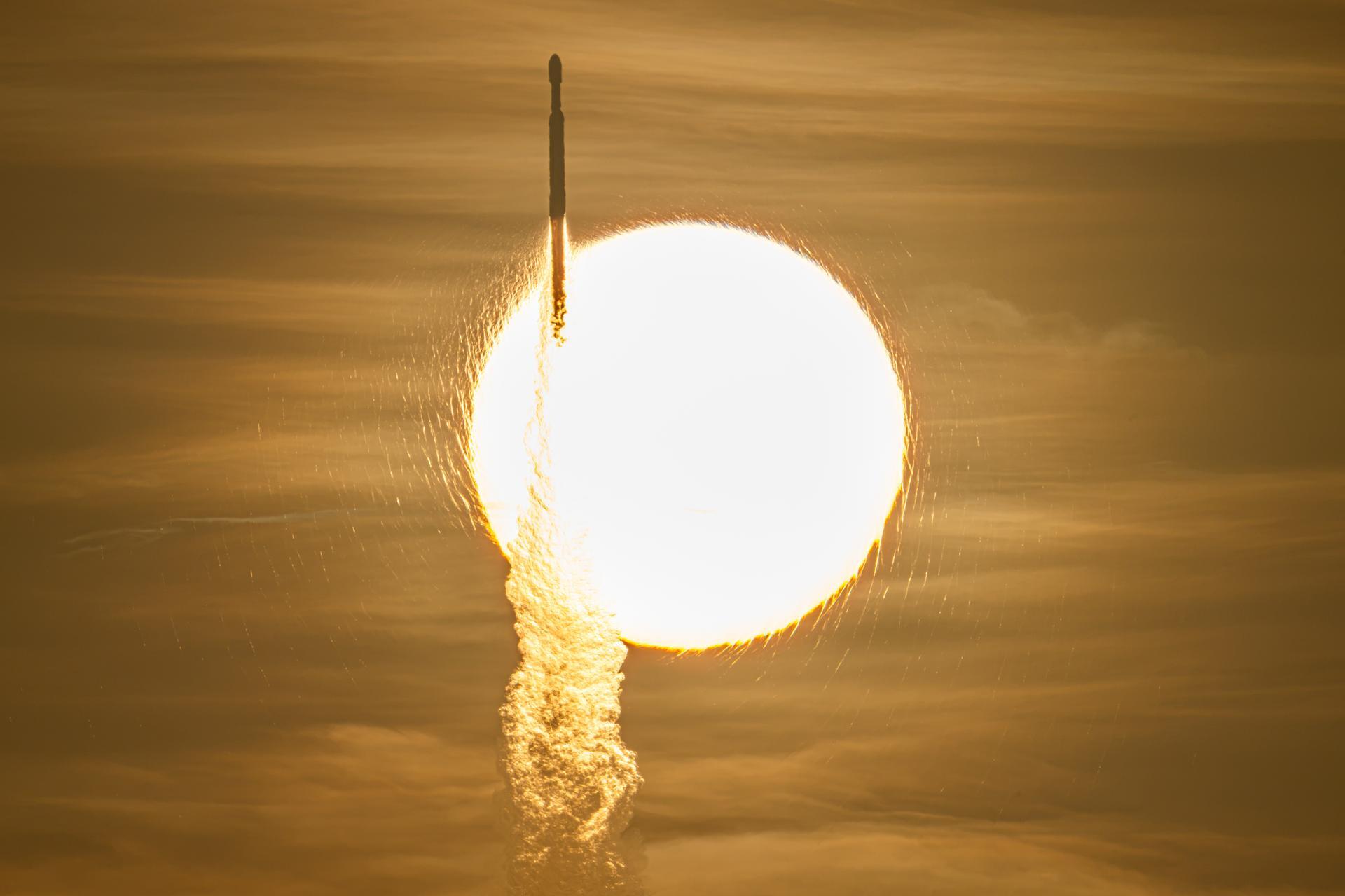
The Nancy Grace Roman Telescope, named for NASA’s first chief astronomer, lifted off aboard a SpaceX Falcon Heavy rocket at 7:26 a.m. EDT Aug. 30. The launch kicked off a three-month journey to an orbit around the second Sun-Earth Lagrange point (L2), a gravitationally stable region about 930,000 mi. away from Earth in the opposite direction from the Sun.
From that vantage point, the observatory will measure shapes, distances and positions of hundreds of millions of galaxies to determine how the structure of the universe has grown and expanded over cosmic time. “Roman is going to revolutionize the way we look at our universe,” said Nicola Fox, associate administrator for NASA's Science Mission Directorate.
The crux of the mission, slated to last at least five years, is to better understand the amount and distribution of dark matter—which emits no detectable electromagnetic radiation—and dark energy, a poorly understood repulsive force driving the expansion of the universe.
“It’s like you throw a ball in the air and instead of seeing it coming down, it goes rocketing away. It’s as surprising that the universe behaves like that,” said Julie McEnery, Roman telescope senior project scientist NASA’s Goddard Space Flight Center.
Current models of the universe account for this repulsive force as a constant property of space-time. “That model is exquisitely good at taking the early observations and accurately predicting what we should see now,” she said.
However, as scientists began measuring objects with greater precision, flaws in the standard model began to emerge. “The … expansion of the universe now is not quite consistent with what our models would have predicted,” McEnery said. “The structure is not quite what we predicted it should be, and then excitingly, there have been observations that have suggested that that dark energy—the cosmological constant—is in fact not a constant and that it is varying with time.
“That could mean that we have dynamical dark energy, that the properties of dark energy change as the universe expands. It could mean that our understanding of how gravity works on very large scales is in fact not well described by general relativity,” she added.
“What I'm sure of is that Roman's observations … will definitively say the [standard] model works or it doesn’t, and if doesn’t it going to provide us with the precision and quality of data that will allow us to start to distinguish between those options,” McEnery said.
Roman’s largest observation program, the High-Latitude Wide-Area Survey, will use imaging and spectroscopy to reveal about 1 billion galaxies existing throughout a wide swath of cosmic time covering 5,100 sq. degrees of sky.
A second study, the Time-Domain Survey, will make repeated observations of the same region that can be stitched together to reveal how objects and phenomena change over periods of times ranging from days to years. The movies to reveal about 100,000 exploding stars, black hole feeding regions and other dynamic events. One type of explosion, known as Type Ia supernovae, will serve as yardsticks to probe dark energy and trace the universe’s expansion rate, which has varied over time.
In a third study, Roman will focus on the heart of the Milky Way galaxy in search of regions where starlight is naturally enhanced by the gravitational fields of intervening transiting objects, relative to the telescope’s line of sight.
The so-called microlensing observations will be used to look for planets orbiting their host stars; free-flying orphan planets gravitationally untethered from parent stars; planet-like brown dwarf stars too small to maintain themselves by fusion; and stellar corpses, including neutron stars and white dwarfs.
Scientists also expect to find about 100,000 new exoplanets as they periodically eclipse the light of their host stars.
The Roman Space Telescope follows NASA’s Great Observatories program, which includes the still operational Hubble Space Telescope and Compton Gamma Ray Observatory—launched in 1990 and 1991, respectively—and the defunct Chandra X-ray Observatory and Spitzer Space Telescope, which observed in the infrared portion of the electromagnetic spectrum. Roman joins the James Webb Space Telescope, which operates at L2.
The heart of Roman is a 300-megapixel wide field camera that is expected to gather as much data in a month as Hubble could collect in a century. Roman has the same angular resolution as Hubble, but a field of view that is at least 100 times larger. A single full-resolution image from Roman would cover 45 city blocks.
The observatory is expected to gather data up to 1,000 times faster than Hubble, adding up to 20,000 terabytes, or 20 petabytes, over the course of its five-year primary mission. NASA plans to maintain Roman data in a publicly accessible cloud system and provide training tools for students, amateur astronomers and hobbyists to understand and use the images.
Roman also includes a next-generation coronograph included as a technology demonstration to directly image planets around distant stars. Using a system of optics, masks, self-flexing mirrors and sensors, the coronograph will block a star’s light so scientists can attempt to find the faint reflected light from orbiting planets and nearby dusty disks. The coronagraph demonstration is slated to run for 90 days sometime during the telescope’s first 18 months of operation.