This article is published in Aerospace Daily & Defense Report part of Aviation Week Intelligence Network (AWIN), and is complimentary through May 01, 2026. For information on becoming an AWIN Member to access more content like this, click here.

Artemis II Lifts Off, Aiming For Lunar Flyby

Credit: Irene Klotz/AWST

CAPE CANAVERAL—After decades of development and false starts, NASA on April 1 launched the first crew in more than 50 years on a mission to leave Earth orbit and travel to the vicinity of the Moon.

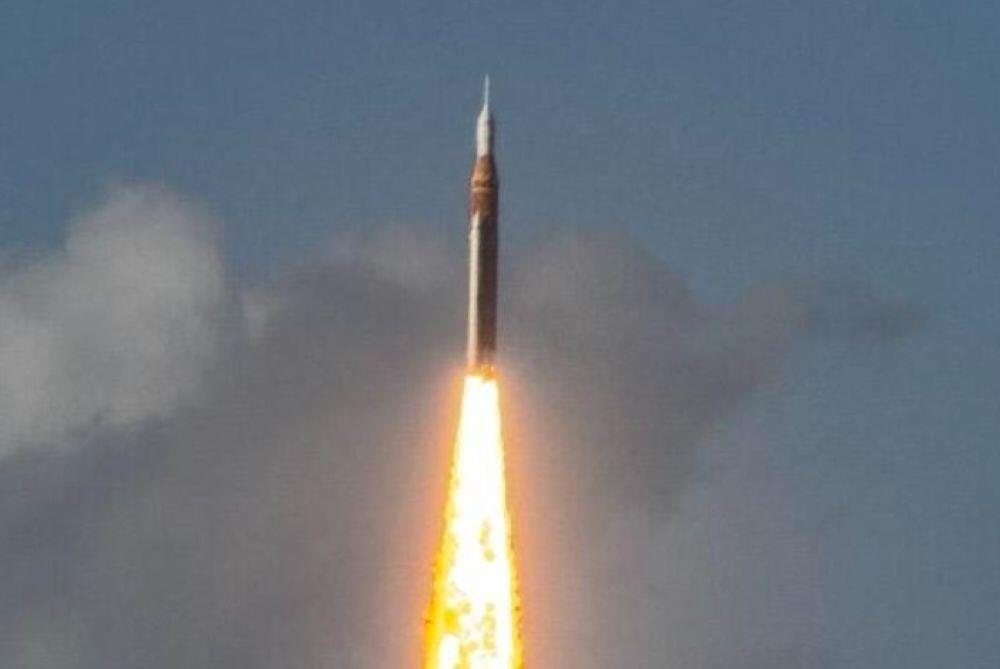
The agency’s Space Launch System (SLS) rocket—flying for just the second time—lifted off at 6:35 p.m. EDT from Kennedy Space Center Launch Complex 39B, kicking off a planned series of flights in the newly revamped Artemis lunar exploration initiative.

Strapped inside the Orion spacecraft atop the SLS were veteran NASA astronauts Reid Wiseman, Victor Glover and Christina Koch, and rookie flyer Jeremy Hansen, with the Canadian Space Agency.

“We really are going for all, by all,” Wiseman, the mission commander, told reporters before launch. “We want to take the whole world along with us.”

The primary goal of the mission, known as Artemis II, is to check out the Orion spacecraft’s environmental control and life support system, avionics and other equipment, and to validate the performance of ground and flight systems needed for a long-term lunar campaign, including emergency operations and procedures.

In development for 20 years, Orion made an uncrewed, 25-day flight test in late 2022 that included an orbit around the Moon. Unexpected wear on its heat shield delayed the follow-on Artemis II crewed flight for a year while assessments and testing were underway. The shield is being modified for future flights, but for Artemis II NASA changed Orion’s return flight profile based on new understanding of atmospheric reentry aerodynamics and the chemical properties of Orion’s ablative heat shield.

Orion, built by Lockheed Martin, is designed to support a crew of four for 21 days.

NASA had hoped to launch Artemis II earlier this year, but technical issues with the SLS prompted a return to the Vehicle Assembly Building to address a problem with the helium system used to pressurize and purge the SLS upper stage. The work was completed in half the time it took to address a similar issue ahead of the Artemis I launch in November 2022.

Since the Artemis II stack returned to the launchpad on March 20, preparations for flight have proceeded smoothly, setting the stage for the 49 hr. 40 min. Artemis II countdown to begin 10 days later.

Fueling of the SLS with more than 750,000 gal. of liquid hydrogen and liquid oxygen began early April 1, with no leaks or issues reported, leaving the weather as a potential concern for launch.

About 2 hr. before the opening of the launch window at 6:24 p.m., the U.S. Space Force, which supports the launch with range safety, tracking and other services, reported a communications issue with the SLS Flight Termination System (FTS), which would be used to detonate the rocket should it stray off course during ascent. The SLS includes a Launch Abort System (LAS) that would fly the crew’s Orion capsule away from a failing booster for a splashdown in the Atlantic Ocean.

The FTS communications issue was resolved, but an unrelated issue with one of two batteries aboard the LAS set off another round of troubleshooting. That issue also was resolved, and with the weather stable, the launch team proceeded into the final 10 min. of the countdown.

Powered by four Aerojet Rocketdyne RS-25 engines—repurposed from the space shuttle program—and a pair of solid rocket boosters, made by Northrop Grumman, the SLS lifted off with nearly 9 million lb. of thrust to begin the planned nine-day, 1-hr. Artemis II flight test.

Eight minutes after liftoff, the SLS core stage, built by Boeing, separated, leaving the upper stage and Orion flying at nearly 5 mi. per sec. about 100 mi. above Earth. The rocket’s Interim Cryogenic Propulsion Stage (ICPS) was then to conduct two orbit-adjustment burns to place Orion in a high Earth orbit ranging from 115-43,730 mi. above the planet.

The ICPS, built by United Launch Alliance, is expected to separate 3 hr. 23 min. after launch. The Artemis II crew plans to use the discarded upper stage as target practice for a 70-min. piloted flight demonstration, the first of two scheduled during the mission.

The manual flying exercise is a practice run for a newly added mission in the Artemis flight test series. Slated for mid-2027, another crewed Orion spacecraft will attempt to rendezvous and dock with one or both of the Human Landing Systems in development by SpaceX and Blue Origin. The redesignated Artemis III mission, which will unfold in low Earth orbit, builds skills for a crewed lunar landing attempt on Artemis IV in early 2028.

Orion is expected to remain in Earth orbit for 25 hr. while the crew exercises and uses the spacecraft’s galley, toilet and other systems as part of the spacecraft checkout. If the equipment is operating as planned, NASA will proceed with the next phase of the mission and send Orion on toward the Moon with a 6-min. burn of the spacecraft’s service module, provided by the European Space Agency. The so-called translunar injection burn would put Orion on a trajectory that would reach as far as 4,700 mi. past the Moon, setting a new distance record for a human spaceflight.

The burn also positions Orion to return to Earth on April 10, with splashdown in the Pacific Ocean off the coast of San Diego about 8:20 p.m. EDT on a free-return trajectory that uses the gravitational forces of the Earth and the Moon.

Artemis II marks the first human spaceflight beyond Earth orbit since the final Apollo mission to the Moon in 1972.

Irene Klotz

Irene Klotz is Senior Space Editor for Aviation Week, based in Cape Canaveral. Before joining Aviation Week in 2017, Irene spent 25 years as a wire service reporter covering human and robotic spaceflight, commercial space, astronomy, science and technology for Reuters and United Press International.