This article is published in Aviation Week & Space Technology and is free to read until Aug 09, 2026. If you want to read more articles from this publication, please click the link to subscribe.

Startup Aims To Catch A Falling Space Telescope

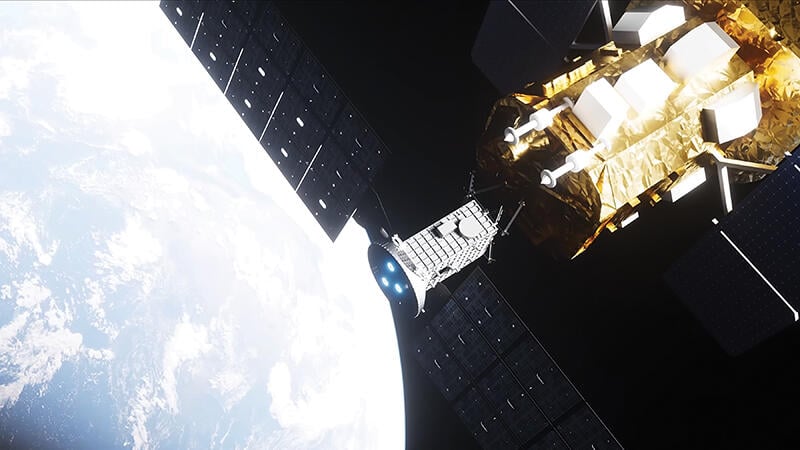
Katalyst Space LINK robotic spacecraft rendering

Katalyst’s LINK spacecraft will conduct a survey of NASA’s Swift telescope before attempting to dock.

Credit: Katalyst Space/NASA Concept

Four years ago, entrepreneur and private astronaut Jared Isaacman proposed a mission to NASA: Reboost the Hubble Space Telescope using a SpaceX Crew Dragon spacecraft. Ultimately, the agency passed on the offer to avoid the risk of damaging the aging but highly productive observatory but kept the door open for future consideration.

Without periodic reboosts, Hubble—like all spacecraft in low Earth orbit—loses altitude over time due to atmospheric drag, as residual gases from the upper atmosphere collide with orbiting satellites, slowing them down. NASA dispatched space shuttles five times in 1993-2009 to service and reboost Hubble. Other spacecraft use onboard thrusters or maneuvering engines to counter atmospheric drag.

  • LINK spacecraft was launched onboard a Pegasus rocket
  • Without reboost, Swift is expected to deorbit this fall

Hubble, currently orbiting about 298 mi. above Earth, is not in imminent danger of reentering the atmosphere, but another space telescope, the Neil Gehrels Swift Observatory, is not as fortunate. Without intervention, Swift is expected to fall out of orbit as early as October.

A novel space mission to prevent that launched on July 3. If successful, the demonstration would not only return the productive gamma-ray hunting Swift to service but pave the way for future satellite rescue missions, including possibly Hubble.

Swift’s potential savior is startup Katalyst Space Technologies’ Lightweight In-space Navigation and Kinematics (LINK) spacecraft, which launched onboard a Northrop Grumman Pegasus XL rocket on July 3. The mission was expected to be the final flight of the air-launched Pegasus, which was developed by Orbital Sciences and first flew in 1990.

With the clock ticking, Katalyst selected the Pegasus launch service to position LINK optimally for its travels to Swift. “It’s the only launch vehicle that can meet the orbit, the schedule and the cost to achieve something unprecedented with emerging technology,” Katalyst CEO Ghonhee Lee said in a November 2025 press release announcing the contract.

Following takeoff of the Northrop Stargazer L-1011 carrier jet from the Kwajalein Atoll in the Marshall Islands, the three-stage, solid-fuel Pegasus placed LINK into a 225-244-mi.-high orbit inclined 20.6 deg. relative to the equator.

Katalyst, which is conducting its first space mission, planned to spend 2-3 weeks post-launch evaluating LINK’s sensor, navigation, propulsion and other systems before beginning the monthlong journey to Swift.

Katalyst Space LINK being integrated into a Northrop Grumman Pegasus XL rocket
Katalyst’s LINK robotic servicing satellite awaited encapsulation into a Northrop Grumman Pegasus XL in June ahead of the rocket’s launch on July 3 from Kwajalein Atoll. Credit: Ron Beard/NASA

Launched on a Boeing Delta II rocket in November 2004, Swift has been detecting gamma ray bursts and monitoring their afterglows in X-ray and ultraviolet/visible light. Although it lacks the resolving power of larger observatories, Swift—as its name implies—can detect bursts in 1-2 min. versus 1-2 days for the Hubble Space Telescope. Swift has fallen from its original 370-mi.-high perch to about 226 mi.

NASA suspended Swift science operations in February to reduce drag and slow the spacecraft’s orbital decay, buying time for the rescue mission. The agency expects Swift to remain at an altitude high enough for Katalyst to attempt the reboost until around October, when it could fall below 186 mi.

Unlike Hubble, Swift was not designed with grapple fixtures, docking ports or other hardware for servicing. Katalyst’s solution is a three-arm robotic capture mechanism that will use its lidar system to attach to telescopes’ primary structures without damaging its delicate science instruments. Once attached, LINK would then fire thrusters to begin boosting its altitude. The goal is to return Swift to close to its original orbit.

“We hope the result is another 10-20 years of observation and discovery,” John Nousek, Swift’s director of mission operations at Pennsylvania State University, said in an interview posted on the university’s website.

Flagstaff, Arizona-based Katalyst hopes saving Swift will open the door for future LINK missions. The company plans to follow the Swift reboost mission with a demonstration in geostationary orbit next summer. Ultimately, Katalyst is aiming to operate a fleet of LINK spacecraft.

NASA is paying Katalyst $30 million for this mission. The company declined to disclose details of any upcoming or pending contracts for additional LINK in-space services but noted in a press release that it is leveraging the Swift mission to showcase tactically responsive and sustained space maneuvering capabilities for the U.S. Defense Department.

“There’s lots of interest in the space industry right now,” Robert Lamontagne, Katalyst’s vice president of strategic partnerships, said during a June 17 prelaunch press conference. “People want to debate the merits of these technologies, but at the end of the day, robotic servicing is an enabler for all of the other things that humanity wants to do in space.”

Irene Klotz

Irene Klotz is Senior Space Editor for Aviation Week, based in Cape Canaveral. Before joining Aviation Week in 2017, Irene spent 25 years as a wire service reporter covering human and robotic spaceflight, commercial space, astronomy, science and technology for Reuters and United Press International.