This article is published in Aerospace Daily & Defense Report part of Aviation Week Intelligence Network (AWIN), and is complimentary through Jun 10, 2026. For information on becoming an AWIN Member to access more content like this, click here.
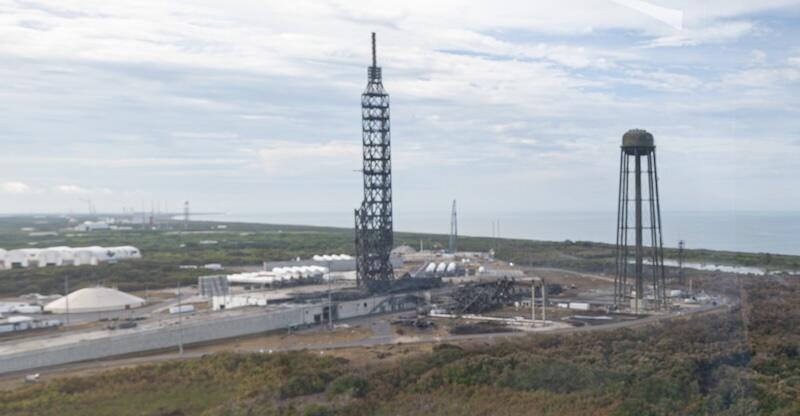
Space Launch Complex 36.
Despite extensive damage from the explosion of a Blue Origin New Glenn rocket on its launchpad, the company is aiming to return to flight before the end of 2026.
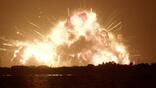
The blast at Cape Canaveral SFS occurred at 9 p.m. EDT May 28 at the start of what was expected to be a routine, preflight static firing of the New Glenn first stage. Blue Origin has not yet said what it believes caused the hot-fire to end so badly, with the New Glenn first and second stages destroyed and extensive damage to the company’s sole New Glenn launch complex, including the transporter-erector (TE) that was used to haul the rocket out of its processing hangar horizontally and hoist it vertically for launch.
The company said late June 1 it will not replace the TE. Instead, Blue Origin plans to implement a previously planned alternative operations concept that bypasses a TE in favor of keeping the rocket vertical throughout most of its processing, integration and launch preparation—similar to how United Launch Alliance (ULA) processes Vulcan rockets and SpaceX prepares the Starship-Super Heavy for flight. “We’ll now go directly to that, so we don’t need a new transporter-erector,” CEO Dave Limp wrote in an update late June 1 that was posted on social media.
The blast at Space Launch Complex 36 (SLC-36) spared the propellant farm, with oxygen, liquid hydrogen and liquified natural gas tanks in good shape, Limp added. “This is good luck because these are very long-lead items. The water tower is also good. The big support tower is damaged, but it can be repaired in place rather than torn down and replaced.”
Limp did not address the condition of the onsite integration hangar itself but noted that a first-stage New Glenn booster and three upper stages which were in the hangar at the time of the explosion “look good.” Manufacturing of additional vehicles will continue at its current pace and the stages will be stored until needed, Limp added.
“We will fly again before the end of this year,” he wrote.
Blue Origin’s response to the accident drew praise from NASA Administrator Jared Isaacman, who toured the facility and addressed the workforce, along with Limp and Blue Origin founder and financier Jeff Bezos, on May 29.
“Blue Origin leadership has responded incredibly quickly, and NASA will do all we can to help with root cause analysis and accelerate pad recovery timeframes,” Isaacman wrote on X late June 1.
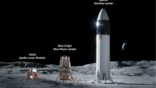
Blue Origin is a primary contributor to NASA’s Artemis lunar exploration program.
In a related post, SpaceX’s Kiko Dontchev, vice president of launch, noted that a launchpad cleanup “can be one of the more challenging parts of the entire project. In the initial days and weeks, you’re using a scalpel, not a bulldozer,” he wrote.
SpaceX’s Space Launch Complex 40 was heavily damaged during a failed static fire of a Falcon 9 rocket in September 2016. The pad was out of commission for 15.5 months, though the company, unlike Blue Origin, had alternative launch sites.
“You have to first study and then precisely engineer the [demolition] as there are many unknowns with the state of the infrastructure. You also want to do your best to save the [ground support equipment] that is still good.
“A miss on a piece of steel mass [center of gravity] or unknown trapped pressure can quickly turn disastrous,” Dontchev added. “The last thing you want to do is make a tough situation worse by getting someone hurt or worse. Cleanup has to be done with a sense of urgency, but extreme precision. It’s literally launchpad surgery.”
Blue Origin was preparing for its fourth flight of New Glenn, targeted for early June. The mission was to be the first of 24 for Amazon—its biggest customer—which hired Blue Origin, along with ULA, Arianespace and SpaceX, to deliver a planned 3,200-member broadband constellation into low Earth orbit. The 48 Amazon Leo satellites assigned to fly on New Glenn-4 were not onboard the rocket during the hot-fire. Another batch of 29 Amazon Leo satellites lifted off May 29 onboard a ULA Atlas V rocket.

Related Content