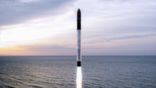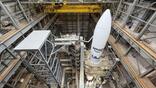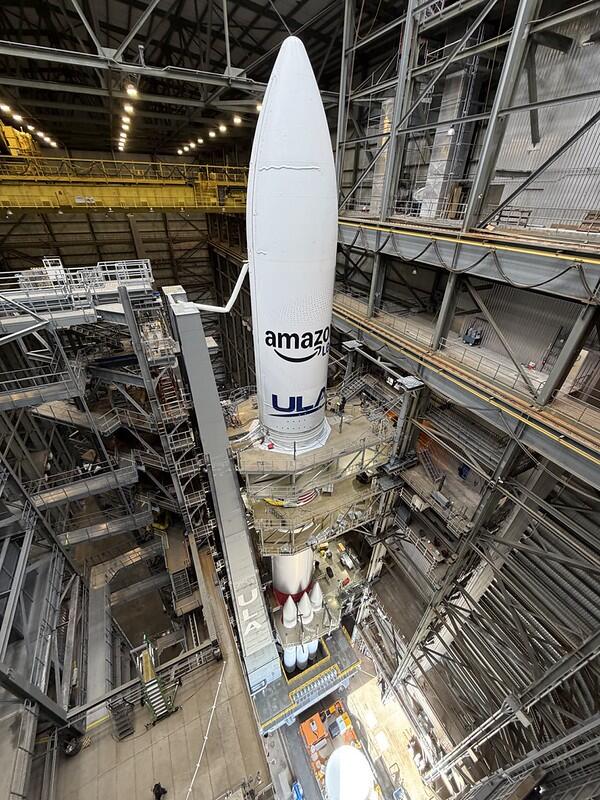
The Amazon Leo mission payload is attached atop a Vulcan rocket in the new Amazon Vertical Integration Facility at Cape Canaveral SFS in preparation for launch Nov. 13.
United Launch Alliance (ULA) is preparing for its first Vulcan rocket launch in nine months, a critical mission intended to not only deliver a batch of Amazon Leo broadband satellites into orbit, but also to demonstrate that design changes to the nozzles of the vehicle’s solid rocket boosters have addressed the failures that marred two of Vulcan’s four flights.
Vulcan’s fifth flight is scheduled to lift off at 12:54 p.m. EST Nov. 13 from Cape Canaveral SFS Space Launch Complex-41. The mission is the first of 38 on Vulcan’s manifest for Amazon, which is in the early phases of building a 3,236-member broadband satellite network in low Earth orbit. So far, about 12% of the constellation has been deployed over 14 launches, including eight by ULA’s Atlas V boosters, which are no longer in production.
If the upcoming Vulcan launch is successful, another 40 satellites are expected to join the Amazon constellation. Meanwhile, Vulcan missions for the U.S. Space Force remain on hold, pending the results of the vehicle’s performance during the Vulcan Leo 1 launch, and possible additional nozzle design tweaks, ULA CEO Mark Peller said Nov. 5 in an interview with Aviation Week.
Vulcan last flew on Feb. 12 on the USSF-87 mission for the Space Force. The launch was successful despite a malfunction of one of the rocket’s four GEM 63XL solid rocket boosters (SRB), built by Northrop Grumman, that occurred about 20 sec. after liftoff. A similar incident occurred during Vulcan’s second mission on Oct. 4, 2024.
Working with Northrop Grumman, the Space Force and other government agencies, ULA conducted what Peller termed a “very thorough investigation” that included testing and analysis of materials, components and a full-scale hot fire of a GEM 63XL.
The company also incorporated modifications to the Blue Origin-provided BE-4 main engines that power Vulcan’s first stage after a BE-4 on a Blue Origin New Glenn rocket exploded on its launchpad during a May 28 prelaunch static fire test. That problem was traced to a main oxidizer valve.
“That BE-4 engine and main oxidizer valve are common to the BE-4s we fly on Vulcan,” Peller said. “They did develop a design improvement to that valve to mitigate that issue. We already had 15 shipsets of BE-4 engines [30 engines] in our inventory—most of those installed on rockets—and so they developed a retrofit kit, tooling and procedures, and then qualified those processes and qualified that design change very rigorously through hot fire testing.
“They were down at our facilities probably a couple months ago and implemented that retrofit kit on the engines on this upcoming mission,” Peller said. “And they're working with us to work through our inventory of engines on vehicles” at the Cape and in the production flow at ULA’s manufacturing facility in Decatur, Alabama.
The fix for the SRB anomaly was more complicated and time-consuming. The first failure was traced to a workmanship issue on a component deep inside the nozzle—Peller declined to release details—that appeared to be resolved by the boosters’ successful performance during Vulcan’s third mission in August 2025.
Six months later, however, the SRB booster issue resurfaced, prompting a new investigation, this time with the benefit of recovered debris for analysis. "That really helped accelerate our learning," Peller said.
“We have a much better understanding of the behavior of the nozzle and the vulnerabilities the previous design had,” he added. “We’ve identified three credible causes, an we have taken positive steps to mitigate all of those.”
The SRB investigation remains ongoing. “There are some other things we are interested in working that could provide increased confidence in those causes, and we have some other potential improvements on the back burner, which depending on the results of that investigation, we could roll in for future flights to further improve the robustness of the nozzle and our confidence in it,” Peller said.
“What we do here is not without risk,” he added. “We work very hard to simulate the environments of flight through either analysis or testing, but there are always limitations. Just like we learned through the first four missions of Vulcan, various aspects of how that system performed and how the SRB performed, we are looking at this as a learning opportunity to further advance our understanding of how the nozzle performs and how effective this corrective action was.”
ULA returns to flight with a second launch-processing capability at the Cape, roughly 15 rockets in its inventory, and a backlog of more than 70 missions, filling Vulcan’s calendar through the end of the decade.
Peller hopes to follow the Amazon Leo 1 mission with another Vulcan launch this year, then ramp up toward a twice-a-month tempo—a pace expected to be dictated by Northrop Grumman's production of new nozzles through April.
ULA is aiming to introduce Vulcan launch services from Vandenberg SFB in California in the first quarter of 2027.

Related Content