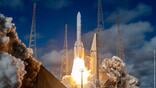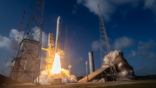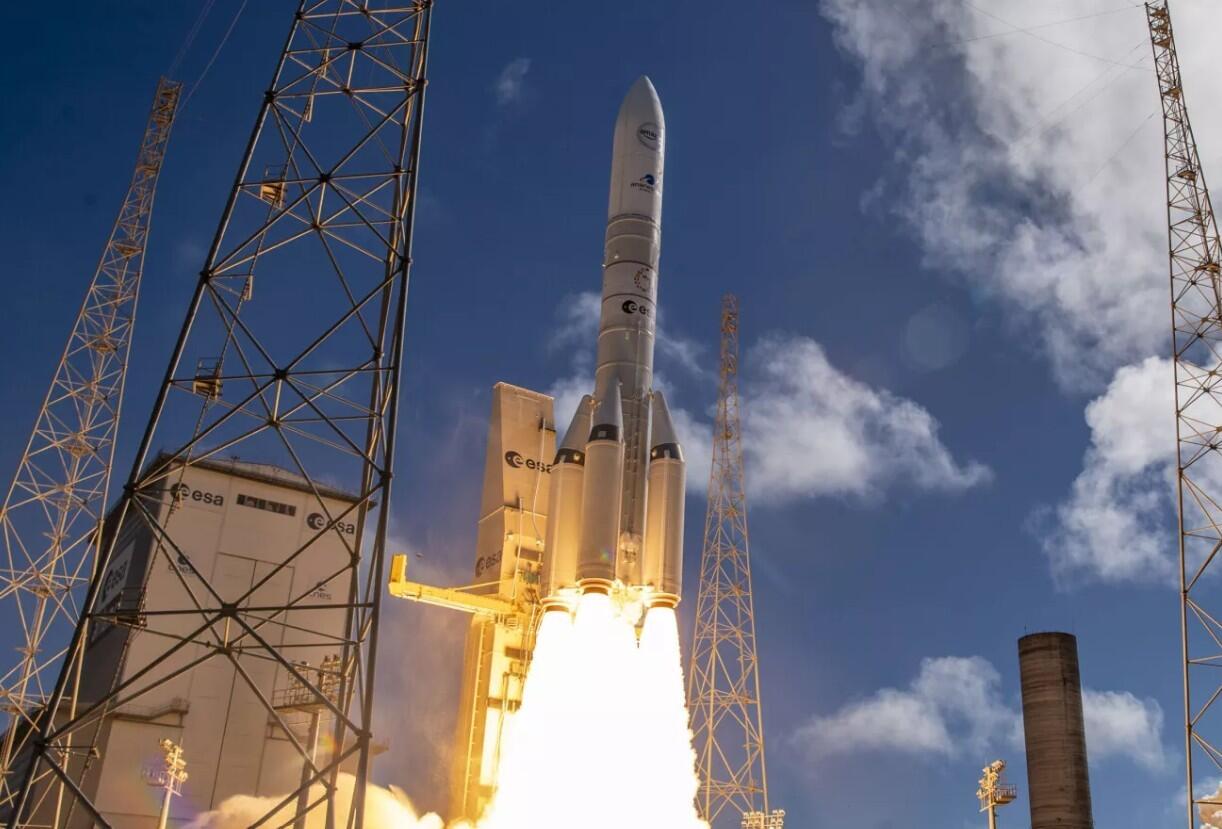
Arianespace has completed the first Ariane 6 mission using the more powerful P160C boosters that enabled the company to deliver 36 Amazon Leo satellite to low Earth orbit (LEO).
The satellites flew on an Ariane 64 featuring four of the boosters rather than the P120C used on the rocket’s first few missions. The launcher carried four more satellites than in the previous deployment for Amazon with the VA269 mission, marking the largest payload an Ariane has ever delivered to orbit.
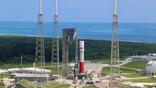
The Ariane 64 launched at 9:21 a.m. local time on June 17 from the European spaceport at Kourou, French Guiana, and deployed its satellites 1 hr. 51 min. later. It was the third of 18 booked Arianespace missions for Amazon.
The launch takes Amazon’s constellation of LEO communication satellites to more than 360. The company’s plans to deploy the Amazon Leo constellation have been held back by a lack of launch capacity. The U.S. Federal Communications Commission this month granted Amazon a limited, conditional waiver of its requirement to meet a 50% deployment milestone for the broadband-internet constellation. The company plans an initial network of 3,232 satellites.
Amazon has been using a variety of launchers, including the United Launch Alliance Vulcan and Blue Origin’s New Glenn. Both have encountered problems that have stalled launches, causing the company to consider changes to its deployment plans to avoid losing time.
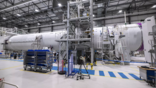
Avio’s P160C, which is about 3.3 ft. longer than the P120, will also power the Italian company’s Vega-C rockets. The new booster has 14 metric tons more propellant, bringing the Ariane 64’s payload potential to about 22 metric tons to LEO.

Related Content