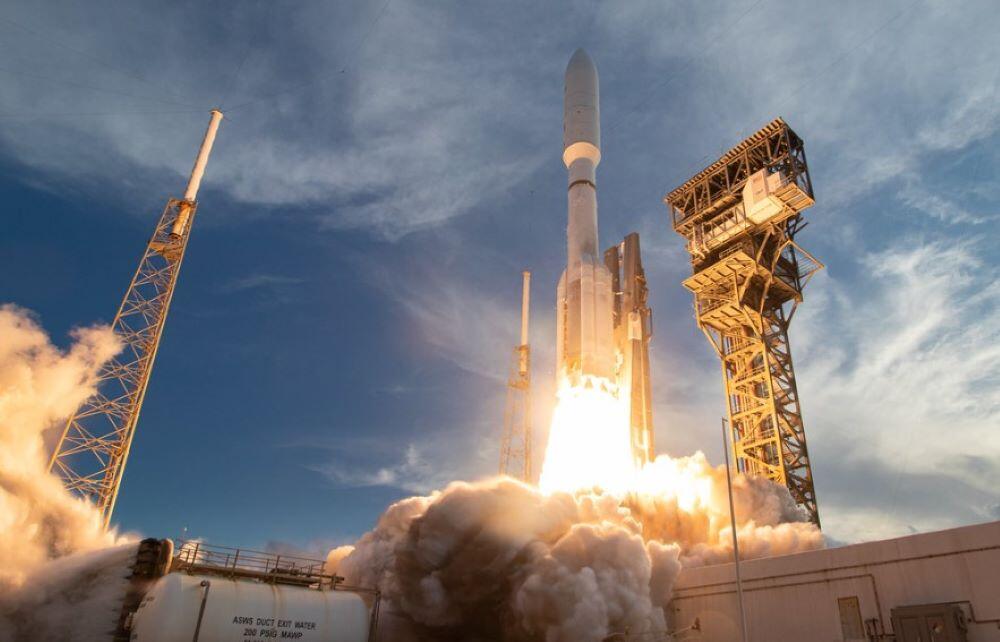
With the launch of an Atlas V on April 28, United Launch Alliance began deployment of Amazon's Kuiper broadband satellite network.
As a shipper, Amazon knows firsthand the challenges of timely and on-budget delivery services. So it was with great anticipation and not a little relief that its initial clutch of Kuiper satellites reached orbit April 28, kicking off what could be the mega-retailer’s next Kindle-class product: global broadband service.
The devices side of Amazon is gearing up to produce millions of antennae for consumers, businesses and government agencies interested in buying high-speed, low-latency global internet connectivity via satellites in low Earth orbit (LEO.)
SpaceX owns the largest LEO broadband constellation, with nearly 6,600 Starlink spacecraft in operational orbits—out of 8,417 launched as of April 30, logs published by astronomer and longtime satellite tracker Jonathan McDowell, editor of Jonathan’s Space Report, show.
The company has FCC authorization to operate up to 12,000 Starlink satellites, and it has requested to launch an additional 30,000.
Amazon will be competing not only against SpaceX, but also OneWeb, a 654-member LEO network owned by Paris-based Eutelsat Group. Eutelsat also operates a fleet of 34 geostationary satellites.
Between October 2023 and April 2024, Amazon flight tested a pair of Kuiper prototypes, setting the stage for launch of its first 27 operational birds aboard a United Launch Alliance (ULA) Atlas V, which lifted off from Cape Canaveral SFS at 7:01 p.m. EDT April 28. Perched on top of the rocket were the first members of Amazon’s planned 3,232-member Kuiper constellation.
Assisted by five Northrop Grumman GEM 63 solid rocket boosters, the Atlas V headed northeast out over the Atlantic Ocean, aiming toward a near-circular orbit 280 mi. above Earth and inclined 51.9 deg. relative to the equator.
The core stage, powered by a single Russian-made RD-180 engine, burned out 4 min. 23 sec. after liftoff and separated, leaving the Centaur upper stage to finish delivering what ULA says was the heaviest payload every launched on an Atlas V.
Following a single 13-min. 35-sec. burn of the Centaur’s Aerojet Rocketdyne RL10A-4-2 engine, the satellites were deployed into a 283- by 285-mi. orbit.
Amazon flight control centers established contact with all 27 satellites, the company reported early April 29. “Initial deployment and activation sequences are proceeding as planned,” Amazon wrote on social media. “Thanks to ULA for a successful launch—the first of many missions together.”
“Welcome to space,” replied ULA President and CEO Tory Bruno. “Proud to have been your Amazon driver.”
Kuiper Atlas 1 (KA-01) was the first of 77 launches that Amazon purchased from ULA, Arianespace and Blue Origin—plus three from SpaceX—to deliver its network into orbit. The bulk of the flights went to ULA, which plans seven more launches on Atlas V rockets, a heritage system that is being retired, and 38 missions on its new Vulcan booster.
“We’ve done extensive testing on the ground to prepare for this first mission, but there are some things you can only learn in flight,” Rajeev Badyal, vice president of Project Kuiper, said in a statement. “No matter how the mission unfolds, this is just the start of our journey.”

Related Content