This article is published in Aviation Week & Space Technology and is free to read until Mar 14, 2026. If you want to read more articles from this publication, please click the link to subscribe.

SpaceX Makes Big Bet On AI For Space

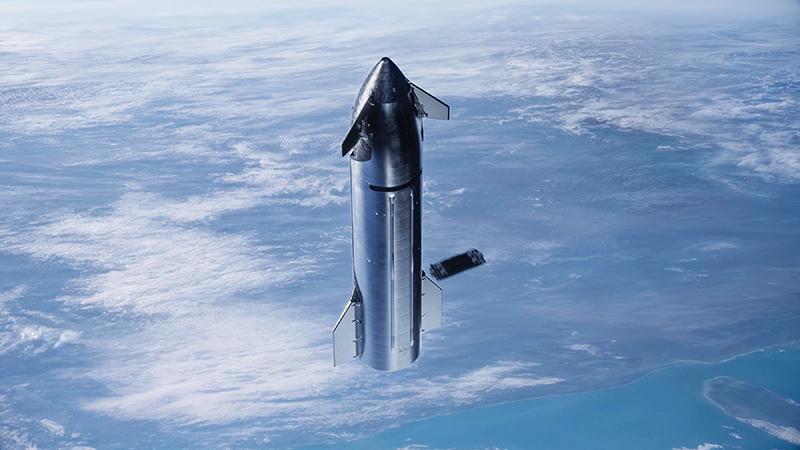
SpaceX Starship rocket

SpaceX plans to rely on its Starship rocket to deploy the constellation of data-center satellites.

Credit: SpaceX

SpaceX is going all in on artificial intelligence, combining two of the hottest investor topics as the space company prepares for its initial public offering.

Elon Musk’s spacecraft business may have made its name as the premier launch service provider, but it is now looking to demonstrate that it is so much more before undertaking what could be the most expensive initial public offering (IPO) this year—and certainly the largest ever for an aerospace company.

Since CEO Musk suggested on social media in December that a public listing was in the offing, SpaceX has received the go-ahead to expand its Starlink broadband constellation vastly. In January, the company said it is getting into the space traffic management business and plans to deploy a huge network of data-center satellites in low Earth orbit (LEO). To top it off, Musk has now combined investor hunger for space and artificial intelligence (AI), disclosing Feb. 2 that SpaceX has acquired his xAI business.

  • SpaceX makes a big bet on AI for space
  • An IPO will bring more investor scrutiny to SpaceX
  • A Maneuvering spacecraft menaced a Starlink satellite

The IPO plan reflects a shift in Musk’s thinking about the future of the company. Although he had said more than a decade ago that SpaceX would list at some point, he more recently signaled the Starlink communications business would go public first and separate from the space transportation operation. Musk has indicated in the past a reluctance to expose SpaceX to the vagaries of the public market while the company still pursues the goal to reach Mars.

Going public is likely to boost the personal wealth of Musk, who is already the world’s richest person. But it also comes with risks. At Tesla, he has bristled at the quarterly analyst scrutiny that public companies receive, and he has been at war with short sellers that probably will circle SpaceX as well.

SpaceX’s eventual stock pricing will likely surpass typical valuation criteria based on earnings multiples, said Chris Quilty, president of research consultancy Quilty Space. “Investors will always give SpaceX credit for the X factor,” he noted.

Timing for the listing is somewhat inauspicious, since China is ramping up its launch and satellite ambitions now. Chinese company BYD displaced Tesla as the world’s best-selling electric-vehicle-maker last year, showing that competitive threats loom.

SpaceX would likely use the IPO to raise tens of billions of dollars to help finance industrial expansion of its Starship program and its effort to put data centers in space. The competition for deploying space-based data centers is heating up. Google parent Alphabet last year mapped out a plan to deploy its first test satellites within two years.

SpaceX stated in a Jan. 30 regulatory filing that it would deploy as many as 1 million satellites into LEO as part of its project. The actual constellation would likely be much smaller. The satellites would operate at altitudes of 500 km (310 mi.) and 2,000 km, the company said. The spacecraft would come in different versions for best performance depending on the orbital shells.

SpaceX Starlink broadband constellation
The Federal Communications Commission has cleared SpaceX to expand its Starlink broadband constellation. Credit: SpaceX

The move comes as growing use of AI has companies looking for better ways to provide processing power, since current methods require massive energy and cooling needs.

Musk has long been focused on AI and its potential. He backed OpenAI a decade ago, before leaving the company amid a rift with its management. He founded xAI in 2023 in part to take on OpenAI and others, such as Microsoft.

SpaceX did not disclose what it paid for xAI. The deal, Musk wrote in a blog post, is intended to create “the most ambitious, vertically integrated innovation engine on (and off) Earth, with AI, rockets, space-based internet, direct-to-mobile device communications” and more.

“By directly harnessing near-constant solar power with little operating or maintenance costs, these satellites will achieve transformative cost and energy efficiency while significantly reducing the environmental impact associated with terrestrial data centers,” SpaceX stated in the regulatory filing. “Orbital data centers are the most efficient way to meet the accelerating demand for AI computing power.”

Musk added in the blog post that he estimates AI computations from space will be cheaper than through terrestrial data centers within 2-3 years.

The deployment request that still needs approval came only a few days after the U.S. Federal Communications Commission gave SpaceX the green light to deploy and operate 7,500 more Starlink Gen2 satellites. That will allow SpaceX to operate a constellation of 15,000 Starlink satellites, the regulator said in a Jan. 9 statement.

The company has said it plans to begin deploying third-generation Starlink satellites this year to deliver more than 1,000 Gbps in downlink and 200 Gbps in uplink capacity. Each Starship launch of V3 satellites, the company will add more than 20 times the capacity to the constellation as the current Falcon launches of the V2 Starlink satellites, Musk said.

With all those satellites in orbit, SpaceX has become vocal in its concerns about near-collisions. In late January, the company unveiled its Stargaze system, which tracks other objects and can alert users about collision risks.

Stargaze pulls data from the almost 30,000 star-trackers on Starlink broadband satellites. The trackers help orient the LEO spacecraft that are constantly observing nearby objects, allowing them to detect 30 million transits daily, the company said. Information on the detected objects is then used to predict their paths and is fed into a space traffic management system.

The Stargaze system then assesses the risk of a conjunction—when two objects are at risk of collision or passing each other at an unsafe distance—and, if necessary, generates Conjunction Data Messages to provide collision warnings. SpaceX said it would share that data at no cost with others via its traffic management system.

SpaceX says it has worked with more than a dozen satellite operators to develop and test the system.

Companies that provide trajectory data to the system on their own spacecraft will in return receive such information involving the satellites from other participants. They will also benefit from receiving collision alerts.

In its announcement, SpaceX detailed a late 2025 event during which a Starlink satellite was closely approached by what it called a third-party maneuvering satellite whose operator did not share trajectory data. SpaceX said the two spacecraft were on track to pass at a range of about 9 km until about 5 hr. before their expected encounter. The other satellite then began maneuvering, which changed its trajectory and reduced the miss distance to about 60 m, causing Stargaze to trigger the Starlink satellite to move out of the way.

“With so little time to react, this would not have been possible by relying on legacy radar systems or high-latency conjunction screening processes,” SpaceX asserted.

Robert Wall

Robert Wall is Executive Editor for Defense and Space. Based in London, he directs a team of military and space journalists across the U.S., Europe and Asia-Pacific.