This article is published in Aviation Week & Space Technology and is free to read until Dec 25, 2026. If you want to read more articles from this publication, please click the link to subscribe.
U.S. Space Force Begins Charting Military Presence in Cislunar Space
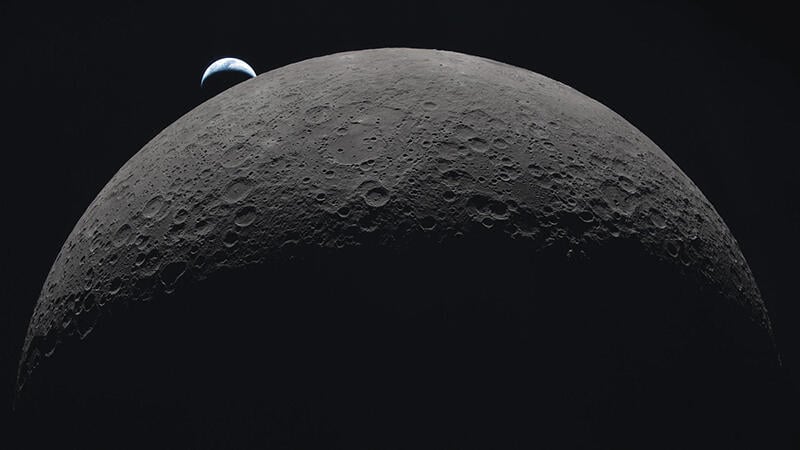
U.S. leaders view the lunar region as a legitimate area of competition—and concern.
The U.S. military has spent decades building the ability to monitor activity in Earth orbit. Now, as China and other actors turn their attention to the Moon, the U.S. Space Force is addressing a much larger blind spot: the vast expanse between Earth and its natural satellite.
The cislunar region—largely understood as starting beyond Earth’s geosynchronous orbit (GEO), from about 36,000 km (22,000 mi.) to 100,000 km above Earth—is swelling in importance as NASA works to return astronauts to the Moon, China explores the far side of the lunar surface, and commercial enterprises see vast opportunities to bolster those ambitions. Deloitte found that the lunar economy could generate $343-566 billion in cumulative potential economic value through 2050, per an August report.
- The service queries industry for first constellation
- NASA plans initial cislunar communications network demonstration with SpaceX
With activities growing, the Space Force established a Cislunar Coordination Office in May and has unveiled an initial blueprint for what would be the first U.S. military satellite constellation in the region. A Nov. 2 request for information for a Cislunar Space System (CSS) shows interest in acquiring up to five space vehicles capable of supporting a government-provided payload. They would need to meet mission needs by late 2029 and help shape a larger satellite network eventually. A second government query seeks off-the-shelf artificial intelligence platforms that can be delivered in 90 days and flight-qualified software that could be ready within 18 months of government approval.
The Space Force needs to keep tabs on the activities of China and other operators in the region, Maj. Gen. Stephen Purdy, the service’s portfolio acquisition executive for advanced capabilities, said at a Washington Times conference in Arlington, Virginia. His team spearheaded the establishment of the Cislunar Coordination Office.
The U.S. has made great strides in observing activities in Earth orbits, but farther out, “all the lights are off,” Purdy said. “We don’t know what happens, and you can do whatever you want.”
The Defense Intelligence Agency is treating the cislunar region as an area of legitimate concern, Michael Usowski, a defense intelligence officer for space and counterspace, said in a Nov. 20 webinar hosted by the National Security Space Association. “We want to make sure we have an understanding of how competitors could potentially exploit again the physics of that area of space,” Usowski said.
While still a nascent program, the CSS effort represents the first signs of the U.S. military’s plans for an operational cislunar satellite architecture. Both the Air Force Research Laboratory and DARPA are developing prototype satellites—the former to stress-test space domain awareness capabilities and the latter for autonomous navigation and advanced propulsion technologies.
The queries prioritize readily available commercial options that would allow the Space Force to move quickly on developing cislunar capabilities and explicitly reject the prospect of a research and development program.
Successfully operating in cislunar orbit comes with challenges. If tracking an object in low Earth orbit is comparable to looking for a dropped coin on the floor of a Costco warehouse, doing so in cislunar space is like searching for a coin across Earth’s entire surface, including its oceans, Purdy said.
Time also operates differently that far out, he said. Communications between Earth and GEO-based systems experience a 0.12-sec. delay. Those between the Earth and the Moon, meanwhile, average a 2.56-sec.-delay roundtrip. “That doesn’t sound like much to humans, but to computers, that’s all eternity,” Purdy said.
NASA is working on an early test of cislunar communications targeted for 2028. The agency selected SpaceX for the Cislunar Communications Deployment Demonstration on Nov. 7 with the intent to launch a few Starlink-type communication satellites onboard a Starship vehicle in 2028. Data from the demonstration could shape future lunar relay networks to keep equipment and personnel on and around the Moon in constant contact with science and operations teams on Earth.
SpaceX could deploy the satellites in one of Earth’s orbits and then use the onboard electric propulsion systems to maneuver into position to perform the demonstration, NASA Moon Base Program Manager Carlos García-Galán told Aviation Week Nov. 18.
“They don’t have to send Starship to the Moon to do this communications demo,” he said, noting that SpaceX could alternatively opt to refuel the Starship in Earth orbit and deploy the satellites into a higher-energy orbit to reach their operational stations.
—With Irene Klotz in Cape Canaveral

Related Content