This article is published in Aviation Week & Space Technology and is free to read until Oct 31, 2026. If you want to read more articles from this publication, please click the link to subscribe.
SDA Transport Satellite Constellation Grows Larger As Integration Lags
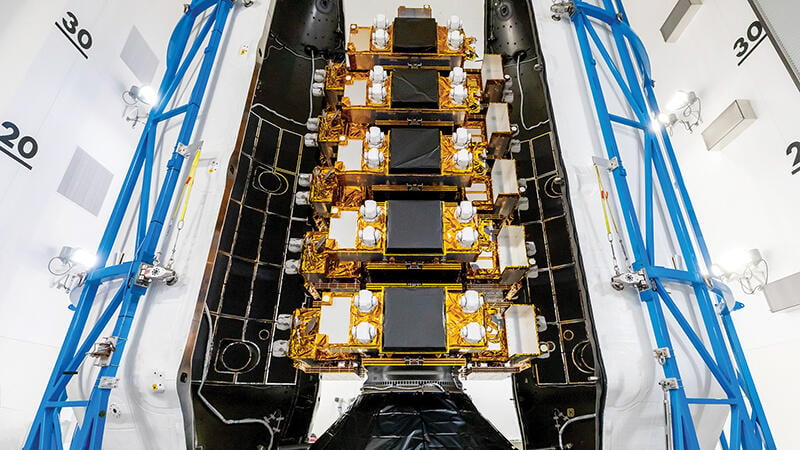
The Space Development Agency’s latest satellite deployment included the first batch of data relay satellites built by Northrop Grumman for the agency’s proliferated constellation.
With more than 80 satellites in orbit, the U.S. Space Development Agency’s nascent orbital mesh network is still proving elusive to establish.
A SpaceX Falcon 9 rocket carried the Space Development Agency’s (SDA) fourth plane of Tranche 1 Transport Layer satellites—the first such batch from Northrop Grumman—to low Earth orbit on Oct. 10.
That mission was originally slated to launch Oct. 5, but the Falcon 9’s automated systems halted the initial countdown just before liftoff. The launch was then pushed off two more times as SpaceX conducted extra safety checks on the vehicle and worked with the U.S. Space Force to deconflict with other mission deployments.
- Three out of four vendors for the initial constellation have satellites in orbit
- The constellation could support new Army battlespace awareness systems
The new satellites are intended to help build out the SDA’s Transport Layer—envisioned as an orbital mesh network providing 24/7 global data relay to support space-based missile warning and tracking, tactical user connectivity and beyond-line-of-sight targeting, including via Link 16 radios.
This new plane of 21 spacecraft brings the SDA’s tally of Transport Layer satellites in orbit to 84. The agency launched two planes of York Space Systems satellites in September 2025 and July 2026 and one plane of Lockheed Martin satellites in October 2025. It is taking longer than expected, however, to connect the satellites and put them into operation.
The SDA was established seven years ago with the charge of fielding new spacecraft on iterative cycles to provide operators with initial capabilities on much faster timelines than the decades-long satellite programs of yore. The first operational satellites built under Tranche 1 are launching more than one year later than originally envisioned, but proponents argue that the program is still moving more quickly than traditional cycles.
The challenge is not a physics problem but one of engineering integration, SDA Director Gurpartap “GP” Sandhoo recently told reporters. The agency’s multivendor architecture model allows contractors to implement slightly different system designs for satellite command and control. That is now causing delays as the companies and SDA work to transfer command and control of the spacecraft from vendors to government operations centers at Grand Forks AFB, North Dakota, and Redstone Arsenal, Alabama, he said.
The Lockheed Martin satellites were also launched with fewer optical communications terminals than originally designed, which caused delays in putting the mesh network online, Sandhoo said. The SDA has had to cope with yearslong supply chain delays for those terminals.
The agency is performing on-orbit experiments with the York satellites, while Lockheed Martin’s are being slowly pulled into the operations centers, Sandhoo said. Four of the 21 spacecraft in that plane had been handed over to government operations as of Oct. 4, he said.
“We are trying not to push them all in at the same time because that produces some challenges, so we’re doing one or two at a time,” Sandhoo said.
A Lockheed Martin spokesperson tells Aviation Week the company is working closely with the SDA to transition the full plane of Transport Layer satellites over to government operational control.
“These experiences are an important part of developing new, integrated space systems, and we’re focused on ensuring reliability and mission success during this transition while still moving quickly as a team,” the spokesperson says.
The SDA is preparing for two more Tranche 1 Transport Layer missions—to deploy the second planes of satellites built by Lockheed Martin and Northrop Grumman—and four missions for the L3Harris Technologies satellites providing missile warning and tracking. The SDA expects the full Tranche 1 network to provide initial warfighting capability beginning in 2027. Sandhoo says his team will spend the next six months establishing the optically connected mesh network.
The Army will be a primary beneficiary of the SDA’s mesh network once it is online, particularly as the service moves ahead with a new satellite ground system called the Tactical Intelligence Targeting Access Node, or TITAN, which recently entered production. Anduril and Palantir are on contract to build eight initial units over the next 18 months, and a greater production contract award is expected in fiscal 2027.
That platform will help soldiers fuse space and tactical data for battlespace awareness thanks to the data relay constellation, U.S. Army Col. Joseph Mroszczyk, director of the Transformation Integration Directorate for Space Superiority in the Army’s Space and Missile Defense Command, said at the Association of the U.S. Army’s annual convention in Washington.
“That system is something that I would expect to take advantage of that [Transport] Layer and be an integral part of how our formations receive the data out there,” Mroszczyk said.
The Army also plans to delve more deeply into stratospheric balloon experiments next year. The SDA’s constellation could provide a “complementary layer” of data distribution that helps those platforms survive in more contested electromagnetic environments, Mroszczyk said.

Related Content