This article is published in Aviation Week & Space Technology and is free to read until Jun 27, 2026. If you want to read more articles from this publication, please click the link to subscribe.
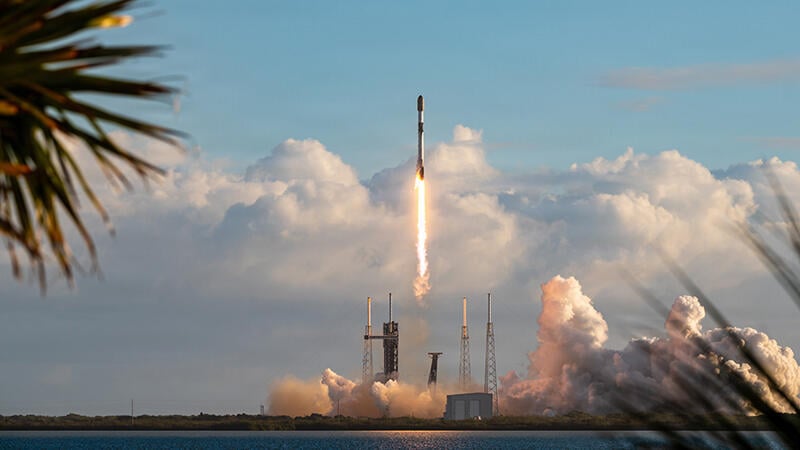
The Space Force expects Cape Canaveral SFS to support about 1,200 annual launches by 2036.
Amid a record-high budget request, the U.S. Space Force is tackling a range of new capabilities ripe for investment in fiscal 2027. Three priorities—space control, launch infrastructure and test and training resources—rise to the top, service officials say.
Space Force budget documents released in April reveal plans for a dramatic funding increase, to $71.1 billion next year from about $40 billion in 2026, with big-ticket items including satellite constellations that would provide moving target indication from space, low-latency data connectivity and expansive missile warning and tracking capabilities.
- Space control takes up bulk of the service’s 2027 classified request
- Launch ranges could support up to 3,000 missions by 2036
As Congress evaluates the Pentagon’s blueprint to spend $1.5 trillion on defense in 2027, appropriators on Capitol Hill want to know: What are the most critical must-fund priorities for each service? When asked that question during an April 30 hearing before House lawmakers, Chief of Space Operations Gen. Chance Saltzman cited space control—referencing systems that can protect on-orbit assets and deter adversarial targeting—as the service’s foremost priority, followed by launch infrastructure improvements and test and training capacity.
Not long ago, the U.S. military could not even utter the words “space control.” Now the term appears throughout the Space Force’s budget proposal to justify investments in satellite cyberhardening, on-orbit threat detection, autonomous satellite technologies and in-space maneuvering.
The service wants to buy more satellite jammers capable of disrupting adversaries’ communications, including seven Counter Communications Systems in 2027 built by L3Harris Technologies, followed by one unit annually through 2031. Funding for space domain awareness, described in budget documents as “the foundation for space control,” also is slated to increase under the proposed budget.
Meanwhile, the Space Force has allocated nearly $19 billion for classified programs. That includes $17.3 billion in research and development investment—a 164% increase from the 2026 allocation of about $6.5 billion. A substantial portion of those proposed funds focuses on space control capabilities, Brig. Gen. Christopher Fernengel, the Space Force’s director of plans and programs, said during a recent webinar.
The service also plans to upgrade its aging spaceport infrastructure on both coasts, earmarking about $1.8 billion to modernize Cape Canaveral SFS in Florida and Vandenberg SFB in California while exploring opportunities to expand range capacity.
Time is of the essence as launch demand continues to soar. Managing launch operations from Cape Canaveral, Space Launch Delta 45 achieved a milestone in 2025 by supporting more than 100 missions in one year. A new Space Force document forecasting the service’s needs in the 2040 time frame predicts greater strain on spaceports as government and commercial operators line up for rides to orbit.
The document projects annual launch rates at Cape Canaveral will reach 1,200 by 2036, while Vandenberg’s launch rate is expected to grow to about 1,800 within the next decade from about 65 launches in 2025.
The Department of the Air Force is preparing to submit a new study to Congress suggesting the need for another site capable of supporting heavy and super-heavy launches, Air Force Secretary Troy Meink told lawmakers during a May 20 hearing.
Meanwhile, the Space Force plans to spend more than $4 billion in 2027—surpassing its entire 2026 procurement budget—to secure 22 National Security Space Launches (NSSL), along with $845 million for nine launches dedicated to the Space Development Agency’s (SDA) proliferated satellite constellation. That compares with four NSSL missions and seven SDA launches earmarked in the 2026 budget.
For testing and training, the service plans to continue efforts launched last year under a new mission area called Operational Test and Training Infrastructure (OTTI). The initiative coordinates the creation of new physical and digital training ranges for orbital warfare and supports investment in testing assets. After consolidating a diverse group of efforts under the OTTI umbrella, the Space Force intends to spend $265-306 million on those initiatives in 2027-31.
Training Space Force Guardians for orbital warfare remains the top priority for head of Combat Forces Command Lt. Gen. Gregory Gagnon, who told reporters in December that 40% of his units lack a realistic trainer for exercises.
“I need to afford our operators more opportunities for orbital warfare training,” Gagnon said during the Space Force Association’s Spacepower Conference in Orlando, Florida, in December. “Their proficiency is excellent, but I need to get them the simulated environment so that they can train.”