This article is published in Aviation Week & Space Technology and is free to read until Feb 15, 2026. If you want to read more articles from this publication, please click the link to subscribe.
China, like the U.S., sees space as a warfighting domain.
A Long March 6A rocket took off from the Taiyuan Satellite Launch Center in Shanxi Province, China, on Jan. 13, carrying a remote sensing satellite to low Earth orbit and marking Beijing’s first orbital launch of 2026.
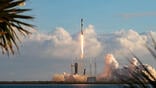
Just over 1 hr. later, a Long March 8A launch vehicle lifted off from Wenchang Commercial Space Launch Site, more than 1,600 mi. away in Hainan Province. The U.S. Space Force had supported three launches from its Eastern Range at Cape Canaveral and two from the Western Range at Vandenberg SFB, California, by the same date, marking a total of five launches in the first two weeks of this year.
- China completed 73 launches in 2025, up from 51 launches in 2024
- Commercial trackers highlight Beijing’s accelerated growth in on-orbit activities
As China and the U.S. ramp up launch rates and investments in the space domain, the U.S. Space Force and other American leaders are warning of China’s accelerated on-orbit activities amid concern that a conflict between the two countries could start in space.
China, like the U.S., now sees space as a warfighting domain, and is pursuing a “whole-of-government strategy to become the world’s preeminent space power,” the U.S.-China Economic and Security Review Commission wrote in its annual report to Congress, released in November.
Over the past decade, Beijing has turned what was a limited commercial space sector into a “thriving, state-orchestrated startup ecosystem,” with investments that are closing the gap in its strategic competition with the U.S. in space, the report states.
China completed 73 space launch missions in 2025, all but four with the Long March series of medium-lift rockets, according to the state-owned China Aerospace Science and Technology Corp. (CASC). More than 300 spacecraft were deployed last year, with one launch occurring on average every five days, compared with 190 spacecraft deployed over 51 launches in 2024, CASC says.
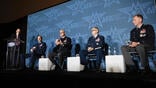
The end of 2025 marked a significant milestone for the Chinese Communist Party, which completed its 14th five-year plan—the first since China established a separate space force, noted U.S. Space Force Chief Master Sgt. Ron Lerch, senior enlisted advisor to the deputy chief of space operations for intelligence, at the Space Force Association’s Spacepower Conference in Orlando, Florida, in December. The People’s Liberation Army Aerospace Force was established in April 2024, after Beijing began consolidating its military space portfolio in 2015.
China set specific goals for this half-decade period, such as strengthening satellite communications, boosting remote sensing capabilities and researching reusable rocketry, Lerch said. “Overwhelmingly, they met or exceeded their goals,” he said.
With more than 1,300 satellites on orbit as of early December 2025, China now has two megaconstellations in operation and is beginning to test and understand the value of proliferated systems and remote sensing. The country has tested artificial intelligence on orbit and proven its ability to detect ships using commercial spacecraft, “automatically highlighting those ships and creating graphics for a user on the ground with no man in the loop,” Lerch said.
Beijing is also incorporating more stealthy satellites into its activities, part of a decades-long plan and research to explore the use of such applications in space, Lerch said.
The U.S. is increasingly harnessing commercial space domain awareness and non-Earth-imaging technology to track Chinese and other non-U.S. activities, and U.S. Space Force leaders are beginning to speak more freely about what they are tracking. Lerch credited partnerships with the commercial sector for the Space Force’s ability to “lift this veil of secrecy and sort of help illuminate these activities that are happening on orbit.”
The dynamics between the U.S. and its peer adversaries in space are also changing. In years past, the Space Force has described the situation on orbit as a “cat-and-mouse game” in geosynchronous orbit (GEO), with U.S., Chinese and Russian satellites “sort of stalking each other,” Lerch said.
In 2025, that dynamic shifted to a “hide-and-seek game” in low Earth orbit (LEO) as China used commercial spacecraft to take non-Earth imaging of U.S. assets, he noted.
As 2026 begins, China appears poised to demonstrate more cutting-edge technology, Lerch warned. Space situational awareness companies monitored the activities of two Chinese satellites appearing to engage in refueling activities during the summer of 2025—an activity that the U.S. wants to demonstrate in 2026. Meanwhile, satellite communications spacecraft in China’s secretive TJS family are seen “zipping all over” GEO, suggesting “some other aspects or some other capabilities that they’re testing, and not just simply satellite communications,” Lerch said.
The U.S. should expect Beijing to continue studying edge computing in space, using the initial tranche of satellites in its Three-Body Constellation launched last year. With a planned 2,800 satellites in total, “it’s going to be fascinating to see where they go with that particular constellation,” Lerch said.
Meanwhile, China is racing to launch and recover a reusable rocket for the first time, with plans to loft a reusable liquid propellant launch vehicle by midyear. Beijing attempted two rocket launches and first-stage recoveries in late 2025 but failed to retrieve the boosters. In contrast, the U.S. now has two launch vehicles that have successfully landed an orbital-class rocket booster—SpaceX’s Falcon family and Blue Origin’s New Glenn, following the latter’s successful launch and recovery on Nov. 13.
The U.S.-China Economic and Security Review Commission warns that although the U.S. currently leads in reusable launch rockets and LEO-based constellations, China is “deploying its industrial policy playbook” as it works to catch up.
For now, SpaceX remains by far the largest operator in space and continues to grow. The U.S. Federal Communications Commission has approved the company to build and deploy an additional 7,500 Starlink Gen-2 satellites, growing the constellation to 15,000 systems, the regulator said Jan. 9.
On the heels of that announcement, the South China Morning Post reported that Chinese companies have submitted filings to the U.N.’s International Telecommunications Unit to field more than 200,000 satellites over multiple orbits, signaling a desire to secure long-term options for orbital and spectrum resources.