This article is published in Aviation Week & Space Technology and is free to read until Jan 17, 2026. If you want to read more articles from this publication, please click the link to subscribe.

How The U.S. Space Force Aims To Avoid A Second Sputnik Moment

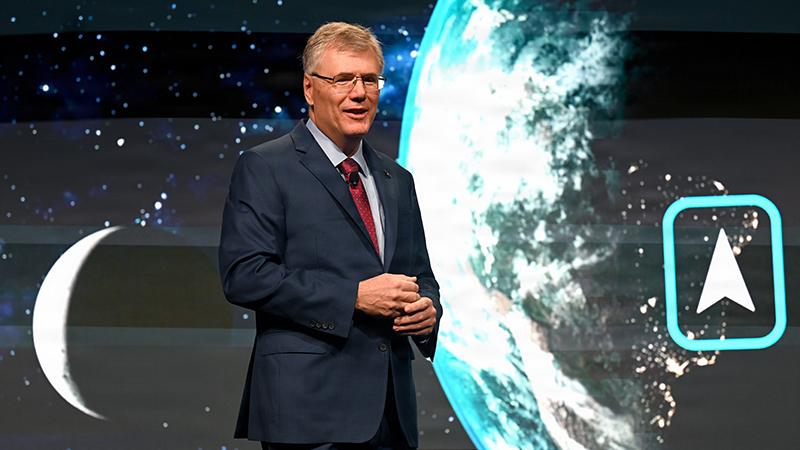
Troy Meink

Space-based threats against the U.S. are moving “staggeringly fast,” Air Force Secretary Troy Meink said Dec. 11.

Credit: U.S. Air Force

China destroyed one of its own satellites on Jan. 11, 2007, creating thousands of pieces of debris in orbit while revealing its capabilities—and plans—for the space domain.

That moment signaled the end of what many considered a period of relative calm in space after Operation Desert Storm, recalled U.S. Space Command Commander Gen. Stephen Whiting during a fireside chat at the Space Force Association’s Spacepower Conference Dec. 10-12 in Orlando, Florida. “That period of calm was deceiving,” he said.

As the Space Force celebrates its sixth birthday on Dec. 20, China and Russia are creating new dynamics for the U.S. to counter in the domain, service officials said at the conference. Those space-based threats are advancing “staggeringly fast,” Air Force Secretary Troy Meink said in a keynote speech. His appearance marked the first by a service secretary at the three-year-old conference, signaling the growing prioritization of space in U.S. defense strategy.

  • Russia and China are demonstrating new assets in orbit
  • The Pentagon is moving quickly to field satellites for moving-target indication

In his prior roles in the intelligence community, Meink watched China develop weapon systems “at about half the timelines of the U.S.—even worse, in some cases,” he said.

Meink warned that the U.S. risks entering a new space race with Russia and China, alluding to the Soviet Union’s 1957 launch of Sputnik 1 and the subsequent U.S. start of the Apollo program. “That is what we all need to focus on, to make sure that there is not another Yuri Gagarin, that there is not another Sputnik,” he said, referencing the Soviet cosmonaut who became the first human to enter outer space in 1961.

China is now the pacing threat, with Russia not far behind. Beijing, Moscow and Washington have regularly engaged in a cat-and-mouse game, “sort of stalking each other” in orbit, said Chief Master Sgt. Ron Lerch, senior enlisted advisor to the deputy chief of space operations for intelligence.

In the past year, that has evolved to “more of a hide-and-seek game” in low Earth orbit (LEO), Lerch said. The activities of China’s three Shiyan-24 satellites in LEO suggest progress with “a decadeslong plan and research to potentially use some stealth applications in space,” he said.

Meanwhile, Russia has debuted its experimental, low-visibility Mozhayets satellite in medium Earth orbit, Lerch said. Slides presented during his speech credited information on Shiyan-24 and Mozhayets to space situational awareness companies LeoLabs and Slingshot Aerospace.

Countries around the world are making strides in space as the domain becomes more affordable and accessible. The U.S. Space Force has built momentum, fielding new space domain awareness assets, integrating automation into operations and exponentially increasing launch rates, Meink said.

The young service will benefit from structural acquisition changes proposed by Defense Secretary Pete Hegseth to empower leaders and accelerate timelines, Meink said, explaining that the department is shifting from a program executive officer model to “portfolio acquisition executives” that would have “authorities, resources and talent to execute some of the most technical programs.” The transition should be complete within 60-90 days, he told reporters.

The Pentagon’s pivot from using airborne platforms for ground- and air-moving-target indication (MTI) to spacecraft could be among the first programs to benefit from the new model. The Department of the Air Force is moving quickly to award multiple competitive contracts for space-based MTI assets to track ground targets first and then air targets, Meink said.

Both missions are important for the Space Force to accomplish in the near-to-midterm, but the service partnered with the National Reconnaissance Office earlier for ground MTI and is thus “further down the road in pulling those systems together,” Chief of Space Operations Gen. Chance Saltzman said. Because targets move more slowly on the ground than in the air, “we’re just ahead of the game” on ground-based MTI, he said.

As the Space Force is known for missile warning and tracking capabilities, MTI from space will soon become the next major “brand” of capability for the service, new Combat Forces Command Commander Lt. Gen. Gregory Gagnon told reporters Dec. 10.

Combat Forces Command was known as Space Operations Command until Nov. 17, when it was redesignated to reflect a shift in forces toward integrated space defense and combat readiness. Gagnon assumed command after serving as deputy chief of space operations for intelligence.

“Our goal is to make [MTI] just like missile warning,” he said. “No one ever questions missile warning. It’s the best in the world.”

Vivienne Machi

Vivienne Machi is the military space editor for Aviation Week based in Los Angeles.