Podcast: CAPA Summit Recap—ATM Overhaul, Bedford And Low-Cost Strategy
Editors recap the CAPA Airline Leader Summit, covering air traffic modernization debates, rising costs, FAA head Bryan Bedford's certification news, LCC strategy and more.
Subscribe Now
Don't miss a single episode. Subscribe to Aviation Week's Window Seat Podcast in Apple Podcasts, Spotify or wherever you get podcasts.
Discover all of our podcasts on our at aviationweek.com/podcasts.
AI-Generated Transcript
Karen Walker (00:10): Hello everyone and welcome to Window Seat, our Aviation Week air transport podcast. I'm ATW and Aviation Week Air Transport Editor-in-Chief Karen Walker. Welcome on board. So I'm recording this Window Seat episode from the lovely city of Charleston in South Carolina, and Charleston is the host of the CAPA Leader Summit Americas. I've been helping cover this event with my colleagues, Lori Ranson, CAPA Senior Analyst Americas, and Christine Boynton, Aviation Week Senior Editor, Air Transport. So welcome to you both, and we're going to talk about some of the key things we heard and saw through this event. What I'm going to do actually is just start with a little bit of a news flash that none of us expected, but it was quite an interesting one. One of the key speakers here was the FAA Administrator Brian Bedford. And we suddenly got a surprise, didn't we, in something he said, Christine?
Christine Boynton (01:09): Yes, that's right, Karen. And it actually came in the last, I would say, 30 seconds or so of his panel, he was asked about certifications. Now he does believe that the Boeing 737 Max will be certified by the end of the year, the Max Seven first, followed by the 10, but then he said hopefully the 777X early next year. And now that was a bit surprising because Boeing had previously suggested things were on track for an amended type certificate by the end of the year. And though it's unclear as of now what's behind that stretch, CEO Kelly Ortberg did appear to hint towards that timeline in remarks at the Bernstein Conference, specifically around ETOPS, which he said was going to extend into next year. So we have the story online with far more detail, but that was a bit of an unexpected announcement at the end of that presentation.
Karen Walker (01:55): So yes, news was made. Anyway, there was a lot of talk, of course, with the administrator being here. There was a lot of talk about US national airspace system modernization, air traffic control modernization. Obviously that's what he talked a lot about, but also a lot of the people were talking about this throughout the conference. So that was certainly a theme. Lori, I'd be interested in your take on the air traffic modernization side. I mean, it seems to me that in the US, everybody in the industry wants it to happen, but there was quite a lot of different sectors represented here. There was a lot of pilots and union people, including the head of ALPA, Captain Jason Ambrosi. And there was quite a lot of senior air traffic control people. Then you got airlines, of course, and some manufacturers. And it all seemed to me that they were definitely supportive of it happening, but had slightly different views in some cases about what the priorities should be.
(02:55): What did you think?
Lori Ranson (02:56): I think so too. I think everyone's very excited about it, but at the same time, it's execution. And one thing that stood out to me was an airline on a panel and they were just simply talking about equipage, what needs to happen on the aircraft to be equipped to handle all these proposed changes. Some of them stemming from tragic accidents, obviously, but still, it's the execution timeline. Can all of this be done in the timeframe that the administration has promised? And we did hear a lot of differing views about that. And you did, you get sort of some of the practical side from the pilots as well, just, "Oh, my iPad's here and we don't have visuals, but my iPad's to the right, I have to look to the right." Just certain everyday aspects of operations that have to be taken into account when you're proposing this huge of an overhaul of a system.
Karen Walker (04:00): It was interesting what you just said about the iPad, because the point that was being made, and that was by Captain Ambrosi in fact, was that ALPA's position is that they want every aircraft to be equipped with ADS-B, collision avoidance equipped, and they want military aircraft in the system to not just have ADS-B, what they call ADS-B out for the military aircraft, but they want it turned on, actually active. But what he was actually saying was that they use those iPads on the left, their airline equipment, and that's very important. It's all giving them maps and details, but when it comes to an ADS-B alert, they want that on the main screen in front of them, the display in front of them. They don't want to be turning their head monitoring and looking at that. So there was just some interesting equipage aspects that came up.
(04:55): Another theme, not surprisingly, with all the rising oil prices, and there was quite a lot of talk about generally higher costs and how are the airlines going to deal with all of this. And John Heimlich, who is the chief economist at the Airlines for America, A4A, he spoke to that. You heard that presentation. What are your takes on that, Lori?
Lori Ranson (05:19): That capacity's already coming out of the system. I can't remember his exact stats, but it was pretty drastic to me. GDP estimates have gone down drastically, and you contrast that with what some of the airlines have been saying. Demand is still strong, pricing traction is holding. So there's this big disconnect of what the numbers are saying and what airlines are saying. Some of that plays into the K-shaped economy, but given that it looks like fuel's not coming down anytime soon, I mean, how long does the K stay intact?
Karen Walker (05:59): Yeah. And you also made a great presentation and you and John were very much aligned. What struck me is there was very much, which is good, a very good optimistic feeling of optimism across all the aspects and things that were talked about, that people were saying demand's still there, this is a great industry. That's good. But you and John both made the point that the second half of the year could be much tougher and bigger decisions being made about how to deal with these costs because nobody sees them coming down. So I think you said it, the story is going to really be the second half of 2026.
Lori Ranson (06:35): It is going to be the second half of 2026. And just another point to remember, if we weren't already reminded by Spirit going out of business, if you don't have a solid balance sheet, it's going to be really tough for you in the second half of the year if you have a lot of debt, if you have high cost debt, if you have a lot of aircraft debt, it's going to be really tough. So Abhi Shah, who's the president of Azul, he spoke here and they exited bankruptcy eight days before the war in Iran started. He said basically it put them in a favorable proposition. I forget how much they wiped out—a lot of debt.
Karen Walker (07:14): Yes. Abhi at Azul, I was talking to him actually on the sidelines at one of the networking events and he'd made it clear that before they went into Chapter 11, they already had their business plan, their exit plan agreed and how they were going to do it, and that was critical. First of all, it shortened the amount of time that they were in Chapter 11, but they had that goal and they came out much stronger. And the big thing, as you said, was debt reduction. There were a lot of other points too, but that was huge. And he said they'd have been in much worse position if they'd come out and then faced the oil prices situation. So that was very interesting because I thought that was another theme that came out about the US low cost carriers. How's that market going to do? Because of course, just a month ago, Florida-based low cost carrier Spirit Airlines ceased operations.
(08:06): So there's still a sense of shock about all of that. And one of the things that struck me was when Doug Parker, the former CEO of American Airlines, one of the world's biggest airlines, he was here talking and he actually said he thought the low cost carrier market in the US is broken because the majors learned how to do it even better, that low cost, low fares. They've segmented their economy cabins, they're tiering things.
(08:42): I thought that was quite an interesting statement too. But then we also had the CEO of Allegiant, which is not exactly a low cost carrier, but it's an interesting carrier. It's certainly not a high cost carrier. They keep a very strong eye on costs and they're about to ... Well, they have now, haven't they? They've acquired Sun Country. Christine?
Christine Boynton (09:03): Yeah. So they've just finished, closed their acquisition of Sun Country and they're both, I would say, niche industry outliers. They have unique models in the way they manage their capacity and they fly. Combined, they expect to strengthen that advantage position. But I think Lori, you covered the panel with Greg today and I don't know if he spoke about the merger or what they expect next, but ...
Karen Walker (09:25): Yeah, Christine, you're correct. That of course was Greg Anderson, who is the CEO at Allegiant.
Lori Ranson (09:31): Building on our previous sort of comments there, he stressed really hard. These are two strong financially sound carriers coming together. I think he mentioned we had combined 163 unencumbered aircraft worth about, that's two billion in equity. So that helps the balance sheet. Again, it goes back to balance sheet. There are also two niche players that don't really touch the majors, even combined. And obviously there's some competition with Sun Country in Minneapolis and Delta, but this is the combination of two smaller carriers that it's still going to be relatively small compared to the big guys. So great for them and it just kind of shows there are different aspects to the low cost model in the US, I think.
Christine Boynton (10:30): Yeah. They know their strengths and they've stuck to them.
Lori Ranson (10:33): The audience knows this, but it's worth reminding them a significant portion of the combined business will be charter and cargo. And so you've got this diversified revenue base, you're nimble enough to do it. A Spirit couldn't do that. A Frontier is not going to do that.
Karen Walker (10:54): Yeah, he used the phrase, "You need to stick to your knitting, know what you're really good at and be good at it." And that's a very smartly run airline as Sun Country was. So I think they will be ferocious about that. One last thing that we can't not talk about because all three of us saw a bit of a milestone when there was a demonstration we saw an aircraft, it was prototype of an aircraft called the Electra EL9 that ultimately will be a nine-passenger short takeoff and landing aircraft. But what we saw being demonstrated on the pier of Charleston right next to this hotel was a two-seat prototype version and that was doing its first urban, true urban landing on this tiny pier with water on right one side and loads of buildings on the other side. All three of us went to see that.
(11:53): So we stood right next to the aircraft. It was a gusty day.
Christine Boynton (11:57): It was. There were some headwinds.
Karen Walker (11:59): And crosswinds. So we saw it wobble, but stayed totally good and landed really short and very quiet. Christine, tell us the rest of that story.
Christine Boynton (12:11): Yeah. So we had a chance to witness this first urban flight of their prototype, as you said, and you taped a separate podcast with Electra's CEO. So be sure to check that out. But it was very exciting. We saw it come down and it was a very gusty day. We saw it come down, land right in front of us, a precision landing between two fairly close together lines. So impressive, entirely manual landing. So very impressive. And we were told there's a VIP on board, so we're waiting to see who is going to pop out. And—
Karen Walker (12:42): Some of us guessed Tom Cruise, but we were wrong.
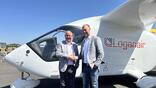
Christine Boynton (12:45): We almost did. But out popped JSX CEO Alex Wilcox, still exciting. And he told me afterwards, "Well, I had to try it before I buy it." And he said, "I'm very excited about it." And JSX, which is a public charter operator based here in the US, they have actually signed a letter of intent for about 82, I believe, EL9s. That was back in 2023. And Electra expects to certify this ultra short takeoff and landing aircraft in about late 2029 or 2030. So they've got a ways to go, but as I say, Alex says he's excited about it. We'll continue to watch that program develop. And to me, Lori, you and I were talking about this. We're in this period of volatility, of uncertainty, a lot is going on, but we get to see these really interesting and exciting glimpses into the future. Innovation has not stopped.
(13:35): So for me, that was a very positive piece of the past two days.
Karen Walker (13:39): It is very unusual these days to turn up to a conference, not an airshow and actually see a brand new aircraft, a prototype. And I've never seen an aircraft just land, not even a helicopter, land that close to me.
Lori Ranson (13:54): I think everyone that was in attendance at this conference was on that pier watching that aircraft come in and land. And it's like you said, the adrenaline gets going and it's so exciting and it really does make you think, okay, yep, hard times, but innovation doesn't stop.
Karen Walker (14:14): Yep, that was a fun thing to see. It was also bright yellow. So it was all sorts of fun things. It was just a nice thing to see happen here. And I think it fell in line with the overall, for all the challenges and heaven knows this industry's always got challenges, but I think it fell in with the overall theme here. Everybody was still very optimistic.
Lori Ranson (14:38): So the next CAPA conference in the Americas is the CAPA Airline Leader Summit, Latin America and Caribbean. And that's going to be in Panama City in September on the 10th and 11th.
Karen Walker (14:50): And of course, thanks to COPA, that's quite a major hub for that whole region and a lot of exciting things happening in that part of the world on the aviation front, so I'm sure that will be exciting too. So Christine, Lori, thank you so much. Great to work with you both here and thank you very much for joining Window Seat. Thank you of course to our producers, Corey Hitt and Guy Ferneyhough and especially all our listeners. This is Karen Walker disembarking from Window Seat.



Related Content