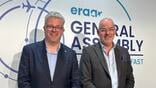
Karen Walker sits down with Boeing's Phil Swinsburg to talk about Wisk and the company's autonomous air taxi targeting late-decade certification. They discuss the futuristic yellow aircraft's pilotless technology and Boeing's vision for revolutionizing urban air mobility.
Subscribe Now
Don't miss a single episode. Subscribe to Aviation Week's Window Seat Podcast in Apple Podcasts, Spotify or wherever you get podcasts.
Discover all of our podcasts on our at aviationweek.com/podcasts.
AI-Generated Transcript
Karen Walker: Hello everyone, and thank you for joining us for Window Seat, our Aviation Week air transport podcast. I'm ATW and Aviation Week Air Transport Editor-in-Chief Karen Walker, and I am delighted to welcome you onboard. Now, this week I'm recording this program at the Singapore Air Show, which is why I'm sure you can hear the sound of jets overhead, which we all love, of course, in this industry. I have a very special guest with me. I'm at the booth of Boeing and I am with Boeing's Director of Asia Pacific Operations and Business Development. And his name is Phil Swinsburg and he's based in Brisbane, Australia. So Phil, welcome. Thank you so much for joining us today on Window Seat.
Phil Swinsburg: It's great to be here, Karen. Thank you.
Karen Walker: And what we're going to be talking about, and I'll straight up say I don't have much knowledge on this, so I'm really looking forward to hearing about this from the expert. We're going to be talking about Advanced Air Mobility or AAM and what's going on there in that sector, for the airlines. In particular, Phil is involved with a very interesting project. It's called Wisk, and I'm going to start off, I've just seen it. It's fascinating—yellow aircraft in development out there that I've just been to see. So Phil, can you please start off by telling us what Wisk is, what's the relationship to Boeing and what it is you're developing?
Phil Swinsburg: Sure. So Wisk is a wholly owned subsidiary of Boeing. We were bought out back in 2023. Prior to that, we were a joint venture with part of the Google organization where we've been looking at and exploring the technology around autonomous aircraft for many years, 10 to 12 years now. And what you saw this morning was our Generation 6 aircraft. So we have five previous generations of aircraft, which we've worked through over that time to get us to this point in time now. So Wisk is developing a fully autonomous air taxi, electric air taxi aircraft, as well as all of the ecosystem that surrounds that. And we might get to that in a minute as to what that actually means, but for the listeners it's really about we're designing an autonomous air taxi that we look to bring into service toward the end of this decade.
Karen Walker: Excellent. So I just got my first viewing of this. It looks very modern, futuristic, high-tech. It also looks a little bit like a yellow submarine with wings. It looks fantastic. It looks cute, which I think is a nice thing. Just give me, what are the timelines that you're thinking of? When could that actually be operational?
Phil Swinsburg: So we're going through the certification process now. We've started that with the FAA and our intention is to have this certified in the US through the FAA. Our timelines really are quite dependent upon the FAA in a lot of respects because we might be able to get the technology to a point, but the certification process really guides when we can actually get that approved. We're aiming for the end of this decade for certification, and then we aim then soon after that to look at bringing it into service in the United States.
Karen Walker: And what about partners with this? And I'm particularly thinking of things like the engines and things. What are you doing that way?
Phil Swinsburg: Right. So a lot of the current aircraft is vertically integrated. And what that means is that we actually make a lot of the components ourselves. Now, not all components, but things like the motors and batteries as an example, they're actually being made by us. The reason for that is because not a lot of those exist yet. We're kind of building not only a brand-new aircraft, we're making it autonomous and we're trying to resolve some of the airspace challenges, but we're also building a lot of the supply chain at the same time. So we've got a lot of plates in the air spinning those around, but that's what we need to be doing. In the future, we might look to outsource some of those, but at the moment, we are doing a lot of that in-house.
Karen Walker: And where is development and where would production take place? Do you know that yet?
Phil Swinsburg: Right, so the company itself, Wisk, is around about 840 engineers. They're based in the United States. Myself and my small team, we're based in Brisbane, Australia. We also have some offices in Canada and Poland doing specialist components. So the majority of the research and development that we're doing—because there's also not just aircraft manufacturing, we're also doing a lot of research and development—the research and development, our flight test team and our engineering team, who are still in the final stages of the final design, are based in California. So that's where we're doing a lot of our flight tests and we'll also do our early production, most likely in the California region.
Karen Walker: One of the dumb questions I asked when you showed me the vehicle, because this is obviously about getting people to and from airports—so one assumes they have luggage. Tell me where the luggage goes.
Phil Swinsburg: Okay, so whilst we do envisage moving between airports, we also envisage moving people into the city. And so there is actually new infrastructure that will come with this industry, we believe. We call them vertiports instead of an airport, we'll call them a vertiport. Reason being is the aircraft takes off vertically and then flies horizontally. And we want to do that to differentiate a little bit from the existing infrastructure. That's a long-term journey with infrastructure development across many, many cities. But to your point, the luggage, we have accounted for carry-on luggage, and it goes in the front of the aircraft. We call it a frunk, which is the front trunk.
Karen Walker: I love that. I want to put my carry-on in a frunk.
Phil Swinsburg: And just to add onto that, we've also got space inside the cabin as well for the other. So normally when you get onto a flight, you've got a carry-on bag, which is a roller bag, and then you might have a backpack or a purse or something else. There's also space inside the cabin to then put those other items as well. So you've got them near you when you're flying, in case you want to do some work on the laptop or your phone, you can charge your phone on the aircraft as well. We've got those provisions. And then your rollaway is just in the front of the aircraft.
Karen Walker: So obviously the big question here, you chose to go autonomous with this, which essentially means no pilots, for [four?] passengers who likely have no flying experience. Why did Boeing choose to go that way and what do you expect in terms of airlines and FAA and passenger concerns on that?
Phil Swinsburg: Sure. There's a lot in that question. So let's take autonomy first. We believe that autonomy really is the ability for us to unlock the future of aviation within this particular market. Autonomy gives us the ability to scale instead of having a pilot in every single aircraft. The scalability also brings profitability. So we believe that scale is also the foundation for the economic base of the product, but autonomy also gives us the ability to have an extraordinarily safe aircraft. So this aircraft will be designed to be 10 to the minus nine, which is basically the same as a commercial passenger-carrying aircraft. We chose that deliberately because we want this aircraft to be the first certified autonomous aircraft in the world. What that enables us to do is to then use that technology to enable the remainder of the aviation ecosystem to demonstrate that autonomy can actually be safe and safer than existing flights. So we're setting ourselves a bit of a moonshot, as they used to say in the Google space. We're setting ourselves a moonshot, we're on that trajectory to achieve that moonshot hopefully by the end of this decade. And we think autonomy really unlocks the potential for mobility in this third dimension, both inter- and intracity.
Karen Walker: What sort of heights will it go to?
Phil Swinsburg: So the aircraft can fly much higher than what we would normally fly during the city. I think when you see this flying around a city, it will fly around about 1,500 to 2,000 feet. So it's not too high. The distances are only relatively short between two points. There's no point in trying to climb up too high, just only to climb back down again. So we'll sit around about 1,500 to 2,000 feet. Of course, that depends on the airspace that we operate in and the National Airspace Authority will give us those approvals. But that's generally what we're targeting.
Karen Walker: One assumes the airlines are a big target here in terms of customers. Are you talking to airlines and how much interest are you seeing?
Phil Swinsburg: At the moment, what we're doing is we're looking to get it certified and then we will operate. So Wisk is likely looking to operate this aircraft in the United States as the entry to that particular market. What we're then looking at is, okay, after that, what are the other future opportunities? And so yes, we're very interested in the airline market, talking to airlines and who else might want to be an operator with this system.
Karen Walker: And I guess just one big last question: Why did Boeing want to do this? It just seems, yes, it's an aircraft of sorts. It flies, it carries people, but it's just such a different way to look at things. Why did you do this?
Phil Swinsburg: So I think if you look at the Boeing company, but if you also look at the aviation industry as a whole, the aviation industry's foundation really is about revolution, evolution of technology and improving in technologies. So this is really, in my view, this is almost like a natural evolution of the aviation industry. There's shortages of pilots. That's not the main reason. The main reason really is about how can we improve the safety and reliability of an aircraft. You can do that through making it autonomous, and then we can move that autonomy into many, many other platforms. I think there’s a very similar trend in autonomous cars and the digitization of a whole lot of areas. And one other area that we're also working on is actually the airspace modernization. So we have a subsidiary company of our own, which is called SkyGrid, and they're about the digitization of the airspace. And so when you put this ecosystem together, we've got an autonomous aircraft, we've got the digitization of the airspace working with the FAA and other ANSPs. That's how we really unlock this future dimension. And the only way to do that is through autonomy.
Karen Walker: So it really keeps you in that new technology game if you like, that you can be learning different things as you go along.
Phil Swinsburg: Absolutely.
Karen Walker: Okay. Well Phil, this has been really interesting for me. I've seen something new today, so thank you very much for that. Thank you for your time, and I look forward to following the program now.
Phil Swinsburg: I look forward to it. Thank you very much for inviting me on.
Karen Walker: Thank you again. Thank you, Phil, for your time. Have a great rest of your show. And thank you also to our producers, Cory Hitt and Guy Ferneyhough, and of course a huge thank you to our listeners. Make sure you don't miss us by subscribing to Window Seat on Apple Podcasts or wherever you like to listen. Karen Walker, disembarking from Window Seat.

Related Content