
Featured MRO Content






Sponsored Content





Latest News & Analysis
Jan 07, 2013
As the outlook for heavy maintenance on the global single-aisle fleet of 13,000 aircraft shows only modest growth during the next 36 months, there will be pockets of opportunity, particularly among Latin American operators. Based on the most recently compiled data, heavy maintenance visits (HMV) will generate about $1.4 billion in annual sales, with C checks accounting for nearly $1.3 billion each year through 2015, concentrated strongly in the U.S., U.K. and Brazil.

Jan 03, 2013
Sepang Aircraft Engineering is part-owned by EADS
Dec 31, 2012
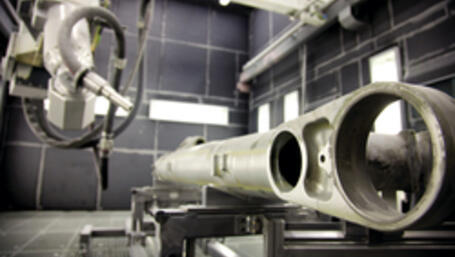
Industrial robots are becoming a common sight on aircraft production lines, laying up composites, drilling holes, inserting fasteners and inspecting structures—automating repetitive tasks that require painstaking precision and drive up the touch-labor costs in aircraft assembly. Now robots are headed for the overhaul center. Lufthansa Technik and Helmut Schmidt University have developed an 8-axis robot that automatically strips the paint from parts using plastic-bead blasting, reducing the time required while improving quality.

Dec 31, 2012
Technologies that allow complex contoured parts to be produced simply and cost-effectively are enabling metallic structures to hold their ground against composites as manufacturers strive to cut cost and weight out of their aircraft. Working with Airbus, France's Dufieux Industrie has developed the milling mirror system to replace hazardous chemical milling of curved aluminum fuselage panels to reduce their weight. One machining center has a high-speed milling head, working in synchronization with its twin with a support head.

Dec 31, 2012
Engine overhaul expenditures will grow modestly in the short term, but prepare for a spike.
Dec 31, 2012
The initial move away from punishing good technicians for maintenance errors began about two decades ago as savvy leaders began to understand the downside of disciplining to “fix” errors—and the upside of instead conducting a thorough evaluation of the “why” behind those errors. Since then, leading maintenance organizations have created non-punitive cultures in which committees dig into the causes behind errors with the aim of identifying whether changes in policy, process or documentation should be made to prevent future occurrences of the same errors.

Dec 31, 2012
Commercial-scale, competitively priced production of drop-in biofuel replacements for petroleum-based jet fuel remains elusive, but technology work continues unabated. Two synthetic-fuel pathways are already approved for use in aircraft, in blends up to 50%: Fischer-Tropsch synthetic paraffinic kerosene (SPK) from coal, gas or biomass; and hydroprocessed esters and fatty acids (HEFA) from animal fats and vegetables oils. At least two more could be added in 2013: alcohol-to-jet (ATJ) and synthetic kerosene with aromatics (SKA).

Dec 31, 2012
A three-dimensional holographic radar that overcomes wind-farm interference with air traffic control radars could be commercially operational by late 2013. When an aircraft flies over a wind farm, its track can be lost amid the Doppler returns from the rotating blades of wind turbines. The problem is growing, as wind farms proliferate worldwide. Aveillant's holographic infill radar with its flat phased-array antennas provides the missing position and altitude data for aircraft.