This article is published in Aviation Week MRO part of Aviation Week Intelligence Network (AWIN), and is complimentary through Mar 05, 2026. For information on becoming an AWIN Member to access more content like this, click here.
Middle East MRO Growth Drives Regional Efforts To Boost Talent
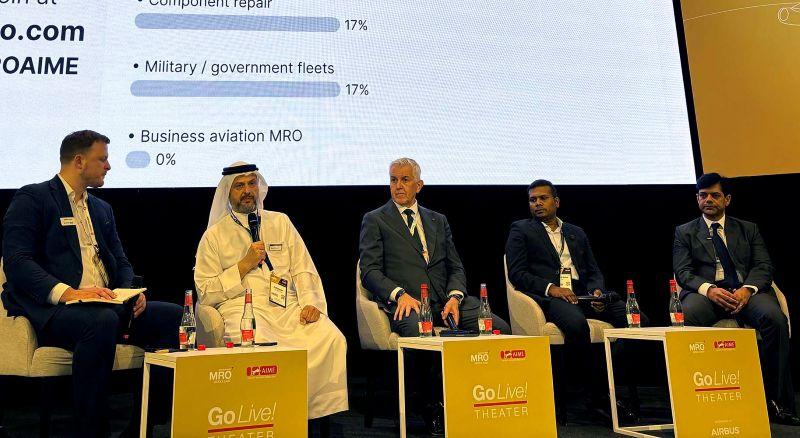
(From left): James Pozzi, Ziad Al-Hazmi, Fraser Currie, Mahesh Kumar and Tej Mehta during a panel at MRO Middle East 2026.
DUBAI—MRO demand in the Middle East will experience the world’s second-fastest compound annual growth rate over the next decade, according to Aviation Week data, and this rapid increase is driving considerable need for qualified maintenance technicians. MRO providers in the region are being proactive about establishing talent and training pipelines to keep up.
During a panel at Aviation Week’s MRO Middle East conference here, Lufthansa Technik Middle East CEO Ziad Al-Hazmi noted that the region’s above average MRO growth and the gap left by pandemic workforce losses are making labor one of the company’s greatest challenges.
“There are enough colleges here [the Middle East], but how do you get people trained with the experience? We lost a lot of talented, experienced people during COVID and are now trying to fill that gap on top of trying to keep up with the growth,” he said.
Lufthansa Technik Middle East is approaching this through partnerships, such as one with GE Aerospace and Etihad Engineering, announced during the Dubai Airshow in November.
The partners are collaborating to develop a comprehensive maintenance training program tailored to address the technical qualification requirements of the United Arab Emirates’ aviation workforce.
Engine MRO Sanad is also relying on partnerships to boost the talent pipeline. Tej Mehta, Sanad’s group head of strategy, said finding qualified technicians “is becoming increasingly difficult,” noting that the supply of labor is not keeping pace with demand.
He referenced Sanad’s leadership program with Embry-Riddle Aeronautical University and its partnerships with local schools such as Khalifa University and Abu Dhabi Polytechnic. The company is also working with OEM partners and other stakeholders to explore opportunities for “cross-pollination” training programs.
Fraser Currie, chief strategy and commercial officer at DAE Engineering, said its subsidiary Joramco added 33% capacity in September, and it will have doubled in size by the end of 2028. In conjunction, it has doubled the size of its Joramco Academy training arm to around 350 students.
Currie asserted that establishing Joramco’s own talent pool through the academy is an advantage—and so is labor cost in the Middle East compared with other regions. For instance, in Europe, “it’s become incredibly difficult to staff your business at a rate that the airlines can afford to pay,” he said. “Often now, people in Europe are paying engineers more than they’re charging the customer.”
Joramco has rolled out several new training initiatives to boost its labor effectiveness. In August, it partnered with the University of Jordan to start offering a five-year bachelor’s degree program in aeronautical engineering and maintenance. Although a bachelor’s degree “is by no means essential for our business,” Currie noted that it is culturally important for talent in the Middle East.
During MRO Middle East, Joramco announced the graduation of its first group of students from its Structured On-the-Job Training (SOJT) program. The graduates achieved a European Union Aviation Safety Agency (EASA) type rating for the Airbus A320, and Joramco also offers this training for the Boeing 737 and 777.
“We are now one of the, if not the only, airframe MRO in the region that’s doing specific on-the-job training,” Currie said. “We’re bringing talent in from other companies. Sometimes it’s a company sending people, sometimes it’s an individual . . . because some companies are finding that they have the talent, but the talent isn’t getting enough exposure to all the tasks they need to complete the logbook to move on in their career.”
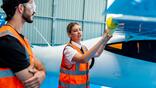
Joramco also recently signed a memorandum of understanding with the College of Advanced Vocational Training in Jordan to support its growing capabilities for composite repairs. It is working with the college to develop a training program in carbon fiber composite technology.
“Most of the aircraft that are coming through our facility now are 50-60% composite,” Currie said. “So yes, there’s still a huge demand for sheet metal. It’ll kind of always be there, but the skill set has to move.”