Airbus: India’s Fleet Boom Will Triple Demand For MRO Engineers And Capacity
HYDERABAD, India—India’s commercial aircraft fleet is set to triple to 2,250 aircraft during the next decade, positioning the country as the world’s third-largest civil aviation market by 2035, according to Airbus.
While these numbers highlight unprecedented fleet growth, the more critical implication lies in maintenance. India must rapidly scale its aircraft engineering workforce and MRO infrastructure to keep pace.
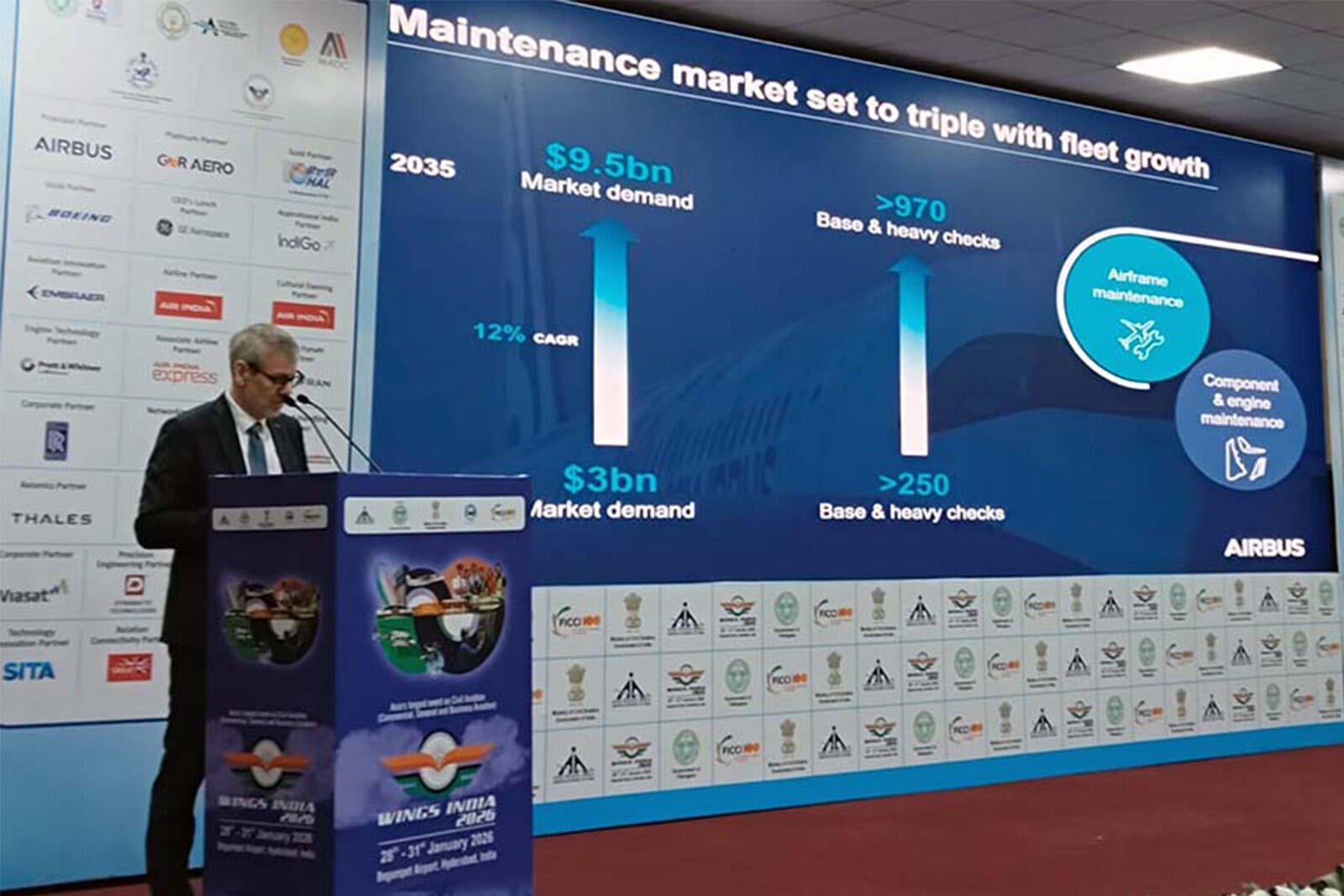
Speaking at Wings India 2026, Jürgen Westermeier, president and managing director of Airbus India and South Asia, said the technical workforce would need to grow to 34,000 by 2035 from about 11,000 today. “To keep this scaled-up fleet airborne, workforce development must evolve at the same pace as fleet and network expansion,” he said.
Airbus projects passenger traffic growth of 8.9% annually in India through 2035—the fastest among major economies—driven by strong economic growth, rising air travel penetration and expanding airline networks. Of the 2,250 aircraft required, Airbus expects to deliver more than 1,250 to Indian carriers during the next decade, with annual inductions peaking at up to 150 aircraft.
For MRO providers, this translates to a sharp increase in line maintenance activity, heavy checks, engine shop visits, component repairs and cabin modifications. Without a corresponding expansion in licensed engineers, tooling, hangar space and digital maintenance systems, fleet growth risks becoming operationally constrained.
The challenge is not just volume, but complexity. New-generation aircraft feature advanced avionics, composite-heavy structures and increasingly digital maintenance regimes. MROs will require engineers skilled in predictive maintenance, data analytics, avionics integration and modern documentation systems, alongside traditional airframe and powerplant expertise.
Westermeier also highlighted India’s expanding role in Airbus’ global engineering and supply chain ecosystem. The company’s annual procurement from India currently stands at $1.5 billion and is expected to rise to $2 billion before 2030. Airbus plans to deepen supply chain integration by sourcing raw materials such as aluminum, steel and titanium locally, a move that could significantly improve parts availability and reduce maintenance lead times.
India will also play a key role in the development of Airbus’ next-generation single-aisle aircraft, which is expected in the second half of the next decade. A new 5,000-seat Airbus campus in Bengaluru will house engineering, digital and innovation centers supporting future aircraft design. Indian engineering teams are expected to contribute to airframe redesigns associated with next-generation propulsion technologies, including larger open-fan engines that will require significant structural changes.
In parallel, Airbus’ manufacturing programs in India, including the C-295 transport aircraft and H125 helicopter final assembly lines, will further strengthen domestic engineering, quality assurance and maintenance capability, with spillover benefits for the civil MRO sector.
As global aviation’s center of gravity shifts eastward, Airbus sees India emerging not only as a major aviation market but also as a critical engineering and maintenance hub. However, the success of this transition will depend less on aircraft numbers and more on the industry’s ability to build a skilled, scalable and future-ready MRO workforce.

Related Content