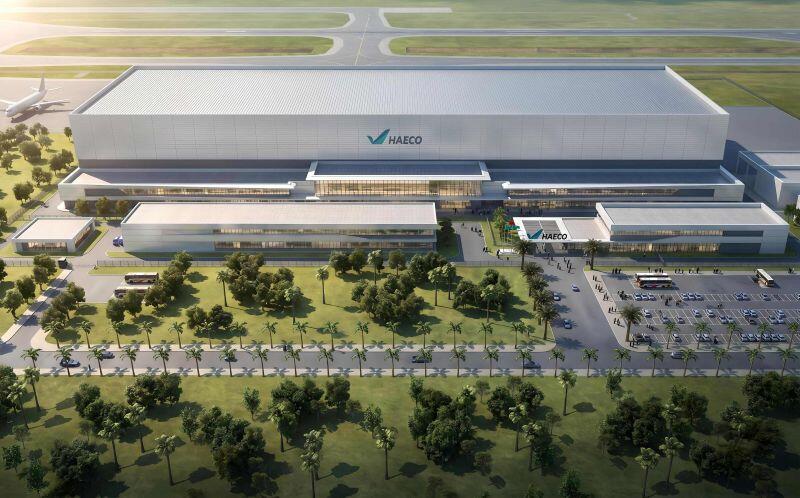
HAECO's new facility at Van Don International Airport is expected to create over 1000 high-skilled jobs.
HAECO’s recent decision to form an MRO joint venture (JV) with Japan Airlines, Toyota Tsusho and Vietnam’s Sun Group at Van Don International Airport was driven by major business advantages in the country, including strategic location, logistics capabilities and local engineering talent.
While the project will significantly expand HAECO’s regional maintenance capability when it enters service in 2028, the company says its decision was shaped as much by Vietnam’s future workforce potential as by the location’s physical characteristics.
“Vietnam is a fast-growing aviation market with strong long-term potential, making it a logical next step in our airframe expansion strategy in Asia,” HAECO Group CEO Richard Sell tells Aviation Week.
“After evaluating the locations across Asia, Vietnam stood out for its strategic location and strong connectivity, with proximity to scheduled flight routes to help minimize ferry-flight and logistics costs,” he says. “It also offers a favorable investment environment supported by local authorities, and room for future expansion.”
Sell says access to skilled technicians and engineers was also a decisive factor in HAECO’s investment strategy. “Vietnam’s robust talent pool, supported by leading universities, was a key factor in this decision,” he says. “Students in Vietnam perform strongly in STEM subjects relative to peers across Southeast Asia, supporting the development of a strong talent base.”
To help build that workforce, HAECO has already established partnerships with local educational institutions ahead of the facility’s opening. Sell notes that HAECO has signed memoranda of understanding with the Vietnam Aviation Academy and the School of Mechanical Engineering at Hanoi University of Science and Technology to boost training collaboration, adding: “We are looking to expand partnerships with other institutions to support long-term capability building and meet future workforce needs.”
The project is expected to create more than 1,000 high-skilled jobs, with structured training programs supporting the development of local engineering capability. HAECO also plans to integrate advanced digital technologies and artificial intelligence-enabled processes into the facility, providing opportunities for technicians to develop skills in next-generation aircraft maintenance.
Sell emphasizes that the future customer mix at the facility is still evolving. “It’s too early to determine the proportion of local versus international airline customers,” he says. “The facility is positioned to support a dynamic mix of both, reflecting Vietnam’s growing role as a regional and global aviation hub.”
Sell says the facility will make HAECO the only independent MRO provider in Vietnam that services international airlines.

Related Content