France’s aerospace industry is moving recruitment efforts into primary schools as employers seek to secure the next generation of engineers and technicians amid growing maintenance workforce pressures.
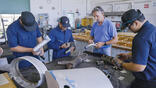
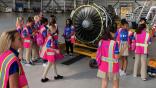
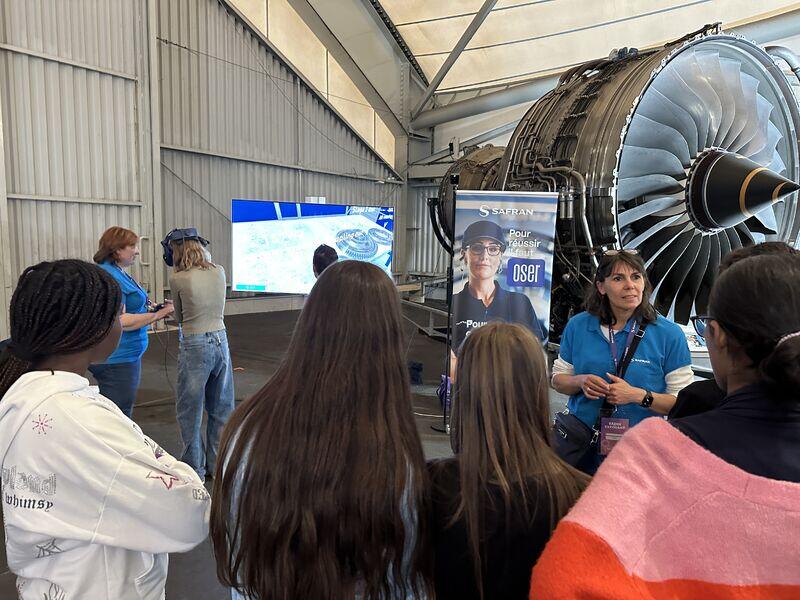
The shift was highlighted during the fifth edition of the “Rencontres Feminisons” event in Paris in June organized by French aviation association Aerometiers, which for the first time welcomed around 100 primary school pupils alongside middle school, high school and university students. While the initiative aims to encourage more young women to pursue aviation careers, it also reflects a broader recognition that building tomorrow’s maintenance workforce now requires engagement much earlier in the education pipeline.
“It is now well established by numerous scientific studies that gender stereotypes are formed at a very early stage and that the moment children enter the education system is a key milestone,” Nicolas Gros, director of Aerometiers, tells Aviation Week. “In coordination with the French Ministry of Education, Aerometiers has therefore begun developing initiatives aimed at primary schools with the objective of sparking young girls’ interest in scientific and technical careers.”
He adds that the approach, supported by the French Aerospace Industries Association (GIFAS), is designed to expose more young people to aviation careers through direct interaction with industry professionals.
The decision to target younger students comes as aerospace employers continue to plan for future workforce requirements across maintenance, engineering and operations roles.
“There is a shared awareness across all stakeholders in the aeronautics, aviation and airport sectors,” Gros states. He notes that more than 30 organizations have now signed the ‘Let’s Feminize Careers in Aeronautics and Space’ charter, bringing together companies, industry bodies, public institutions and academic organizations in a coordinated effort to promote aviation careers among women and girls.
He says the success of this year’s event demonstrates the industry’s long-term commitment to strengthening the talent pipeline rather than relying on short-term recruitment initiatives.
The pressures extend beyond attracting more people into aviation. According to Gros, employers are already experiencing recruitment challenges across several technical disciplines that underpin aircraft maintenance and operations.
“We are seeing recruitment pressures across several occupations that are essential to aircraft maintenance and operations: maintenance engineers and technicians, aircraft mechanics, avionics specialists, as well as industrial professions shared with other sectors, such as electromechanical technicians and hydraulic specialists,” he says.
While addressing technical skills shortages is an important objective, Gros believes diversity initiatives also contribute to operational performance.
“However, the purpose of our diversity approach is not only to help address technical skills needs, but also to enhance the overall effectiveness of teams, as diversity is also a driver of collective performance. More diverse teams bring a greater variety of perspectives, experiences and ways of thinking.”
Evidence suggests outreach efforts are beginning to deliver results, although changing perceptions remains a longer-term challenge. According to the GIFAS Employment Survey of its member companies, the proportion of women employed across the French aerospace sector increased to 27% last year from 21% in 2013. The survey also found that 6,300 women joined aerospace companies in 2025, representing 30% of all new recruits, while female apprentices accounted for 30% of apprentices entering the sector in 2024.
However, Gros says recent research indicates perceptions continue to pose a significant barrier. He points to a June survey GIFAS commissioned from market research firm YouGov, which found that only 15% of women surveyed could see themselves working in the aerospace sector, compared with 28% of men. The survey also found that 45% of respondents viewed the sector as not incredibly open to women, rising to 55% among those aged 18-24.
“We are fully aware that progress is not linear, that opposing trends exist, and that efforts to promote gender diversity in scientific and technical professions must be sustained over the long term,” Gros says.

Related Content