This article is published in Aviation Week & Space Technology and is free to read until Nov 05, 2026. If you want to read more articles from this publication, please click the link to subscribe.
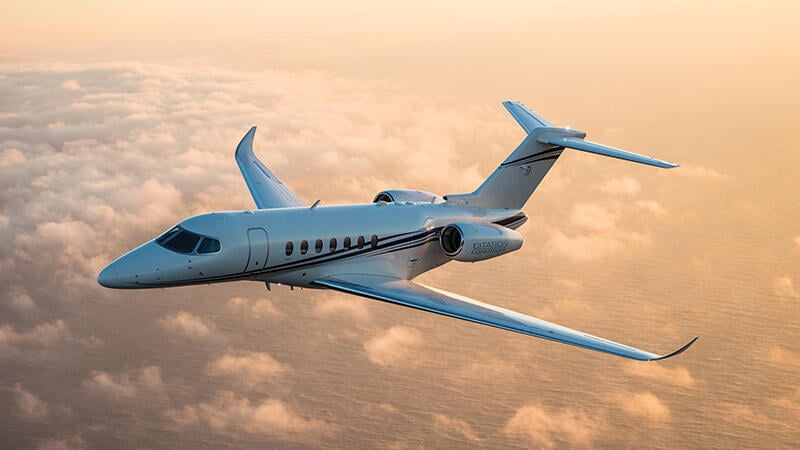
As a pure-play aerospace and defense company, Textron wants to produce at least 200 bizjets a year, including the super-midsize Citation Longitude.
When Lisa Atherton became CEO of Textron in January, the job assignment was self-apparent: Break up one of the last large multi-industrial conglomerates and lead the establishment of a major pure-play aerospace and defense company.
That move, announced April 30, was hailed by stock investors and analysts alike as long overdue and self-evident in the face of surging Western defense spending. But as recent developments have shown, defense might not be the panacea some investors hope for—and Textron’s tried-and-true business jet and private aviation units might be even more important.
Of course, that is assuming the new Textron can fix some issues there first. The company’s Aviation division delivered 168 business jets last year, and Atherton and her team are looking to reach an “equilibrium” of delivering 200 jets per year. But Textron is still is figuring out the considerable workforce and supply chain investments needed to achieve that goal.
“Externally, while the supply chain has improved in most areas, we still experience issues with some key components,” Atherton said in late July. She cited engines as continuingly difficult to source.
“At the same time, the issues are not just external; they are internal as well,” she added. “We have a much newer workforce, and we must utilize our engineering team to improve producibility for that workforce.”
Atherton and Chief Financial Officer David Rosenberg have not detailed when they could reach the 200-jet level, although Wall Street analysts say it is 2027. Meanwhile, Textron leaders increasingly are explaining what they plan to do to attain the goal. While promising not to increase overall spending, the new Textron will redirect some of its research and development funds toward workforce, factory improvements and supply chain dual sourcing.
On direct labor, Atherton asserted that attrition has improved “materially” thanks to Textron Aviation’s Career and Learning Center, a $40 million, 75,000-ft.2 Wichita recruiting and training center completed in April 2025 under Atherton’s predecessor. Walk-ins are welcome, and the center—which this year won an Aviation Week Laureate Award—has a dedicated K-12 student space to try to foster youth interest. Still, about half of Textron’s production workers have less than five years of experience, compared with just 30% in 2019.
“After spiking during COVID-19 and remaining elevated, attrition has now returned to more normalized levels, with the improvement even more pronounced among early career hires,” Atherton said during the company’s 2026 second-quarter earnings teleconference. “In addition, hiring levels have returned to a more normalized pace. As our workforce gains experience and stability improves, we expect to see corresponding gains in productivity and efficiency.”
On the factory floor, Textron says it has “significantly increased” engineering production support. A key goal is to cut out-of-station work, which is even more befuddling to less experienced employees, according to the CEO. Atherton said the company is aiming for more capacity in landing gear, milling and painting to support improved throughput and execution. “We are also investing in producibility and process improvements across the King Air and light jet production lines,” she said.
Similar improvements are being pursued at the Bell helicopter and Systems divisions as Atherton’s team also tries to harmonize the company’s aerospace and defense operations.
Last but not least, Textron’s supply chain team is focusing on dual-sourcing, including critical raw materials for the gearbox and rotor blade manufacturing, such as gear steel, castings and extrusions. Unquantified capital investments made at Textron’s Drive System Center and rotors facility began in the latest quarter.
Analysts at Jefferies said in June that the new Textron could also insource up to a half-dozen suppliers.
Overall, Rosenberg said the improvements should yield about $150 million of additional annual pretax profit as the new Textron looks to increase the Aviation unit’s operating margin to 13%, with incremental improvements of 20-25% per quarter, from around 11%. Just as important, the company should be able to protect its growing backlog—$8 billion at Textron Aviation alone at midyear, up from $7.7 billion at the start of 2026—while better satisfying bizjet customers who are still waiting.
“When we look at the various type models, we want to make sure we don’t disrupt this very strong backlog that we have,” Atherton explained during the company’s first-quarter earnings call on April 30. “There are certain type models that if we put a little more investment, we could reduce the amount of time it takes to build those aircraft. Some of those type models are sold out for years. If we were to bring them in to 18 months or so as a lead time, I think that much more aligns with customers’ expectations.”
Analysts see the logic. Scott Mikus, a director at Melius Research, said in recent research notes that the backlogs in the bizjet market for the main manufacturers—General Dynamics’ Gulfstream, Bombardier, Textron, Dassault Aviation and Embraer—started this year 70% higher than in 2019. President Donald Trump’s signature One Big Beautiful Bill Act’s reinstatement of bonus depreciation should stimulate even more orders, as should good general economic conditions.
For its part, Textron Aviation is in a “very strong position, having increased its backlog by more than four times since pre-COVID,” Atherton said. Not surprisingly, headquarters is girding for the planned handoff of the division’s leadership. Ron Draper, who led Textron Aviation for eight years, retired on Aug. 31 and was succeeded by Brian Rohloff, former senior vice president of customer support. Both men are well known in industry and have spent decades at the company. Draper will stay on as a senior advisor through year-end to aid the transition.
Under Draper’s leadership, Textron Aviation achieved a lengthy list of innovations and product milestones. Among them are FAA certification for the Citation Longitude super-midsize business jet, Cessna SkyCourier twin-engine utility turboprop and Citation Ascend midsize business jet; development of Gen3 iterations of the Citation M2, CJ3 and CJ4; and modernization of the King Air turboprop line. Textron Aviation added technological and safety innovations, such as the Garmin Emergency Autoland on the Gen3 jet lines. The company was the first bizjet manufacturer to offer Gogo Galileo satellite internet across its Citation lineup.
“Serving as president and CEO of Textron Aviation has been the greatest honor of my career,” said Draper, who joined the company in 1999.
“Brian is a proven leader who brings a deep understanding of our business, our products, our customers and our industry,” Atherton said Aug. 24. “Throughout his 29-year career with Textron Aviation, Brian has demonstrated strong leadership across multiple functions and has built trusted relationships with employees, customers and suppliers.”
Such steadiness overseeing the bizjet and private aviation division comes as Textron increasingly is buffeted by the vagaries of U.S. defense spending. While encouraged by Trump’s $1.5 trillion fiscal 2027 spending request for national security, up 50% from the current year, Textron and other companies are nonetheless finding the defense contracting environment difficult.
Recently, the company decided to self-fund certain activities on the MV-75 tiltrotor aircraft to keep the program on schedule while awaiting funding through an above-threshold reprogramming request the U.S. Army has made to Congress. While the funding is ultimately expected, Rosenberg has had to warn shareholders it could reduce the company’s full-year results by $0.20-0.30 per share and have a potential cash impact of $150-250 million if not. In other words, that alone could wipe out the first year of Textron Aviation’s operational improvement.
Then in September, the U.S. Navy again delayed its next-generation trainer, pushing a potential award back three months from March to June 2027 as it gives competitors more time to respond to its request for proposals. Textron and Leonardo together are offering the Beechcraft M-346 against Sierra Nevada Corp.’s clean-sheet Freedom trainer.
Textron’s stock price was down almost 7% year to date as of mid-September, while the S&P 500 index has gained 13%. Analysts cite growth and operational concerns, but they also see the opportunity to pivot post-spinout.
“We continue to be impressed by Textron’s new management team and the impact that they are having on the portfolio, the business and investor communication,” Vertical Research Partners analysts Rob Stallard and Karl Oehlschlaeger write in recent research notes. “Selling Industrial and sorting out the operations will take some time, though, but we think over the next 2-3 years the benefits of these changes will become apparent.”
—With Molly McMillin in Wichita

Related Content