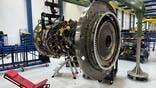
The engine division of Estonia-based Magnetic Group plans to drive up heavier CFM56 workscopes this year while further developing Leap quick-turn services, mooted to come online in 2027, amid testing and material bottlenecks in the engine aftermarket.
Filip Stanisic, managing director of Magnetic Engines—established in 2021 with a focus on CFM56 engine repairs—says the company intends to further expand its existing CFM56 capabilities. “We have transitioned from light repairs to heavier workscopes, including core performance restoration, and this focus will continue into 2026. The company can already perform full hot section restoration in-house and, with the commissioning of its own balancing machine in [the second quarter of] 2026, will be able to complete full CFM56 overhauls and module repairs internally.”
As part of its future Leap capability, on track to start Leap-1A and -1B quick-turn shop visits in Tallinn from next year, the company is currently investing in tooling for the engine programs. “We are increasing our stock of critical hot section material to support fast modular repairs, where exchange parts are often the only practical solution. Given rising material prices and supply constraints, this has become a strategic area of focus,” he adds.
Stanisic says the expansion of the MRO provider’s CFM capabilities continues despite several primary challenges in the CFM56 aftermarket in Europe. “One of the biggest challenges in Europe is the lack of available engine test cells,” Stanisic says. “Many CFM56-5B and -7B engines are now over 20 years old, and demand for quick hospital repairs and modular replacements has increased significantly.”
While several new engine shops have been established in recent years, very few operate their own test cells, he says. “As a result, engines often need to be tested on-wing or sent to third-party facilities, where waiting times can reach four to six months.” Stanisic predicts that there will also be an increased need for CFM Leap engine testing capacity, which in turn will occupy certain resources at MRO shops.
Stanisic identifies another trend for a growing use of spare engine modules, especially fan and low-pressure turbine major modules as a means of reducing turnaround times. “This approach is increasingly applied both in shops and directly in the field,” he says. “At the same time, the number of available CFM56 repair slots in Europe is decreasing, as more shops shift capacity toward Leap engines. This is creating longer wait times for CFM56 repairs, similar to the situation seen in 2017–19.”
Like most global regions, material availability also remains a major constraint. “Critical hot section parts and life-limited components are extremely difficult to source,” Stanisic says. “OEM delivery times are long, and for Leap engines, limited [used serviceable material] availability continues to drive repair [turnaround times] of seven to 10 months.”

Related Content