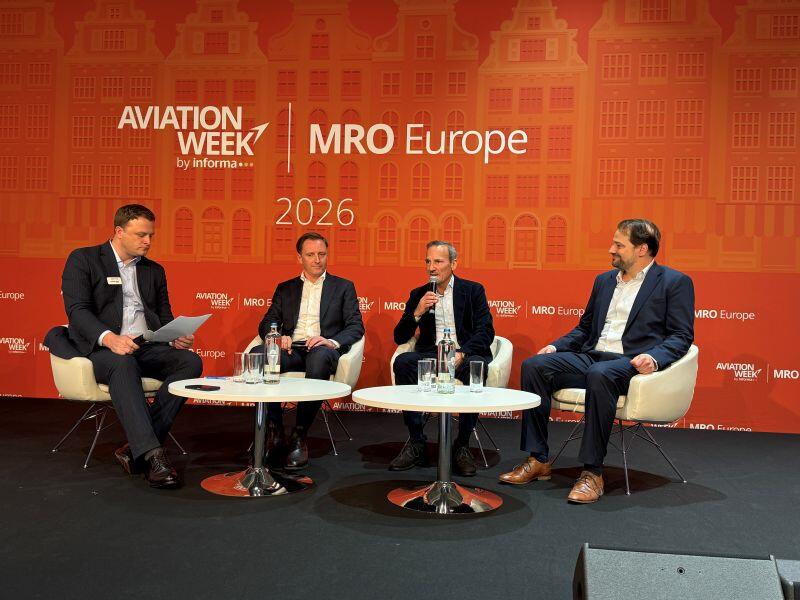
MRO Europe panel on Oct. 27 with (from left) Aviation Week editor James Pozzi (moderator), Lufthansa Technik’s David Doyle, HAECO’s Klaus-Peter Leinauer and AFI KLM E&M's Peter van Helden.
AMSTERDAM—Airline and aftermarket forecasts show strong growth, but one factor is not captured in those key performance indicators. “That’s airline CFO sentiment, which is not high at the moment,” says David Doyle, Lufthansa Technik’s vice president corporate strategy, speaking at Aviation Week’s MRO Europe.
The volatility in fuel prices, geopolitical risks and economic uncertainties are difficult to model, but all of those variables can drive costs higher—especially big-ticket items—and these factors are hard to plan or predict.
Those volatilities are making MROs rethink sovereignty and what capabilities and capacity they locate where. While many companies assessed those factors during the COVID-19 pandemic, a heightened focus has occurred over the last 2-3 years.
Lufthansa Technik “started to look at our own network, and also our exposure to American OEMs in particular” due to geopolitics, Doyle says. “Given that about 50% of the MRO market is engines, and with Pratt & Whitney and GE being so prominent, there’s a lot of IP and a lot of supply chain that is coming out of the U.S. that services Europe,” he says, as well as many component OEMs being located in the U.S.
“MRO is traditionally one of the most global businesses there can be,” Doyle says, and millions of parts move through logistics chains daily. “If somebody somewhere decided to switch off that access (to IP and parts), MROs worldwide would have an issue,” he says.
Aviation until recently largely rose above disruptive politics, “but as we’ve seen over the past 12-18 months, the ability just to play with those dials is becoming a tool that is being used in the geopolitical discussions between the EU and the U.S., but also between the U.S. and China,” Doyle says. And the implications for materials can cause bottlenecks.
For instance, Lufthansa Technik is having a hard time getting a GE Aerospace CF34 bearing because that part also flies on the TF34 military turbofan and other military engines. Doyle says that bearing is first flowing to U.S. military engines so “we’re down the chain,” and its customers’ engines are sitting for months waiting for parts. “We need a European supply chain that produces some of those parts that are free of a U.S. military” need, he suggests.
Peter van Helden, AFI KLM E&M senior vice president of component product, agrees about the IP and parts access concerns, which are influencing the MRO to develop deeper parts repair. He also advocates the independent MROs working together to guarantee IP access in order to serve customers.
Because aviation is “integral to modern society . . .we should not accept any fences in our global industries,” says Klaus-Peter Leinauer, HAECO’s senior VP corporate sales Europe, Middle East and Africa. Geopolitical unrest, especially in the Middle East, is impacting the efficiency of the global logistics network, which “is set up and optimized so that essential parts can move wherever” they are needed, he says.
“Those decisions can’t be made purely on an optimization basis anymore,” adds Leinauer.
That is driving MROs to establish parts pools in certain geographic regions and make different choices about where repairs are made, in some cases due to costs and tariffs.

Related Content