This article is published in Aviation Week & Space Technology and is free to read until Jan 18, 2026. If you want to read more articles from this publication, please click the link to subscribe.

Opinion: The ‘Four Horsemen’ Of Aerospace Supply Chain Risk
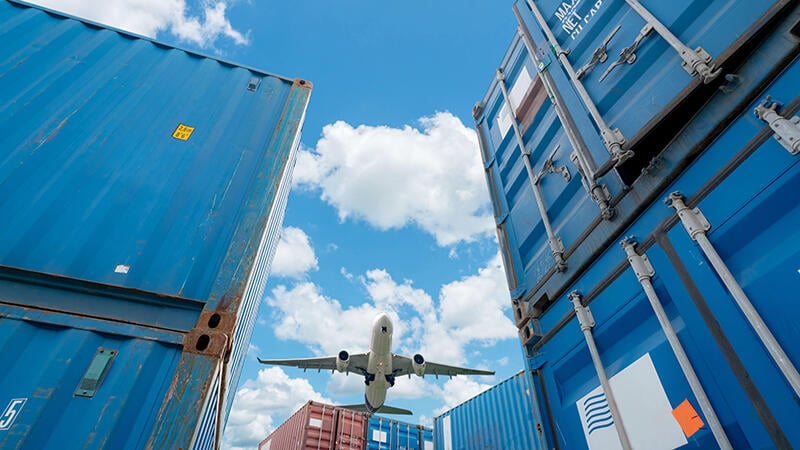
aircraft flying over shipping containers

Repair stations have recently faced new costs and compliance complexities resulting from tariffs.

Credit: Panther Media Global/Alamy Stock Photo

This summer, ARSA began coordinating with the International Air Transport Association on multiple supply chain resilience “workstreams.” The two organizations are focusing on international risks and building on last year’s congressionally mandated Aerospace Supply Chain Resiliency Task Force report—drafted by ARSA and other leading aviation associations. The task force identified four categories of risk to the U.S. aerospace supply chain, all of which have international implications.

GLOBAL INTERDEPENDENCE

Aviation is inherently international. Because the state of registry controls maintenance, U.S.-registered aircraft operating worldwide depend on a network of more than 1,200 foreign FAA-certificated repair stations. These technically advanced, specialized outposts are also certificated to work on other countries’ aircraft, making their capabilities essential to American interests in multiple ways, including maintaining the U.S. fleet while keeping trading partners and international consumers on the move.

Compliance with conflicting national regulatory requirements is a major challenge. In a few cases, bilateral agreements make it easier for repair stations and approved maintenance organizations to serve international customers and operators to receive service abroad. Those agreements also benefit manufacturers by reducing time and complexity associated with obtaining regulatory approvals to export their products. The FAA and its counterpart civil aviation authorities should be more aggressive in expanding bilateral regulatory partnerships to leverage resources of other authorities, reduce compliance and oversight complexity and enhance international market opportunities.

CRITICAL RESOURCES

Modern aircraft are among the most highly engineered products in the marketplace, and material requirements are included in design approvals. Critical minerals used in aerospace include arsenic metal, cobalt, copper, gallium, germanium, hafnium, magnesium metal, molybdenum and titanium sponge (to name just a few). When access to specific materials is disrupted, the risk of manufacturing delays and parts shortages increases.

GOVERNMENT ACTION

To the surprise of nobody in the industry, government action (and inaction) and policy are the third supply chain risk.

Every link in the aviation chain—design, production, operations and maintenance—is closely scrutinized and, in many cases, FAA approval is required before the industry works. When the FAA shuts down, agency personnel who make regulatory determinations are unavailable or diverted. A shutdown like the one endured in October and November also means congressionally directed policy improvement and rulemaking grind to a halt and that the essential government employees we depend on every day to help keep the National Airspace System (NAS) operating go without pay.

None of that is good, and the last is simply unfair. ARSA has long supported legislation to insulate the FAA from future shutdowns and strongly urges Congress to act in this area.

Tariffs are another example of government action affecting the supply chain. For the last 40 years, thanks to the World Trade Organization Agreement on Trade in Civil Aircraft, aircraft and parts have moved tariff-free between signatories. Without artificial trade barriers, American aerospace companies thrived in the highly competitive global market because of our commitment to safety, quality and innovation.

In recent months, however, repair stations—the overwhelming majority of which are small and medium-size entities—have had to deal with new costs and compliance complexities because of tariffs. The industry and its customers, including flying passengers and shippers of goods across the world, would benefit from a return to zero tariff treatment for civil aviation.

WORKFORCE

The technical workforce is both an area of risk and a cause for optimism.

Maintenance technicians, air traffic controllers and other critical professionals have been in short supply for more than a decade, which has undermined the efficiency of the NAS and limited industry growth. Thanks to lobbying by ARSA and its allies, Congress created and expanded workforce grant programs and passed legislation to lower entry barriers for servicemembers, high school graduates and others entering the maintenance industry. While those efforts have borne some fruit, the technical worker shortage continues to undermine industry efficiency.

These “four horsemen” of aerospace supply chain risk need not represent an apocalypse. The overarching risk to the maintenance industry is uncertainty. It is extremely difficult for companies—big or small—to plan in a volatile environment when access to foreign customers and suppliers, resources, government policies, costs and the labor situation are all in flux. The aerospace industry, those who work on its behalf (like ARSA and your other friendly neighborhood trade associations and unions) and policymakers must work together more aggressively to mitigate uncertainty, both in the U.S. and around the world.

Christian A. Klein is the managing member of Obadal, Filler, MacLeod & Klein, overseeing the firm’s policy advocacy practice. He represents trade associations as a registered federal lobbyist and provides strategic communications and legal counsel services to clients. He is executive vice president of the Aeronautical Repair Station Association.