This article is published in Aviation Week & Space Technology and is free to read until Dec 17, 2025. If you want to read more articles from this publication, please click the link to subscribe.

VIP Interiors MRO Takes Targeted Approach

completion center

Suppliers and completion centers are streamlining inventory and tightening engineering collaboration.

Credit: JCB Aero

The MRO sector for executive and VIP aircraft interiors is at an important crossroads, where creating luxurious, custom cabins must be balanced with strict safety standards, smooth technical integration and efficient operations.

The prevailing trends, drawn from discussions with key industry players, such as Collins Aerospace and JCB Aero, reveal a market driven by an accelerating push for technological modularity, a growing appreciation for cost certainty and persistent pressure from a global supply chain still struggling to match capacity with demand. As it appears, the VIP MRO sector is working to balance custom-made interiors with the need for reliable, large-scale operations.

A Strategic Trade-Off

Operators deciding between a full refurbishment or starting fresh with a new eco-friendly completion are facing a more complex choice than ever. “In VVIP interiors, the decision between a major seating refurbishment and a new green completion is increasingly driven by technical integration, cost certainty and long-term value,” says Scott Howard, director of business development for executive aircraft seating at Collins Aerospace.

Howard notes that while refurbishments offer cosmetic and comfort upgrades with minimal downtime, costs and risks escalate quickly when structural or electrical changes are involved. Conversely, green completions allow for fully optimized layouts and stronger resale value, albeit with higher up-front investment.

“The trend among operators is toward standardized, proven seat platforms with customization focused on finishes and ergonomics rather than one-off mechanisms,” Howard notes.

JCB Aero Chief Operating Officer Frédéric Dezauzier echoes similar sentiments, observing that most operators now prioritize shorter downtimes and cost efficiency. “In such cases, the layout is not redesigned, or only slightly modified, and we can offer renewal of the carpets, upholstery and furniture,” he explains. A notable trend is the use of laminates to refresh existing furniture—an approach that is “faster and more economical.”

This shift toward targeted upgrades is also evident in seating strategies. “Many customers now favor targeted upgrades, such as new foams, dress covers or power enhancements, over full retrofits,” Howard adds, with maintainability and reliability remaining top priorities in seat selection and fleet planning.

VIP interiors specialist
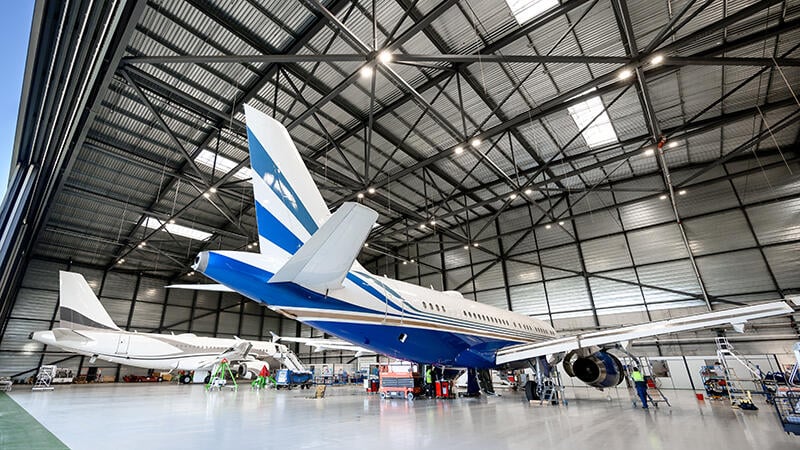
Blending creative design, customer needs and certification rules is a careful balancing act for VIP interior specialists. Credit: JCB Aero

Certification Complexity

As cabin systems advance, meeting certification requirements has become tougher and more complicated. “Seating certification is always a complex step, with many regulatory standards needing to be met around safety, structural integrity, flammability and many more,” Howard explains. The integration of actuated systems, mechanical components and in-seat power adds layers of complexity to testing and validation.

JCB Aero points out a similar challenge affecting both cabin management systems (CMS) and inflight entertainment (IFE). “Systems like IFE or those managed by the CMS, such as window shades, become obsolete over time,” Dezauzier notes. Additionally, spare parts are often unavailable, and legacy systems give the impression of outdated technology. Wireless alternatives are increasingly favored, as they can be integrated into the cabin more easily.

Certification delays are especially tough when bold design ideas run up against strict regulations. “Bringing together elements of creative design, customer desires and certification standards requires a delicate balancing act,” Howard says. At Collins, this is mitigated by a robust team of engineers and cabin integration specialists who “speak a common design language,” he says.

JCB Aero offers a practical example: “One example could be a request to include closed rooms, where rapid decompression must be properly managed.” In such cases, decompression panels and layout revisions are essential to meet certification requirements.

Supply Chain Pressures

The VIP interiors segment is not immune to the supply chain disruptions that have plagued commercial aviation. “The supply chain is still impacting the activity very strongly,” Dezau­zier says. Market capacity remains saturated, requiring focused efforts to secure critical supplies.

Collins Aerospace has responded with a multiprong strategy. “We’ve taken some proactive steps to help mitigate existing and future supply chain snags,” Howard says, citing supplier diversification, localization around critical sites and investment in advanced inventory management systems.

These steps are not just quick fixes—they reflect a wider move toward building stronger operations, especially as delivery times and parts supply keep changing.

Modular Intelligent Cabins

Perhaps the most transformative trend is the emergence of modular cabin architecture powered by next-generation electrical systems. Howard predicts the biggest game changer for VVIP cabins will be the move to high-voltage DC power with solid-state distribution using gallium nitride and silicon carbide technology.

This shift enables a lightweight, software-defined microgrid that delivers power directly to seats and monuments. “That opens the door to true modular interiors where monuments and seating become plug-and-play, refresh cycles are faster, and the cabin runs cooler and quieter,” Howard says.

JCB Aero sees similar potential in wireless technologies and lighting innovations. “Lighting systems are no longer just for illumination but can also be used for projection,” Dezau­zier notes. Electronically dimmable windows and interactive surfaces—where mirrors and windows double as touchpads—are also gaining traction.

Satcom is another frontier, with low-Earth-orbit constellations like Starlink and OneWeb challenging traditional geostationary networks. These technologies promise enhanced connectivity and integration flexibility, especially for high-end operators seeking seamless digital experiences.

“It is an exciting time, as many new technologies are reaching market maturity—and this evolution will not stop, further supported by digitalization, AI and new materials,” Dezauzier says.

BBJ MAX 8
Aloft AeroArchitects will oversee all aspects of the highly customized VVIP interior on a BBJ MAX 8. Credit: Wilhelm Wieland

Strategic Partnerships

Beyond technology, strategic partnerships are reshaping the VIP aftermarket landscape. Silk Way Afezco and Execu­Jet (part of the Luxaviation Group) announced a joint venture in October to develop a next-generation fixed-base operator (FBO) at the new Alat International Airport in Azerbaijan.

The collaboration includes an aircraft management agreement for Silk Way Afezco’s new Gulfstream G500—marking Luxaviation’s entry into the Azerbaijani market. “This is a milestone partnership for Luxaviation and ExecuJet as we expand into Azerbaijan market,” Patrick Hansen, CEO of Lux­aviation Group, said in a statement.

The FBO, slated to open in early 2027, will draw inspiration from ExecuJet’s award-winning facility at Dubai’s Al Maktoum International Airport. The new FBO is part of a broader initiative to establish a comprehensive aviation services hub in the Alat Free Economic Zone, reinforcing Azerbaijan’s role as a strategic gateway between Europe, Asia and the Middle East.

The aircraft management agreement ensures comprehensive support for the Gulfstream G500, including operations, flight planning, maintenance oversight and crew management.

Meanwhile, Aloft AeroArchitects has been awarded a VVIP interior completion contract for a new Boeing Business Jet (BBJ) MAX 8. The project will be executed at Aloft’s Delaware facility and certified through its in-house Organization Designation Authorization on behalf of the FAA.

As with all MAX BBJs, the aircraft also will feature Aloft’s Auxiliary Fuel System, installed in the forward and aft cargo compartments. The modular system can increase range up to 50%, highlighting the growing demand for mission-flexible configurations.

All these changes show that the VIP interiors market is both maturing and innovative. Refurbishments are planned with more care, certification is becoming more tricky, and new technology is opening doors—from flexible power systems to touch-responsive cabin surfaces.

Operators are taking a more practical approach, choosing upgrades that look good, work well and do not keep the aircraft grounded for too long. In response, suppliers and completion centers are streamlining inventory, tightening engineering collaboration and forming global partnerships to boost local support.

Keith Mwanalushi

Keith Mwanalushi primarily writes about the global commercial aviation aftermarket and has more than 10 years of experience covering it. He is based in the UK.