U.S. Air Force Pairs Robot Dogs, Drones For Aircraft Inspections
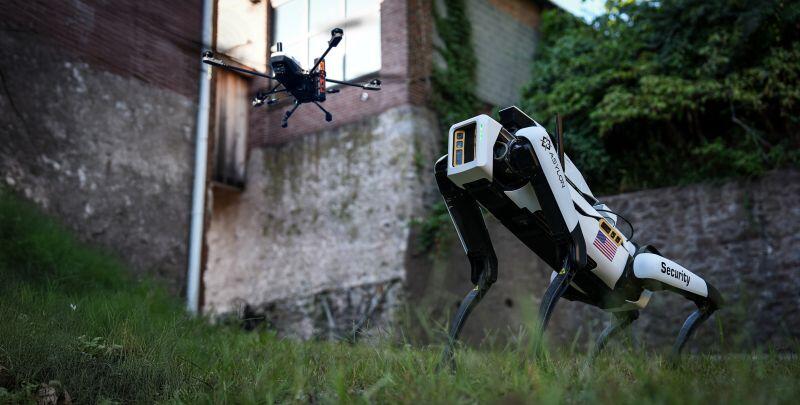
Asylon’s DroneDog inspects aircraft underbellies and sides using cameras and lidar, paired with drones for digital mapping.
Drone-based aircraft inspections have gained prominence in the commercial aviation industry to improve speed and safety. Now, the U.S. Air Force has selected a robotics company that pairs drone technology with ground-based robotic dogs to further increase efficiency.
In July, the Warner Robins Air Logistics Complex awarded a Phase III contract to Asylon, a robotics company that specializes in security automation systems. Asylon will use its complementary robotic platforms to perform general visual inspections of the base’s aircraft and weapon systems.
The Multi-modal Autonomous Robotics for Inspection of Aircraft (MARIA) system uses Asylon’s Guardian sUAS drone system and its DroneDog quadrupedal robot to perform digital mapping of an entire aircraft with cameras and lidar. These are paired with Asylon’s back-end software to program inspection paths and ingest inspection data.
“Picture the DroneDog underneath the aircraft inspecting the underbelly and sides, [alongside] the Guardian sUAS with the same basic hardware and software package [inspecting] the top of your aircraft,” says Anthony McCarty, senior vice president of government at Asylon. “Working in unison, they’ll autonomously do digital mapping of the aircraft and be able to identify anomalies, defects or other things the customer . . . is asking us to pay attention to.”
Inspection data is fed to Asylon’s “command and control platform,” says McCarty, which maintenance staff can use to evaluate results. Like other drone-based aircraft inspection platforms, the technology eliminates the need for inspectors to work manually at height while strapped into safety equipment and makes the process considerably faster.
McCarty says what used to take the Air Force days or weeks to execute can be “knocked down to a matter of hours,” while also creating consistency across inspections via pre-programmed inspection routes and points of interest. Asylon is working with the Air Force to program aircraft specifications and inspection locations, such as hangar bays or outdoor areas, into the system.
“Right now, we’re focused on the [Lockheed] C-5 and C-130, but [Warner Robins] has a vast array of weapon systems or aircraft types down there,” he says. “The ultimate goal is that we will expand to all of the aircraft types [there] and then to the larger Air Force Logistics Complex writ large.”
Asylon also intends to expand the MARIA system’s capabilities, including enhancements of its robotics and software, stronger artificial intelligence anomaly detection and possibly even what McCarty calls “humanoid fleet management,” in which a robot could conduct maintenance tasks on an aircraft while the Guardian and DroneDog systems perform inspections.
Warner Robins is Asylon’s first aerospace industry customer, but McCarty says the company’s board includes civilian aviation experts, and its founders and C-suite have experience in the defense industry, so he is confident about growing its aircraft inspection capability. For instance, he says Asylon has advisors who are “very familiar with FAA landscaping, how to work authorizations beyond visual line of sight waivers and some of the other waivers,” which has helped the company navigate regulatory nuances for operating the technology in an aviation environment.
“We absolutely think there's a demand signal from other government clients and what we’re hearing, and so we’re looking to expand this capability across all of the services at that depot level maintenance activity, whether it be aircraft, ships, large facilities, whatever the case may be,” McCarty adds.

Related Content