Setna IO CEO: MRO Earnings Could Soon Outpace Parts Trading Business
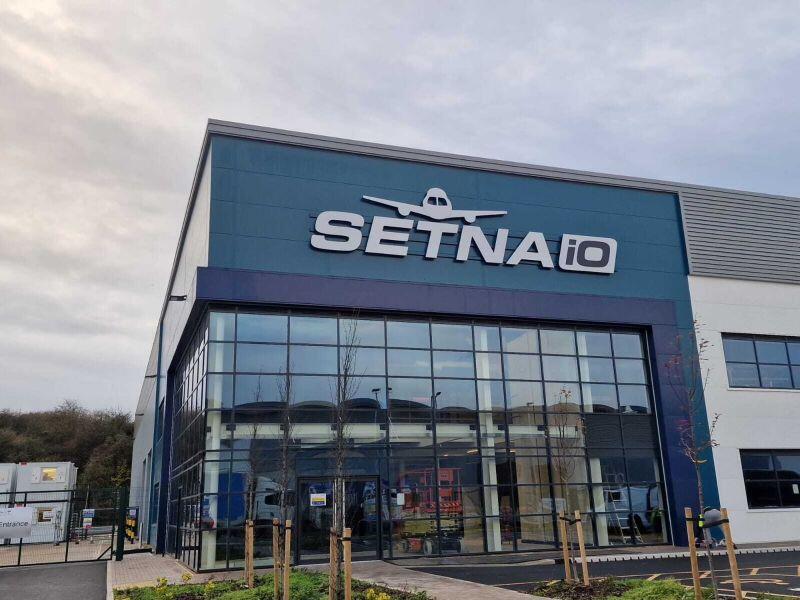
ORLANDO—Setna iO has spent the past couple of years building up its internal MRO capabilities, and if CEO David Chaimovitz has his way, this portion of the business could outpace its parts trading business in the next five years.
“I’m very excited about building up our MRO business,” he told Aviation Week during its recent MRO Americas event. “Our goal, medium term, is to have our MRO earnings outpace our USM [used serviceable material] earnings. I don’t think there is ever going to be an entity in Setna that’s going to be bigger than trading, but if you take everything else and add it up, it could be in the future, and we hope that it will be.”
Chaimovitz previously told Aviation Week he expected MRO to grow to 20% of Setna iO’s earnings by this fall. He said momentum is now on track for MRO to reach $35 million of EBIDTA by the end of this year, and he thinks this can grow to $50 million next year.
The company’s recent acquisitions of Zulu Global, Landing Gear Technologies (LGT) and J&C Aero are helping to boost the portfolio, as are expansions at Setna iO’s Setnix repair stations in Tempe, Arizona, and the UK.
LGT recently signed a lease for another 40,000 ft.2 of space, bringing its total footprint to 180,000 ft.2 in Hialeah, Florida. The subsidiary is also adding high-velocity oxygen fuel thermal spray coating capabilities and investing in its accessory shop. Chaimovitz expects LGT’s staff to grow to 300 from around 200 in the next 2-3 years.
Zulu Global is more than tripling its footprint in South Florida, having recently signed a lease on a new 110,000 ft.2 facility in Hialeah. Chaimovitz said the new facility will add room for additional staff, noting that this should grow to up to 200 employees in the next five years, up from its current 65.
Setnix UK is finishing construction on its new headquarters, where it will “hire very significantly,” according to Chaimovitz. He noted that the company has purchased a lot of automated test equipment to support growth in its avionics business, and its wheels and brakes business “is doing solid.”
Setnix Arizona recently moved into a new 120,000 ft.2 facility and will grow to 300 employees from 100 over the next five years. “There’s a lot of room and plans for growth there, as we start to dismantle more engines and repair more engine parts, as well as the [auxiliary power unit] parts that we’ve historically done,” Chaimovitz said.
While Setna iO’s MRO businesses are receiving significant investment, Chaimovitz said that he expects USM segment growth to continue amid industry acquisitions of large players and more material from aircraft such as Boeing 737 MAXs, 787s, Airbus A350s and A320neos hitting the market.
“We’re going to be in an interesting time where you have a massive legacy fleet that’s flying, but you also are going to have a very significant new generation fleet flying that is far larger than any time in the history of the MRO space,” he said. “People throw out $9 billion [as] the total USM spend today around the world. I don’t know what that number really is, but whatever that number is today, I expect it to be much, much larger in the next 10 years, just because we’re going to be able to trade in the older generation stuff at scale, as well as the newer generation stuff at scale, which is not really happening today, but will be as we move forward.”
Although Setna iO bills itself as agnostic when it comes to aircraft acquisitions, Chaimovitz said he would be thrilled to win a bid on a Boeing 787 or 777-300 tomorrow. “There’s a lot of demand; there’s not a lot of supply out there. There’s a fundamental shortage of widebody aircraft,” he said. “There’s been very few 787s parted out, and now they’re starting to age where there’s really strong demand for USM, and we don’t have much of that material, so that would be really great if we could get into that.”
Chaimovitz added that asset sourcing can be a challenge. “Our pipeline this year is significantly better than it was last year, and we closed more assets in [the third quarter], [the fourth quarter] and [the first quarter] than we did versus a year ago,” he said. “We’re very happy with where we sit, but that’s always something in the back of our mind: Can the market ever become truly irrational, where people are buying assets for more than they’re actually worth in pieces? And I haven’t ever seen it happen, but the possibility of that happening is real—although I don’t think it’s a high likelihood of happening.”

Related Content