This article is published in Aviation Week & Space Technology and is free to read until Jan 17, 2026. If you want to read more articles from this publication, please click the link to subscribe.
Next-Gen Aircraft Brake Designs Seek Extended Life Spans
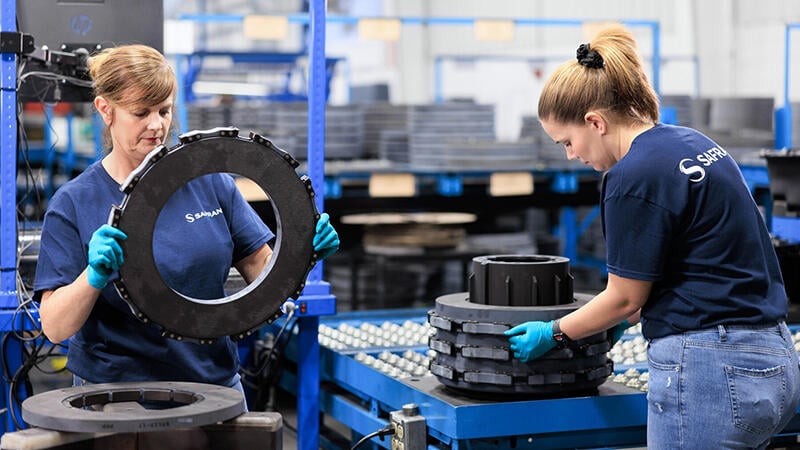
Safran says its SepcarbIII OR carbon brakes have a service life three times longer than steel brakes with three times more energy absorption capacity.
Few other airframe components endure greater stress than brakes. They are subjected to extreme heat in the process of stopping an aircraft on touchdown and exposed to corrosive chemicals and temperature extremes. Consequently, keeping them on-wing longer continues to present challenges, which OEMs are addressing with emerging carbon anticorrosion coatings and manufacturing technologies.
CARBON CONSIDERATIONS
Jean-Michel Hillion, executive vice president for Safran Landing Systems’ wheels and brakes division, says the OEM’s SepcarbIII OR advanced, proprietary carbon composite material offers endurance, weight and performance advantages compared with steel brakes. “This material offers an energy absorption capacity three times greater than traditional steel brakes along with quick cool-down capacities,” he explains. “They offer airlines a service life up to three times longer, with an average of 2,200 landings per overhaul.”
Hillion says Safran Landing Systems is working on designs of new carbon brakes for airframe producers of commercial, military and business aircraft. Specifically, he cites the Boeing 777X-8F, Airbus A350-1000 freighter and ultra-long-range versions of the A350 among their applications. Other new carbon brake designs are being pursued for the Dassault Falcon 10X business jet, Bell Textron MV-75 tiltrotor and the Airbus H160M Guepard helicopter. Flight-test campaigns, including brake certification tests, have begun for the H160M Guepard and are set to begin soon for the 777X and Falcon 10X, he reports.
Ed Wasilewski, Honeywell Aerospace’s general manager for wheels and brakes, points to Carbenix C6000 as the OEM’s newest carbon braking innovation. It is the latest iteration of Honeywell’s carbon technology, which is being incorporated into brakes and other specific programs. The first implementation was on the Boeing 777 brake, supplied by Honeywell and introduced a few years ago.
“With the initial Carbenix C6000 brakes coming back for overhaul, we are seeing better than a 20% improvement in time on-wing compared with our prior iteration of carbon technology, and two to three times as long as conventional metal alloy brakes,” Wasilewski says. “By extending the time on-wing, we can reduce the volume of carbon required to support our customers.”
Wasilewski adds that Carbenix C6000 is enabling Honeywell to achieve a higher density product in less processing time, which can further reduce carbon footprint. “Overall, we continue to evolve our understanding of the carbon manufacturing process with an aim to reduce cycle time and input materials,” he says.
Honeywell is in the final stages of certification approval for implementation of Carbenix C6000 on Honeywell’s Airbus A380 and military platforms, with fielding commencing in 2026, Wasilewski reports.
Advances in carbon technology have a dual benefit of cost savings and sustainability. Along those lines, Matt Maurer, vice president and general manager of landing systems at Collins Aerospace, cites the OEM’s Duracarb carbon heat sink.
Building on the company’s long-established, proprietary Super-Carb carbon heat sink technology, Duracarb offers a 35% longer life span compared with other carbon materials, resulting in reduced spare parts provisioning and lower overall maintenance costs, Maurer says. He notes that the technology is now deployed on thousands of commercial and military aircraft worldwide.
Compared with steel brakes and competing carbon brakes, Duracarb carbon brakes offer two to four times longer life and reduce shipset weight by approximately 700 lb. over steel brakes, Maurer explains. “These benefits translate into considerable fuel cost savings and emission reductions. We will continue to incorporate technological advancements to our Duracarb carbon heat sinks on upcoming commercial and military aircraft programs,” he says. “At the same time, we are developing cutting-edge friction materials that will extend on-wing life, as well as designing solutions which incorporate more reusable components with the goal of greater sustainability and innovations.”
ANTIOXIDATION
Maurer points out that carbon brakes operate in extreme environments, and over the life of the brake, high temperature exposure for prolonged periods of time can potentially cause the carbon material to oxidize. “Brakes also typically operate in an environment where they are often exposed to modern runway deicers and other contaminants,” he says. “Collins’ HTx oxidation protection system is a specially formulated multilayer coating that increases resistance to thermal oxidation while protecting the brake from the adverse effects of catalytic oxidation.”
At Safran, “Our cutting-edge coatings are designed to prevent carbon oxidation caused by extreme braking temperatures over 1,000C (1,800F) and runway deicing products, which are effective against ice and snow but can be harmful to carbon-carbon composites when left unprotected,” Hillion reports. He notes that the OEMs’ proprietary antioxidation coating (AnOxy 360), now in-service on the latest generation of single-aisle airliner carbon brakes, is reducing oxidation of brakes in-service by a factor of three.
Honeywell’s Wasilewski also notes that carbon brakes are especially vulnerable to catalytic oxidation caused by deicing fluid—a variable which is difficult to control.
“BC-1, our latest antioxidant development, provides significant improvements in oxidation-caused weight loss with fewer coatings than previous solutions,” he says. “Testing has shown greater than a 30% improvement in weight loss protection compared to the next best alternative.” He adds that Honeywell is in the process of certifying it on brakes for military aircraft, with future application to commercial aircraft.
Wasilewski also notes that the development of new antioxidant coatings “involves the creation of new chemical compounds” which are better able to withstand the challenging environment in which an aircraft brake needs to endure. “This requires continuous investment in understanding the chemical reaction occurring in these environments in order to engineer the solutions required to survive them,” he says.
PUSHING THE TECHNOLOGY
As with carbon brake components, those employing metal alloys are also undergoing progressive developments. As an example, Hillion reports that a new additive-manufactured brake selector valve is undergoing flight testing.
Made of titanium, the part is used to distribute hydraulic pressure to the braking system. Hillion explains that its differentiating benefits include 30% lower weight than the machined version utilized on the Airbus A320, while offering identical functions and performance levels. The new valve is also fabricated as a single-piece component, compared with the current design on the A320 consisting of two parts bolted together. “This provides greater strength, a simpler manufacturing process and a reduced inventory requirement,” Hillion says.
Attention is also being focused on advanced aluminum alloys, which Maurer says are inherently resistant to corrosion. However, he explains that over their service lives, wheels and brakes are exposed to water, cleaners, deicers and other corrosive agents.
“Scratches or abrasions to the surface can also remove the protective oxide layer, exposing aluminum to the environment and starting of the corrosion process,” he stresses. “Deicing salts can penetrate the oxide layer, leading to a type of corrosion called pitting, where small holes form on the surface. Highly acidic or alkaline environments can also dissolve the protective oxide layer faster than it can be restored, causing corrosion.”
To combat advanced aluminum alloy corrosion, Maurer says that Collins applies advanced corrosion and damage-resistant coatings and materials, which include anodizing, specialized paints and proprietary surface treatments that protect aluminum and nonaluminum wheel and brake components from corrosion and damage. “These innovations not only enhance product durability but also provide a reliable, low-cost solution that helps reduce maintenance expenses and maximize efficiency for operators,” he says.
With respect to maintenance efficiencies, Maurer reports that Collins’ electromechanical braking system includes an electronic wear pin measurement that allows its airline customers to monitor the wear state of each brake from anywhere in the world. “This enhances logistical planning for Collins and our customers, as well as enables a deeper understanding of the intricate drivers that affect carbon brake wear,” he says. “One key area of focus is using advanced statistical and machine learning techniques to predict brake life with greater accuracy.”