This article is published in Aviation Week & Space Technology and is free to read until Nov 15, 2026. If you want to read more articles from this publication, please click the link to subscribe.
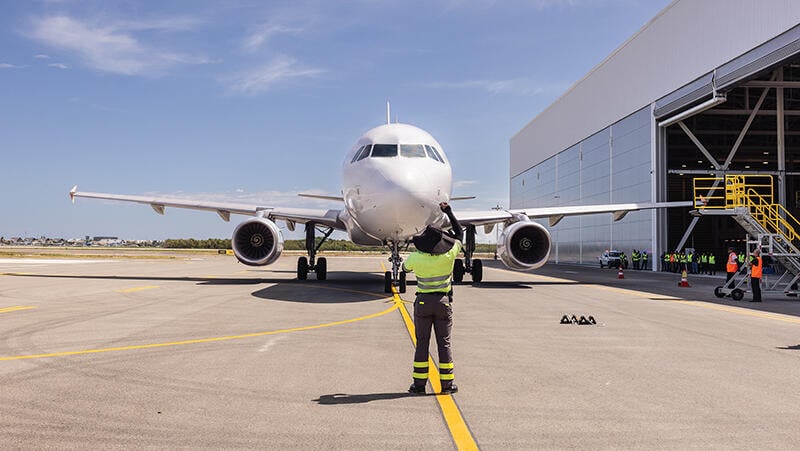
FL Technics inducted its first customer aircraft in the Dominican Republic in August.
Saulius Bajarūnas took over as CEO of FL Technics on Sept. 1 amid the company’s rapid global expansion. So far this year, the company has opened several new global facilities and acquired two subsidiaries while continuing to add capabilities. As he hits the ground running, Bajarūnas aims to steer the company through its considerable portfolio growth by leveraging technology and best practices from its Lean management approach.

FL Technics finalized its acquisition of Czechia-based MRO provider Job Air Technic in February as part of efforts to strengthen its presence in Europe. The company provides a wide range of aftermarket services for Airbus A320ceo/neo and Boeing 737 NG/MAX aircraft, including line and base maintenance, component and spares support, technical training and aircraft engineering.
Bajarūnas granted Inside MRO an exclusive interview, his first as CEO, to discuss the company’s initiatives and strategy.
FL Technics is working to incorporate Job Air Technic into its organizational and operational structure by implementing its bay system and Lean culture. A key part of this effort will leverage Sensus Aero’s Sensus MRO software, which consolidates digital and paper-based maintenance systems into a single program. FL Technics acquired the software provider in June.
Bajarūnas says Sensus MRO will help FL Technics integrate under one digital platform. “After implementation in all locations, it will be a huge benefit for us for data collection, for our customers and employees, because then we can work with one system under one umbrella with the same outcomes from the software itself,” he notes.
Bajarūnas says FL Technics had been working with Sensus Aero prior to the acquisition and is now collaborating with the software provider’s team to improve processes and data collection while considering potential automation strategies using artificial intelligence. Although the current focus is implementation across FL Technics’ global footprint, this could eventually include developing additional digital services or products.
“When you’re going from one country to another, you see different approaches and new ideas” that could benefit the business and drive potential profits, Bajarūnas says.
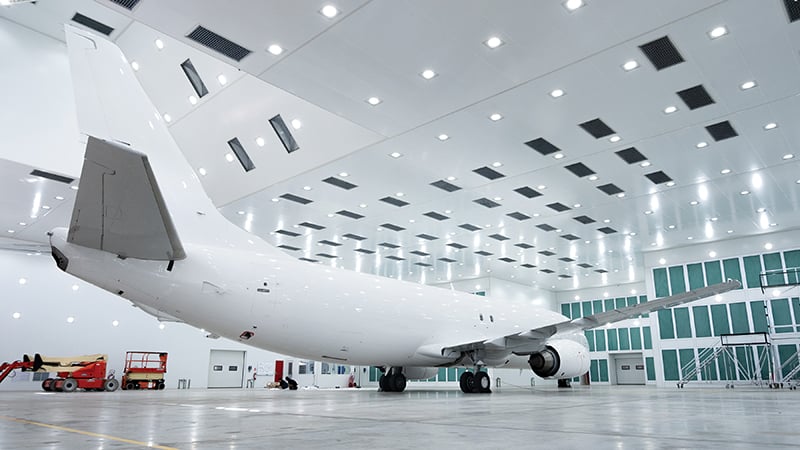
Another new location in which FL Technics is focused on transferring business culture and expertise is the company’s new $70 million facility at Punta Cana International Airport in the Dominican Republic. The facility obtained Part 145 approval from the FAA and the Dominican Civil Aviation Institute in June. It officially began operations in August with launch customer JetBlue Airways and the arrival of its first Airbus A320ceo aircraft.
The company says the 20,000-m² (215,000-ft.²), five-bay heavy maintenance hangar is the first facility of its kind in the country. It is also FL Technics’ first dedicated heavy maintenance site in the Americas. Bajarūnas is confident that the facility will attract considerable business from customers in the region as it ramps up operations. He expects the location to be fully booked next year.
“We are getting a lot of requests” for the facility as airlines compete for tight maintenance capacity in the Americas, he notes. “Technical personnel from airlines are willing to come to make audits to facilities to see how we are prepared. Our competitors are speaking about us, so it is a huge compliment for us, too.”
Once FL Technics reaches full capacity in Punta Cana, it intends to increase its staff to up to 2,000 people. The company says initial recruiting efforts drew more than 3,500 applications, including about 1,000 from certified engineers. It also recruited experienced, certified staff from other Latin American countries, such as Colombia, Peru and Venezuela.
“We are putting in a lot of effort and energy to train our technicians locally,” Bajarūnas says. “We are bringing expertise from Lithuania, where key personnel are coming to train local mechanics and engineers. We are bringing different supporting units to . . . bring in our culture of Lean and bay systems.”
This also includes cooperating with local technical schools and launching a dedicated MRO academy in Punta Cana. FL Technics uses similar approaches in other locations, such as Indonesia, where it is also expanding facilities as it marks its 10th year of operations there.
FL Technics Indonesia opened a new aircraft painting booth at its facility in Denpasar, Bali, in June. The site undertook its first painting project later that month—a Boeing 737-400F for Philippines-based cargo carrier Skyway Airlines. By the end of August, it had already completed 10 aircraft painting projects.
FL Technics Indonesia CEO Martynas Grigas told Aviation Week last year that the company planned to more than double its MRO footprint in Jakarta by adding another six-bay hangar, two painting bays, an engine shop and a wheels and brakes shop. Bajarūnas says the company is still on track to open the new facilities this year.
Grigas told Aviation Week this summer that Indonesia’s MRO sector provides “enormous and largely still unrealized” opportunities. However, he noted several challenges to ramping up in the country, including meeting workforce demand and tackling persistent logistics issues. The company has invested in a bonded logistics center there to help reduce delivery lead times for internationally sourced components and materials, but he noted that “this is an area that demands ongoing attention across the industry.”
To this end, FL Technics opened a new warehouse in Dubai in January to speed up component delivery times to regional customers. Bajarūnas says FL Technics previously relied on its logistics hubs in Europe, Asia and North America to deliver components to customers in the Middle East.
The warehouse, which is located near Al Maktoum International Airport (DWC), primarily stores critical rotable components with the aim of minimizing aircraft-on-ground (AOG) situations.
FL Technics LLC—the company’s Abu Dhabi-based line maintenance subsidiary—added approvals for four new aircraft in August: the Airbus A350 and Boeing 777, 787 and 737 MAXs equipped with CFM International Leap-1B engines. The approvals apply at DWC as well as at Dubai International Airport and Abu Dhabi’s Zayed International Airport. Bajarūnas says the company wants to add as many certifications there as possible.
Although geopolitical instability in the Middle East has been challenging, “you always need to prepare when it is difficult, because when aviation starts booming [again], we will immediately jump in and offer our services,” Bajarūnas says. “At the moment, of course, customers are waiting [to see what will happen], but this time is always good to use for preparation.”
One capability FL Technics has boosted in the Middle East and other regions is its AOG GO Team. In July, the company announced that its UK-based Storm Aviation subsidiary would begin centrally coordinating AOG recovery across the FL Technics Group. The development is intended to simplify the handling of AOG events through a single point of contact across more than 100 global line maintenance stations.
“Operators no longer have to chase multiple contacts across time zones,” Storm Aviation CEO Thomas Buckley said in a statement. “They have a single point of contact through our GO Team, and behind that team stands the entire capability of the FL Technics Group.”
As Bajarūnas shapes his 2027 road map, he says the focus will be on customers, infrastructure, expansions and adapting to challenges such as OEM delays, supply chain headaches, labor shortages and geopolitical instability. “The market is changing very rapidly and very often, so you are always under pressure to manage that, but with a strong team, you can do a lot,” he says. “I believe the FL Technics Group is in good shape to manage all these challenges.”

Related Content