This article is published in Aviation Week & Space Technology and is free to read until Dec 12, 2025. If you want to read more articles from this publication, please click the link to subscribe.

Atitech Unveils Business Jet Lines In Sardinia

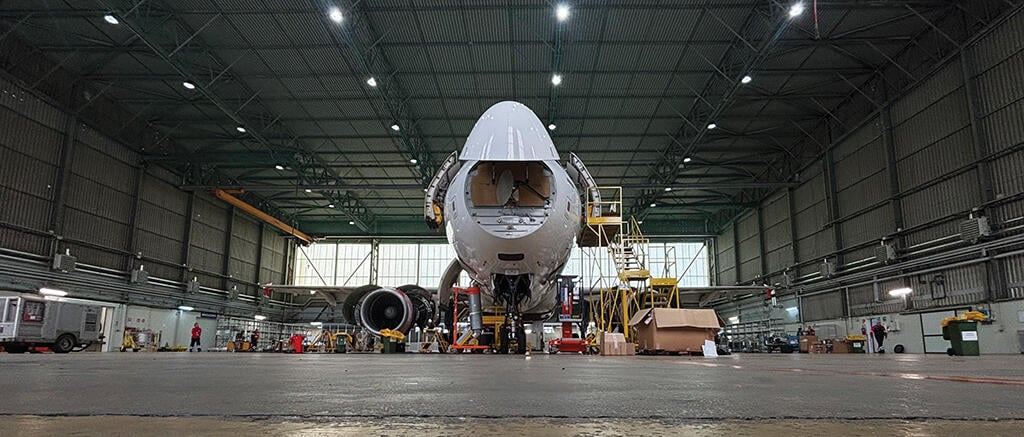
front view of aircraft undergoing maintenance in hangar

Atitech has occupied the hangars at Olbia Costa Smeralda Airport since January.

Credit: Atitech

Italian MRO Atitech has opened the doors of its new private aircraft facility in Olbia, Sardinia, where it hopes to induct its first business jet for maintenance in late November.

Atitech primarily services commercial aircraft from base maintenance facilities in Naples and Rome, with 20 line stations in Italy and 10 overseas. However, last year the company acquired two hangars formerly operated by defunct airlines Air Italy and Meridiana at Olbia Costa Smeralda Airport, located about 250 mi. off the west coast of mainland Italy.

Addressing an Atitech-hosted event in Olbia that coincided with the hangar unveiling in October, CEO Gianni Lettieri said the company plans to invest several million euros in the site over five years for workforce and training; new capabilities, equipment and tooling; and developing sustainable energy systems and technologies.

Lettieri highlighted Olbia’s high concentration of business jets, particularly during the long summers, as well as the availability of hangars. He also noted the access to licensed personnel, such as former Air Italy technical staff, who could train to work on new aircraft types. Nearby universities and technical schools also support hiring and training for the venture, as does proximity to Sardinia’s yacht industry to collaborate on crafting and interiors.

“After winning the bid for the hangar, refurbishment began immediately, and the facility was handed over to us in January,” Atitech General Manager Pietro Pascale told Inside MRO at the unveiling.

“We are in the process of inducting our first private jets,” Pascale said. “One project involves a prebuy inspection for a customer purchasing an aircraft in the U.S. Another involves a structural check for a different client. We have already established partnerships with experienced consultants and engineers in the business aviation sector to support this initial phase.”

The company received certification in February for Airbus A320 and Boeing 737 maintenance checks and has undertaken checks on the aircraft types at the new facility. “From there, we extended our approvals to include Gulfstream aircraft, and we’re now in the process of adding other platforms, such as Bombardier- and Dassault-manufactured aircraft,” Pascale added. He expects Bombardier approval by mid-2026 and said talks are ongoing with airframers to achieve approved repair station status.

Atitech intends to establish eight lines for private jets by 2027; one hangar would hold up to five jets, and the other up to three. Two lines would be dedicated to modification and refurbishment, and the remaining lines would focus on maintenance.

“Our strategy focuses on larger long-range aircraft—these offer greater operational flexibility because they can fly globally, offering a wide market,” Pascale said. “They also create efficiencies for operators, who can often conduct a revenue flight into or out of our facility, eliminating the cost of ferry flights typically required in commercial MRO.”

Operationally, Atitech is looking to drive supply chain efficiencies to ensure turnaround times are met. A typical structural check on a business jet takes up to two months, whereas a similar check on a commercial widebody takes 30-45 days.

The company saw opportunity in business jet maintenance in Southern Europe, where relatively few MRO providers exist, yet more than 4,000 privately owned aircraft operate across Europe as a whole, according to Atitech. Olbia Costa Smeralda Airport is also a hub for private and general aviation, handling more than 15,000 private jet flights annually—a figure expected to grow in the coming years—with capacity to park more than 120 large private aircraft.

Pascale said commercial MRO activity will continue at the hangars until 2027, when the site is planned to service business jets exclusively.

While the Olbia operation marks a formal move into business jet MRO, Atitech has some experience with the segment. Since 2017, the company has maintained the Italian presidential fleet, including conducting airframe maintenance in Naples, although the aircraft themselves are based at the joint civilian, commercial and military Rome Ciampino Airport. The government work is managed under power-by-the-hour agreements and includes full support for engines, landing gear and components.

Atitech also recognizes the potential for government work in Olbia. Pascale noted that the Italian Air Force acquired new Gulfstream G550 and G650 special-mission aircraft. “We see opportunities to support those fleets locally,” he said.

Pascale added that Atitech has worked on other VIP aircraft, such as Boeing Business Jets and Airbus Corporate Jets, and installed custom cabins for Airbus under European Union Aviation Safety Agency (EASA) Part 145 certification. “That experience has given us valuable insight into the quality and care required for cabin work, which requires meticulous attention,” he said. 

Atitech plans to build up its workforce in Sardinia, with a target of about 330 direct employees across the eight maintenance lines by 2027. “The operation will gradually ramp up,” Pascale said. “We’ll begin with one commercial aircraft line, then expand to all eight lines over the next two years, achieving full activity by 2027.”

The company has spoken with local technical schools in Olbia, and several are able to provide students with credits toward their maintenance licenses under EASA Part 66. “Students can complete specific training modules during their studies, graduate with recognized credits and then continue the remaining modules to obtain the Part 66 license,” Pascale said. “After that, they must complete on-the-job training, which we are able to provide at our new facility in Olbia. Once this training is completed, we aim to hire these individuals, creating a full pathway from education to employment.”

Atitech has also identified opportunities to collaborate with Sardinia’s yacht industry. “There are skilled craftsmen and companies specialized in luxury interiors, design and finishing,” Pascale said. “While aviation regulations are stricter than those in the yacht sector, we see opportunities to collaborate. We hold EASA Part 21J [design] and Part 21G [production] approvals, so we can design and manufacture cabin elements ourselves in cooperation with experienced specialists.”

Given Atitech’s planned recruitment drives, Pascale does not expect the maintenance provider will be competing for talent with yacht specialists. “The idea is to integrate into the local industrial ecosystem—working with local suppliers, sharing expertise and developing specialized training rather than competing for the same labor pool,” he explained.

James Pozzi

As Aviation Week's MRO Editor EMEA, James Pozzi covers the latest industry news from the European region and beyond. He also writes in-depth features on the commercial aftermarket for Inside MRO.