This article is published in Aviation Week MRO part of Aviation Week Intelligence Network (AWIN), and is complimentary through May 27, 2026. For information on becoming an AWIN Member to access more content like this, click here.

Airlines Mull AI’s Potential, Limits For MRO

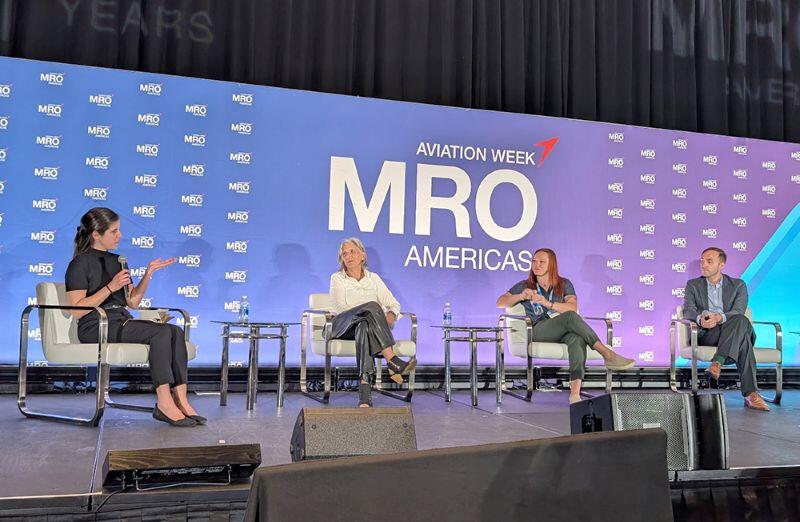
Aviation Week’s Christine Boynton (left) moderates an AI-focused panel at MRO Americas with (from left) Alice Belcher, Nicole Austin and Stephen Snyder.

Aviation Week’s Christine Boynton (left) moderates an AI-focused panel at MRO Americas with (from left) Alice Belcher, Nicole Austin and Stephen Snyder.

Credit: Lindsay Bjerregaard/Aviation Week Network

ORLANDO—Airlines shared examples of how they are leveraging artificial intelligence to drive maintenance efficiencies at MRO Americas, but some stakeholders are urging caution about overreliance on the technology.

Delta TechOps, which has been using artificial intelligence (AI) to perform functions like predictive maintenance, digesting maintenance data and helping technicians search for information, recently achieved success with a new use case for expendable warranties. According to Alice Belcher, head of predictive engineering and innovation, Delta Air Lines has data for 1,000 aircraft and 2,200 engines “everywhere and nowhere,” so it developed an AI agent that could act as a warranty specialist to “go out and find the purchase order, find the information in our [maintenance and engineering] system about the log pages, read that, bring that data in and structure it on [Palantir] Foundry.”

Belcher said her team worked with Delta TechOps’ warranty specialists to understand their workflow and pain points to build the tool, and now they can use the AI agent to build an entire warranty claim, so “instead of spending 80% of the time finding the information and 20% of the time negotiating, we’re trying to flip it on its head.”

At Alaska Airlines, Innovation Program Manager Nicole Austin and her team are using AI to pull data from multiple sources to drive product development across many aspects of the business. For instance, she said the airline pulled review data about its mobile application from various online sources and parsed it with an AI agent to drive meaningful change with its designers, and they are looking at how maintenance data could be mined in the same way, such as identifying maintenance trends and pulling out actionable items.

Austin’s team performs proofs of concept and hands over documented results to the appropriate leaders within the airline to evaluate whether the technology does what they want it to. “We need to fail fast,” she said. “There’s an old saying at Boeing, and I forget exactly how it goes, but it’s [something like] ‘Evaluate the technology. Is it going to serve the purpose? No? Move on.’”

For example, Austin pointed out that several airlines rolled out automated bag drop systems to reduce labor during check-in, but a previous airline she worked for had to increase labor to support them. “They’re a very similar use case to the self-service grocery checkouts. They’re not as infallible as we thought, and somebody somewhere did a really great sales pitch and got a bunch of airlines on board, but we’re not seeing the benefits that we wanted to,” she said. “That’s where a robust tiger team can come in and say, ‘Hey, is this going to work or not?’”

Stephen Snyder, MD of SKY VC, the aviation industry venture capital arm formerly known as JetBlue Ventures, said he sees potential in using AI to create intelligence from verbal information during airline operations.

“There are so many valuable things that are stated on a walkie-talkie” that are not captured and kept by organizations, he said. “If I’m a flight attendant and I know that the [inflight entertainment system] is not working in seat 12B, and I want to grab the captain before the plane lands and then the pilot is running off to make their connection and go home, it’s not going to get written up. It’s not going to get put in a logbook.”

Snyder also pointed out the importance of being able to pivot on how AI could be most useful. “I see really wonderful applications for AI that just might have to be in the secondary use case for what they do,” he said, noting that borescope inspections are an example of something regulators may not yet be comfortable outsourcing to AI.

“While that market is developing, perhaps instead we can think about this through the lens of documentation for lease returns for lessors,” he said. “When an engine gets returned, it turns into a giant finger-pointing exercise of what state it was delivered in, what state it was received in, and the sorts of losses that one party has to eat . . . are in the magnitude of six or seven figures on things like this. So having a single source of truth and the ability to pivot as well in your mindset . . . to where AI can actually take you [is] a really important tool to have in your toolkit.”

Ryan Kee, SVP of maintenance strategy and technical operations at CommuteAir, said he worries that the hype around AI will lead to overuse “without creating the technical know-how long term for the implementation of AI.” Stressing the critical thinking considerations of AI usage, he added, “If you have a tool that’s giving you the answers every time, but you don’t have the talent to understand why the answer is being provided, then long-term, how are you going to continue to develop and improve upon those processes?”

Kee pointed to the European Union Aviation Safety Agency’s AI guidance, which states that the technology’s ability to make fully autonomous decisions is still at least 10-15 years away. “There still has to be that human interaction. So, how do you put it in place where it is a supporting tool, but you’re instilling the knowledge at the root of the individual for the long-term success of your organization?” he said. “Because AI is still just a large data set of information. Well, if the information is wrong, how do you know if that’s all you’ve ever been provided on the forefront? You still have to have those critical thinking skills with your labor pool, and AI has a very high chance of taking that away, [harming long-term talent development].”

Snyder also expressed concerns about overreliance on the technology, particularly as it pertains to leadership development. “I worry about organizations that are overly dependent on AI. If we look at the workforce more broadly and how you cultivate the next generation of leaders who will come from it, if you assume the managerial aspect of it is the top 10% of performers, let’s say, you need that entire minor league system. You need iron sharpening iron,” he said. “The top 10% can’t just magically appear without any formation of actually getting there.”

However, Belcher said that machine learning has been part of Delta TechOps’ workflow for almost a decade, “so it’s just part of our normal workflow,” and that AI is just helping its workforce get information faster.

“It’s just aiding your workflow, helping you be more efficient and helping you get to the information that you’re so frustrated that you can’t get to,” she said. “You’re not going to be replaced by AI, but you will be replaced by somebody who knows how to use it and is comfortable with using it.”

Lindsay Bjerregaard

Lindsay Bjerregaard is managing editor for Aviation Week’s MRO portfolio. Her coverage focuses on MRO technology, workforce, and product and service news for MRO Digest, Inside MRO and Aviation Week Marketplace.