This article is published in Aerospace Daily & Defense Report part of Aviation Week Intelligence Network (AWIN), and is complimentary through Sep 25, 2026. For information on becoming an AWIN Member to access more content like this, click here.

Top USAF Officer in Europe Outlines Opportunities Amid Modernization
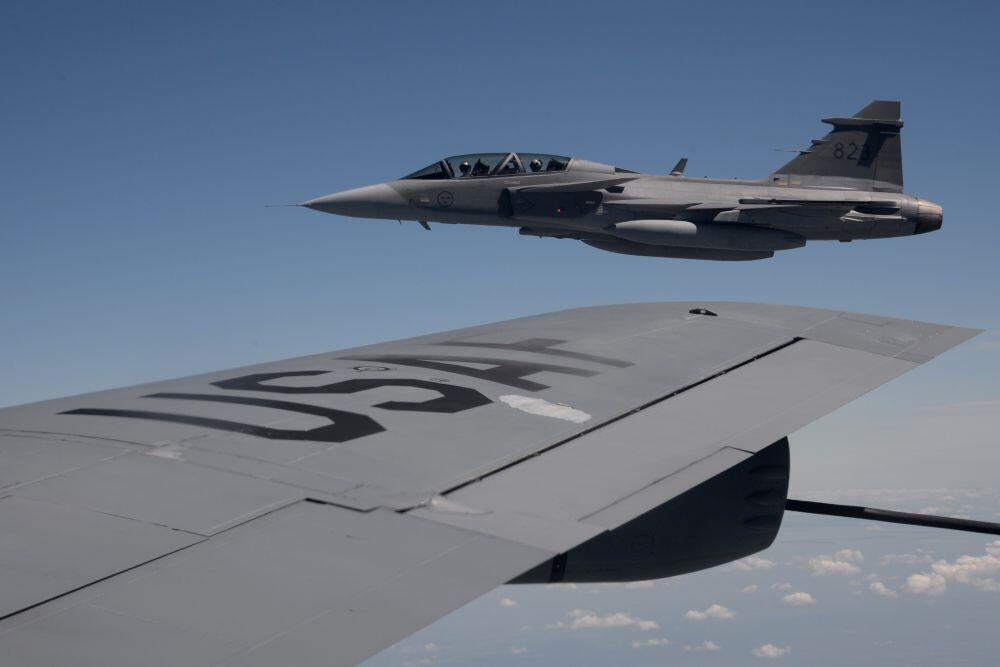
A Hungarian JAS-39 Gripen flies alongside a U.S. Air Force KC-135. Credit: U.S. Air Force

A Hungarian JAS-39 Gripen flies alongside a U.S. Air Force KC-135.

Credit: U.S. Air Force

NATIONAL HARBOR, Maryland—A shift by some European nations to more domestically produced aircraft and weapons does not necessarily signify a move away from the U.S. Instead, it shows they are doing what American leadership has requested: Ramp up the industrial base, the top U.S. Air Force officer in the region argues.

“What I see them doing is what we’ve asked them to do. We’ve asked them to ramp up the transatlantic defense industrial base, and we’re seeing the nations that have the capacity to do that, they are doing that,” says Lt. Gen. Jason Hinds, commander of U.S. Air Forces in Europe and NATO Allied Air Command.

Hinds spoke at the AFA Air, Space & Cyber Conference here this week.

The shift away from American-produced kit in recent years has been seen by some as avoiding a reliance on the U.S. amid uncertainty with the Trump administration. Hinds, however, sees this in many ways as an opportunity because it has raised defense spending and production inside NATO and most of the aircraft and weapons are already interoperable with the U.S.

He points to Sweden and the SAAB Gripen as an example.

“[Sweden is] a new nation into the alliance, right? They’re building new kit all the time, including brand new Gripens. Gripens are interoperable right now with the alliance and they’re using them inside places like Hungary ... Other nations are thinking about buying them,” he says.

While the top goal for the U.S. is to have commonality—the Lockheed Martin F-35 and Block 70 F-16, for example, are American and international operators can plug directly in to the existing logistics and operational infrastructure, he says.

“If we can’t get commonality, the next thing I ask the nations to do is think about interoperability by design, which means they’re starting to look forward to industry to solve some of the problems,” he says. “And they want to purchase some kit; I ask them to ensure that they’re purchasing kit that we know will be interoperable with NATO standards from the start.”

Hinds was responding to a question from Aviation Week about the modernization trend across Europe, including the Global Combat Air Program and new Collaborative Combat Aircraft (CCA) efforts in nations like the UK, Germany and Sweden, among others.

The U.S. Air Force and allies in Europe are collaborating on how CCAs could operate in the theater, specifically on increasing integrated air and missile defense capacity in the case of a hostile incursion into NATO territory.

“If we have to respond to be able to push a force out, we would have to be able to reduce integrated air defense systems and potentially even attack fielded forces from an opposing nation inside the European theater,” he says. “There are nations that want to be able to incorporate CCAs into the future force design ... and they’re interested in using CCA for dual roles, for defensive missions and then for things like counter-integrated air missile defense systems.”

Hinds says there will be experimentation soon in Europe, following the U.S.’s own experimentation, with these tactics.

Brian Everstine

Brian Everstine is the Pentagon Editor for Aviation Week, based in Washington, D.C.