This article is published in Aviation Week & Space Technology and is free to read until Jan 02, 2026. If you want to read more articles from this publication, please click the link to subscribe.
Decision Time Nears For Next Evolution Of Airlifters
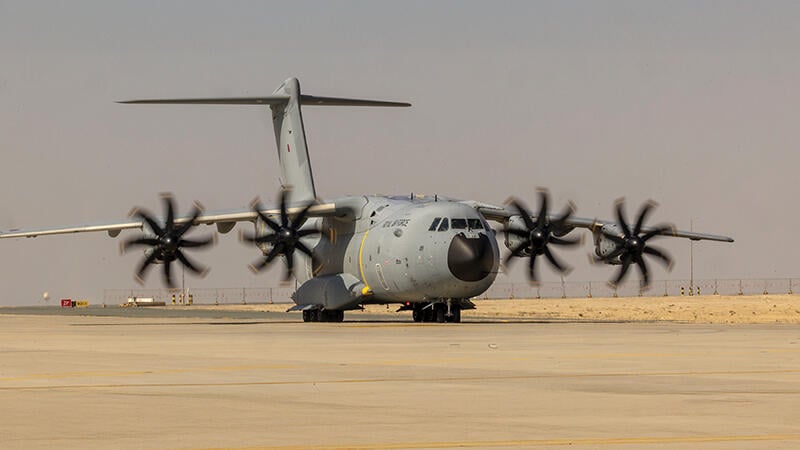
Airbus is promising UAE companies workshare on the A400M and on other programs, hoping to land an order.
The Western airlifter market is set for change as manufacturers finalize product upgrade plans and customers make choices about their fleet evolution.
Near-term decisions at Airbus and Embraer could lead them to introduce new capabilities on their airlifters before the end of the decade. In the U.S., the planning looks further out, but could spur a multibillion-dollar development push within the next 24 months.
- U.S. Air Force aims for a new strategic airlifter by 2041
- Embraer and Airbus court the UAE for a transport order
Embraer, for instance, in the first quarter of next year aims to pick a refueling boom provider for its KC-390 tactical tanker/transport, Embraer Defense and Security CEO Bosco da Costa, Jr., said during the Dubai Airshow. The KC-390 currently functions as a tanker with a hose-and-drogue system, but the boom would be crucial in the company’s ambition to sell the aircraft also to the U.S. Defense Department and could drive demand elsewhere.
Airbus hopes to finalize talks with users of its A400M before the end of next year to define the next round of capability enhancements for the airlifter. Before the end of the decade, the company is looking to introduce enhanced satellite communications on the platform and the ability to control uncrewed aircraft systems (UAS), among other features. The effort is gaining traction as Airbus aims to complete the baseline package of A400M capabilities, known as SOC 3, in October 2026 to finally close out the development contract.
Airbus signed an agreement last year with European joint defense procurement agency Occar for a Block 0 enhancement package and is now in talks to sign a contract for Block 1 toward the end of next year, said A400M Chief Engineer Francisco José Hernández. Block 0 includes narrowband communications upgrades, human-machine interface improvements and the introduction of the Link 16 Multifunction Information Distribution System.
Connectivity is a particular focus to ensure the A400M is a key node in the evolving battlefield, Hernández said. That means incorporating different wideband connectivity options to the platforms using both geostationary-orbit (GEO) satellites and the growing options in low Earth orbit (LEO), as well as other data links.
One of the options Airbus is exploring is a roll-on/roll-off system to connect to LEO constellations using a dedicated antenna. For the GEO system—because different users have different national systems to link to—Airbus wants to devise a generic installation system with, for instance, a common fairing and links to the modem, and then accommodate the antenna that specific users need to connect to their preferred constellation. The goal is to have that ready by 2029, Hernández said, as part of the Block 1 effort.
Airbus also has an ambition to turn the A400M into a UAS mother ship or cruise missile launch system, the latter similar to the Rapid Dragon capability demonstrated on the Lockheed Martin C-130 by the U.S. Air Force. Airbus already has demonstrated the ability to deploy a UAS from the airlifter and has plans to deploy and control up to 36 medium-size air vehicles with about 500-km (310-mi.) range and different payloads. That also means adding mission control stations on the platforms, Hernández said.
Customers have expressed interest in a minimum capability by 2029. The initial setup likely would involve simply deploying a smaller number of drones and having onboard workstations, before growing the number and moving to full onboard control about two years later with the enhanced data link capability, Hernández added.
The company that previously disclosed plans to increase the maximum takeoff weight of the A400M to 40 metric tons from 37 said it would achieve that without changes to the structure or engines. The higher loads would be used principally when the aircraft is used for strategic lift missions, not tactical insertions, so Airbus would introduce flight control limits to reduce some of the aircraft’s tactical maneuverability when operating at the maximum load. The extra lift potential also could be used to extend range about 250 mi. The feature would be something that could be applied to existing aircraft, if operators want the enhancement.
In the U.S., where production of large transport aircraft ended a decade ago with the closure of the Boeing C-17 line, the military is looking to define what comes next. The U.S. Air Force expects the Lockheed Martin C-5M to remain operationally viable until 2045 and the C-17A through 2075.
U.S. Air Force Air Mobility Command released a strategy to recapitalize its airlift fleet with the Next-Generation Airlift (NGAL) platform on Nov. 18. The document calls for an analysis of alternatives in 2027, production starting in 2038 and an initial operational capability in fiscal 2041.
“One NGAL aircraft will replace one C-5M aircraft until the entire C-5M fleet is retired,” the strategy states. “Then the C-17A fleet will be replaced by NGAL at a one-for-one swap.”
The Air Force is toying with a C-17 reengining program to keep the platform going another 50 years.
The strategy does not address tactical airlift plans, but the Air Force has said it sees NGAL as a family of systems, including smaller aircraft to replace the C-130 and even smaller roles.
Airbus and Embraer are looking to capitalize on that window of opportunity to win market share in a segment long dominated by the U.S., even if Lockheed Martin continues to compete in the tactical transport business with the C-130J.
Embraer used the Dubai Airshow to disclose the withdrawal of a two-year-old proposal to open a final assembly center in Saudi Arabia for the C-390 Millennium and an offer of a regional completion center for the airlifter in the United Arab Emirates (UAE).
“To be honest with you, there is no space to have two completion centers in the region,” Embraer’s da Costa said.
The switch comes after the U.S. and Saudi Arabia agreed on a new pact that reportedly includes a C-130J deal.
Embraer also disclosed agreement with Abu Dhabi-based maintenance, repair and overhaul specialist Ammroc and Global Aerospace Logistics to secure work on the KC-390, should the UAE buy the aircraft.
Airbus has similarly been courting the UAE with the promise of workshare if the country places an order for an expected 8-10 A400Ms. Airbus has been in talks with Edge Group’s EPI unit, Mubadala’s Strata and others over part production and services for the A400M and other programs, says Jean-Brice Dumont, head of airpower programs at Airbus. The A400M workshare would support the global program, not just the UAE’s fleet, he added.
The company signed agreements at the Dubai Airshow with Mubadala and also one with UAE-based defense company Calidus that could lead to the creation of a maintenance, repair and overhaul facility for the A400M airlifter in the country.
The UAE, which at one point also flirted with the Japanese Kawasaki C-2 and a South Korean airlifter concept, has not signaled when it will make a fleet decision.


Comments
DECISION TIME IS NOT HERE OR NEAR HERE for a production that is to take place in 2040!
“One NGAL aircraft will replace one C-5M aircraft until the entire C-5M fleet is retired,” the strategy states. “Then the C-17A fleet will be replaced by NGAL at a one-for-one swap.”
The Air Force is considering a C-17 re-engine program to keep the platform flying for another 50 years.
Is this the craziness that Dwight Eisenhower was referring to and Peter Hegseth is talking about today? This propaganda organ is absolutely tone deaf, silent on spending money for decades, literally decades, before the production is initiated.
DECISION TIME IS NOT HERE OR NEAR HERE for a production that is to start in 2038!