This article is published in Aerospace Daily & Defense Report part of Aviation Week Intelligence Network (AWIN), and is complimentary through Sep 09, 2026. For information on becoming an AWIN Member to access more content like this, click here.
U.S. Navy officials have set a “feisty” schedule for developing a replacement for the RTX-built Standard Missile family and are asking industry to fund much of the development, according to a recorded presentation obtained by Aviation Week.
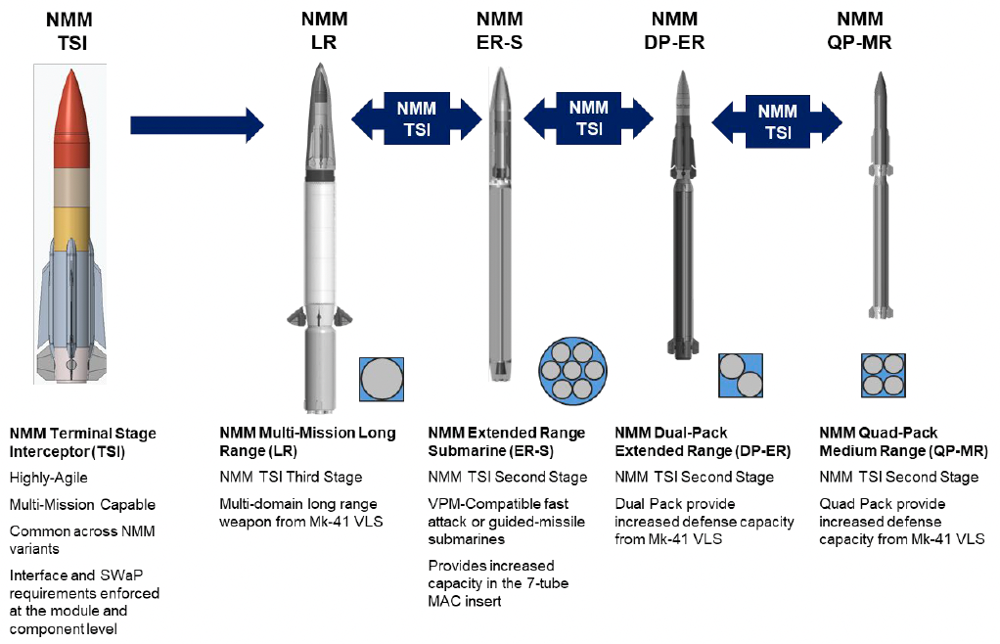
The Aug. 27 presentation to a virtual crowd of industry bidders about the Terminal Stage Interceptor (TSI) prototype project within the Navy Modular Missile (NMM) program offers a glimpse into the unique acquisition strategy for what could become the primary ship-based air and missile defense interceptor for several decades.
Navy officials emphasized that the goals are speed, modularity and companies willing to self-finance major parts of the development phase. “The goal is to be able to have an initial capability as fast as humanly possible,” said Capt. Tom Seigenthaler, the Navy’s program manager for Surface Ship Weapons.
Underscoring that point, the Navy wants to award a contract for the TSI prototype in November, or less than three months after releasing the solicitation for the fast-tracked, Other Transaction-category contract, according to the briefing slides. The first test flights also should be completed by the end of 2027, Seigenthaler said. “The schedule, I do recognize, is feisty,” he said.
Acknowledging that the contract award schedule would normally depend on the timely approval of the fiscal 2027 budget by Congress, Seigenthaler said the Navy wanted the responses from bidders to include self-funding plans in the event that lawmakers fail to pass spending legislation by then. But the Navy developed that strategy after hearing from multiple companies that they were willing to develop the missile partly or even mostly at their own cost, with a plan to earn a return on their investment in the production phase.
“There has been nothing but discussion from industry that [tells the Navy], ‘We're ready to support, we want to do all the development, we want to run, we don't want to be told how to do things. We want to do things fast. We're ready to put investment behind it,’” Seigenthaler said. “So we're going to expect that.”
That approach explains how the Navy launched such a major program despite requesting only $311 million in research, development, test and evaluation funding for the TSI prototype in the fiscal 2027 budget. The strategy also appears to offer a workaround in case Congress fails to pass the fiscal 2027 budget on time or approve a continuing resolution.
“If the plan for your companies is to wait for us to get a go signal from congressional funding, that's probably a bad path, and I would recommend against it,” Seigenthaler said.
A critical factor in the Navy’s evaluation of bids for the TSI prototype is modularity. The TSI represents the upper stage of a missile stack that will be acquired separately. The TSI itself is divided into five modules: a control and actuation module; a solid rocket motor; a guidance system; a warhead; and a classified seeker.
The latter module for the targeting system also will be acquired separately. But the Navy intends to mix and match the modules as much as possible instead of relying on a single contractor to deliver and sustain the full all-up round.
Seigenthaler noted the industry shouldn’t get attached to the name of the overall program. Noting that the “Navy Modular Missile” moniker fails to distinguish the family of ship-based interceptors from several other modular weapon systems in development around the Navy, the NMM acronym will probably be changed to a new name in the future, he said.
Responses for the TSI prototype solicitation are due on Sept. 10.