This article is published in Aerospace Daily & Defense Report part of Aviation Week Intelligence Network (AWIN), and is complimentary through Sep 13, 2026. For information on becoming an AWIN Member to access more content like this, click here.

U.S. Navy Reveals Details Of Standard Missile Replacement Plan

Credit: U.S. Navy
Credit: U.S. Navy

A newly obtained document reveals the full scope of the U.S. Navy’s preliminary plans for replacing all members of the venerable, RTX-made Standard Missile (SM) series with a family of new air and missile interceptors that are focused on boosting load-outs and raising performance.

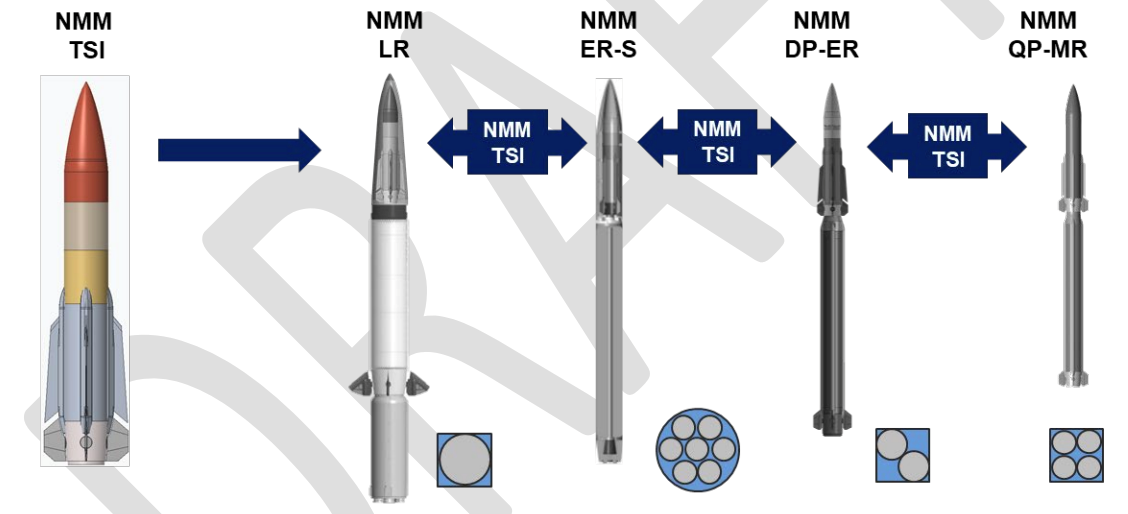
The family of Navy Modular Missiles (NMM) is currently expected to include four major variants, with each topped by a common, 10-in.-dia. terminal stage interceptor (TSI).

The smallest variant—the NMM Quad-Pack Medium-Range (QP-MR)—would sacrifice distance for maximum load-out. A standard Mk. 41 vertical launch cell would contain four NMM QP-MRs, rather than only a single missile of either the SM-2, SM-3 or SM-6.

The next largest version—NMM Dual-Pack Extended-Range (DP-ER)—features a longer and slightly wider booster rocket. The additional volume enables the DP-ER to hit more-distant or higher-altitude targets. The trade-off is that only two of the missiles fit inside a Mk. 41 cell, although that is still twice the current capacity. A modified version of the DP-er missile—NMM Extended Range-Submarine (ER-S)—is adapted for launch from the Multiple All-Up Round Canister (MAC) found in attack submarines, with seven ER-S missiles fitting inside each MAC tube.

The NMM Long-Range (LR) missile adds a 21-in.-dia. rocket motor and a booster stage, with the TSI as the upper stage. It is expected to bring significant new speed and range to the Navy’s arsenal of shipboard interceptors.

“The Long Range (LR) variant brings multi-mission, hypersonic capability to the Mk. 41 Vertical Launching System, leveraging existing USN investments in a 21-in. rocket motor and fully integrating with future Long-Range Fires kill chains,” the Navy says in a draft version of a request for solutions for the TSI stage.

Each member of the family relies on the TSI for the actual intercept of an inbound aircraft or missile.

The TSI is described in the Navy document with five major components: a seeker, a warhead, a guidance section, a rocket motor and an actuation module for the control surfaces.

As the “modular” term in the NMM title suggests, the Navy wants to maximize interchangeability within and between the different sections of the family of missiles, including the TSI. Interested vendors will be required to comply with a government-owned reference architecture that defines the interfaces between the major subsystems.

The release of the draft solicitation for the TSI comes after the Navy held an industry day event for the NMM program in March. The Navy recently certified top-level requirements for the NMM program, the draft solicitation document says. The technical specifications have not been released and are held at the “secret” level of classification.

The Navy plans to launch the NMM program in fiscal 2027, with a $311 million request for research, development, test and evaluation. The budget justification documents show no funds in the NMM account beyond the next fiscal year, so the Navy will need to update the program’s budget in the fiscal 2028 cycle of spending requests. But the documents describe a need for a new interceptor that significantly increases magazine depth aboard ships in the future.

“Adversary capacity and expected large raid engagement tactics will demand U.S. and allied forces increase their platforms' defensive capacity (depth of magazine) or be forced to resupply frequently in the midst of combat operations,” the budget document says. “The adversary's increased capacity comes with increased capability in the form of highly maneuverable, complex threats that will stress the current U.S. weapon systems capabilities. The NMM program will tackle all of these challenges through a family of weapons approach.”

Steve Trimble

Steve covers military aviation, missiles and space for the Aviation Week Network, based in Washington, DC.