This article is published in Aerospace Daily & Defense Report part of Aviation Week Intelligence Network (AWIN), and is complimentary through May 15, 2026. For information on becoming an AWIN Member to access more content like this, click here.
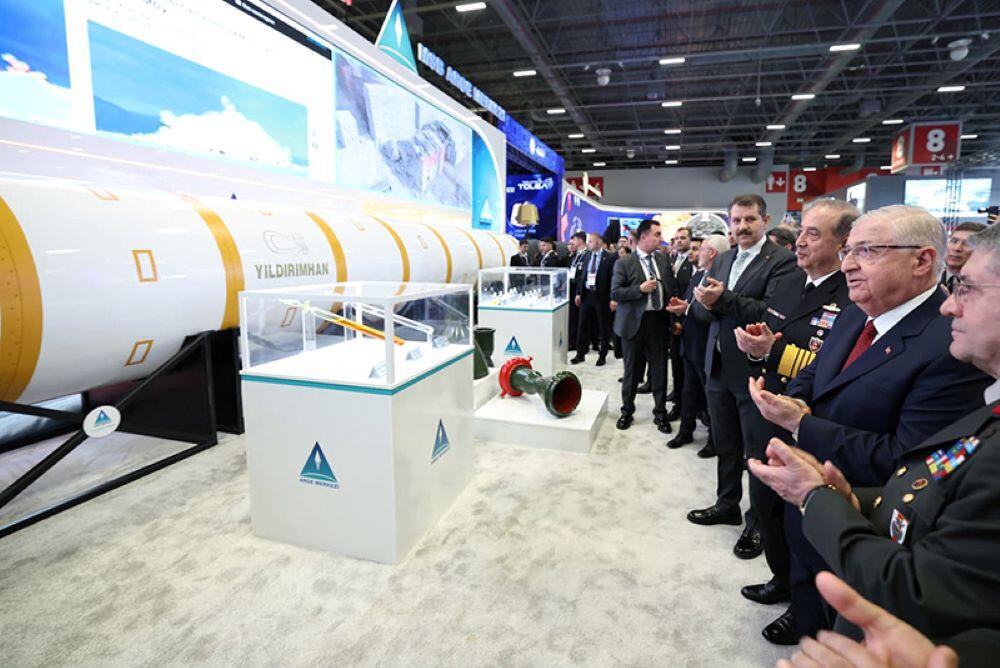
Defense Minister Yasar Guler (right) welcomes the unveiling of the Yildirimhan missile model during Saha Expo.
ISTANBUL–Turkey has unveiled plans to develop long-range conventionally armed ballistic missiles as a deterrent against adversaries.
Turkish Defense Minister Yasar Guler unveiled a 15-m-long model of the Yildirimhan intercontinental ballistic missile (ICBM) on the opening day of the Saha Expo here on May 5.
The surprise unveiling of the missile reportedly follows a 10-year development effort by the research and development department of the Turkish defense ministry, known as ARGE Merkezi.
Yildirimhan is envisioned to have a range of 6,000 km (3,728.2 mi.), making it an ICBM—intermediate range ballistic missiles (IRBMs) have ranges of up to 5,500 km.
The four-engine missile would have a 3,000-kg (6,613.8 lb.) warhead and be road mobile, videos published by the defense ministry suggest. The missile would be liquid fueled using a combination of nitrogen tetroxide and hydrazine. But this process would mean the missile would have be fueled prior to launch and defueled if a decision was made not to launch. No details about the timelines for the missiles introduction to service have been revealed. But Turkish media say production of the fuel and development of the warheads is already underway.
No decisions have been made on who will build the missiles. But Roketsan is the country’s missile producer and has already made tactical missiles with a range of 800 km. It is also working on a family of satellite launchers called Simsek.
A medium range ballistic missile called Cenk with a range of 2,000 km is also reportedly in development.
Turkish President Recep Tayyip Erdogan has previously called for Turkey to have missiles with ranges beyond 2,000 km because the region had become highly contested.
“As Turkey, we are located in a geography of high strategic importance, located in the heart of three continents, where global arm wrestling is never lacking ... the first condition for survival in such a geography is deterrence,” Erdogan said at the time.
But observers have questioned Turkey’s need for a 6,000-km-range weapon given that many of the country’s potential adversaries could be struck with weapons with a 2,000-km range. Furthermore, Turkey has no current way of testing such a weapon, although one possibility might be to rely on the country’s growing relationship with Somalia. Ankara has already announced it hopes to build a spaceport in conjunction with the government in Mogadishu to take advantage of the East African country’s position on the equator.
Guler also revealed that ARGE Merkezi had been working on a fighter engine called Guchan and a 1,550-shp turboshaft engine for rotorcraft called Onur, as well as a Wankel engine for uncrewed aircraft systems (UAS). The revealing of the three engines came as a surprise to teams from Turkey’s jet engine developers, particularly those working on the propulsion system for the future indigenous Kaan fighter. But it is unclear how far advanced Guchan and Onur have progressed in terms of testing.