This article is published in Aerospace Daily & Defense Report part of Aviation Week Intelligence Network (AWIN), and is complimentary through Aug 14, 2026. For information on becoming an AWIN Member to access more content like this, click here.

Baykar Proves Kizilelma Payload Bay Weapons Release

Baykar Proves Kizilelma Payload Bay Weapon Release
Credit: Baykar

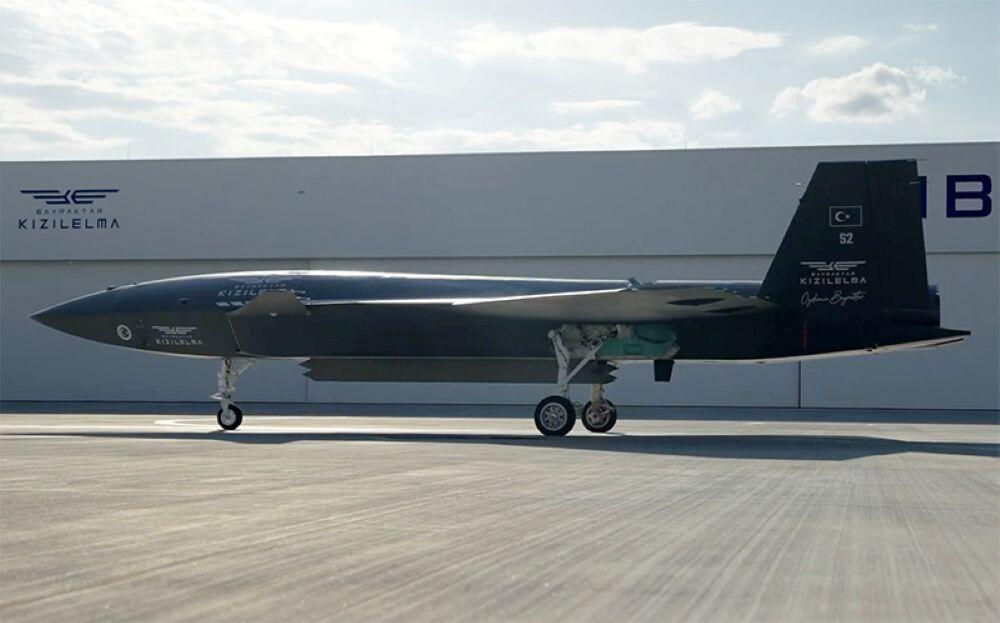
Turkish uncrewed aircraft systems (UAS) manufacturer Baykar has completed the first releases of weapons from the payload bay of its Kizilelma autonomous combat aircraft.

The trial—disclosed by the airframer on July 30—is the second release from an internal weapons bay by a Turkish manufacturer in 20 months.

Last January, Turkish Aerospace Industries (TAI) released weapons from the bay from its Anka III uncrewed combat air system.

In the latest trials, the Kizilelma released a Teber-82, a 500-lb. Mk. 82 fitted with a Roketsan-developed guidance kit that was dropped from the weapons bay of the second production-standard (S2) Kizilelma on July 25. This was followed by the release of an Aselsan Tolun small-diameter glide bomb from the bay on July 28.

Kizilelma is fitted with a single under-fuselage bay located between the nose wheel and main landing gear equipped with two retractable doors.

The company says the use of an internal weapons bay reduces the cross section of the canard-equipped aircraft and will enable the platform to “carry out strategic missions more effectively in areas with dense air defense coverage.”

The company did not say whether the weapons were being guided by the aircraft with laser designation or if they were merely launched with global navigation satellite coordinates. A video published by the company shows the Tolun weapon landing just outside the targeted area.

Kizilelma—Turkish for Red Apple—emerged from Baykar’s MIUS project to develop an uncrewed fighter aircraft. Since its first flight in December 2022, Baykar has been making steady progress on the integration of sensors and weapons. Last November it became the first uncrewed aircraft system (UAS) to perform an engagement of an aerial target with a beyond-visual-range, air-to-air missile, beating Boeing MQ-28’s Ghost Bat to the milestone.

The release of the two weapons from the Kizilelma’s bay is illustrative of the progress being made to integrate Turkish indigenous weaponry on the platform.

The milestone comes a couple of weeks after Baykar and Leonardo at the Farnborough Airshow revealed the results of combined crewed-uncrewed teaming trials between the Kizilelma and Leonardo’s M-346 jet trainer performed in May in western Turkey. The joint K-Swarm project aims to design and develop interoperability between crewed and uncrewed aircraft. Using a datalink and an integrated avionics suite, the M-346’s crew were able to command the Kizilelma to fly in different formations with the M-346.

“Different maneuvers and formations, including position changes, separations and rejoins, were successfully tested with the Kizilelma accurately responding to the M-346 commands,” the two companies said.

Baykar has previously suggested that Kizilelma had been designed to operate as a standalone platform. But the Turkish Air Force increasingly see the platform, along with TAI’s Anka 3, as an adjunct to support future platforms like the new Kaan fighter. The LBA joint venture of Baykar and Leonardo also increasingly sees the Kizilelma as a capable collaborative combat aircraft (CCA), with future phases of the K-Swarm project set to further this concept with the aim of “increasing complexity” and testing additional functions.

Tony Osborne

Based in London, Tony covers European defense programs. Prior to joining Aviation Week in November 2012, Tony was at Shephard Media Group where he was deputy editor for Rotorhub and Defence Helicopter magazines.