This article is published in Aerospace Daily & Defense Report part of Aviation Week Intelligence Network (AWIN), and is complimentary through Oct 31, 2026. For information on becoming an AWIN Member to access more content like this, click here.
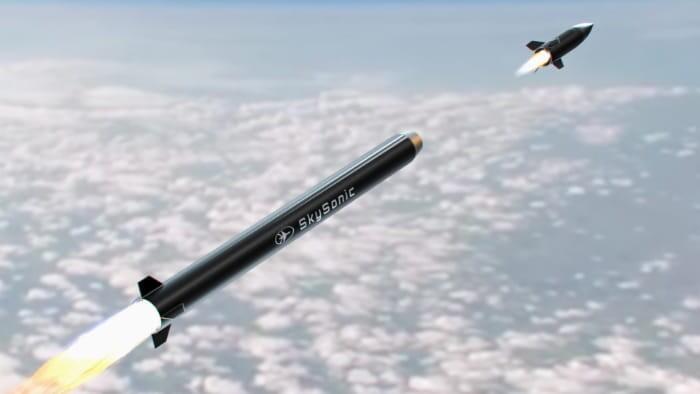
The public history of Rafael’s newest and most advanced missile interceptor is short and incomplete, but the concept is starting to come into clearer focus.
The state-owned Israeli manufacturer, which produced the Tamir interceptor for Iron Dome and co-developed the Stunner missile for the David’s Sling batteries, unveiled the Sky Sonic concept design in June 2023 at the Paris Airshow, saying the two-stage system would add shooting-down maneuvering, hypersonic missiles to its list of missile defense capabilities.
But that represented nearly everything known about the status of the Sky Sonic and the Israeli’s military’s plans for the proposed interceptor until the beginning of October.
So the debut appearance of a full-scale mockup at the Association of the U.S. Army’s (AUSA) annual convention last week sparked curiosity.
As displayed next to a mockup of the Rafael/RTX Stunner, the model of the Sky Sonic all-up round, including an upper-stage kill vehicle, appeared to share the booster diameter of the single-stage Stunner. But the Sky Sonic, which the Israelis call the “Sharp Slingshot,” appeared to be about 6 in. taller.
The dimensions may offer clues about the role of the Sky Sonic within Israel’s multilayered defense system.
The Tamir and Stunner form the lower layers of Israel kinetic options against rockets, mortars, cruise missiles, short-range ballistic missiles and enemy aircraft. The Arrow 2, Arrow 3 and the future Arrow 4 systems made by Israel Aerospace Industries (IAI) form the upper layers, with the Arrow 4 slated to replace the Arrow 2 after completing development.
The Sky Sonic appears to slot in between Rafael’s lower-tier interceptors and IAI upper-layer systems, but with a unique set of capabilities that allow it to perform multiple kinds of intercepts beyond maneuvering hypersonic threats.
“The main concept that Rafael is insisting on is having an interceptor that is multipurpose,” Rafael CEO Yoav Tourgeman told Aviation Week in an interview.
“It doesn’t intercept only ballistic missiles,” added Tourgeman, who formerly led the Arrow program for IAI. “It intercepts all kind of threat. Because if you have a battery that can counter only one kind [of missile] and the other side can launch two kinds, one is hitting you. So the whole idea behind our system, it is designed and perfected to counter all kind of things.”
Beyond that partial clarification, the full status of the Sky Sonic’s development remains unknown. Asked for an update on the development project, Tourgeman offered a vague description.
“We have developed all the key technologies needed to be integrated into the product, and now we are in a phase of integration into a system,” he said.
Another feature of the Sky Sonic could be the price tag. In 2023, the Globes newspaper in Israel reported on the estimated price of a Sky Sonic round, saying it could cost about $700,000, or less than half the $1.5 million unit cost of an Arrow 2 interceptor.
It remains unclear if the Israeli military has invested in development or production of the Sky Sonic interceptors. At the time it was unveiled, Rafael executives confirmed that it was being developed with internal research and development funding. The unveiling event in Paris was part of the company’s campaign to attract foreign investment. The Israeli press has documented Rafael’s previous outreach to South Korea.
The appearance of the mockup at the AUSA convention indicates that Rafael views the U.S. military as a potential buyer. The Golden Dome for America program is prioritizing low-cost interceptors for a broad range of threats.
“We are talking to the leaders of the Golden Dome program, and we will be happy to be part of it,” Tourgeman said. “I do believe that we have a unique experience and technologies that can contribute.”

Related Content